The Fabulous Forties #38: The Devil Bat (dir by Jean Yarbrough)


1940_devil_bat_012

The 37th film in Mill Creek’s Fabulous Forties box set was 1940’s The Devil Bat, which Gary Loggins reviewed on this site back in October.  Since, for the most part, I agree with Gary’s review, I’m going to recommend that you go read it and then I’ll just add a few thoughts of my own.

The Devil Bat is usually described as being one of the films that Bela Lugosi made during his decline, even though he made it just a year after appearing in a supporting role in the Oscar-nominated Ninotchka.  Lugosi plays Dr. Paul Carruthers, a small-town chemist who uses radiation to create a gigantic bat that he unleashes on everyone who he feels has wronged him.  The bat targets anyone who makes the mistake of wearing an aftershave lotion that Carruthers has created.

I would argue that there is a hint of genius to be found within The Devil Bat.

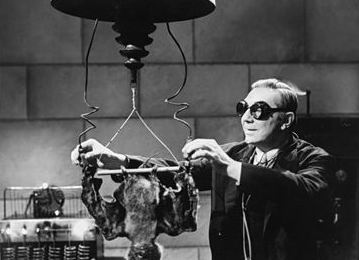
First off, there’s the fact that the giant bat is so clearly fake that it actually becomes rather charming.  Wisely, the film makes no effort to convince you that the bat is real.  Whenever that big, fake bat is lowered in on a bunch of often-visible wires, it works as almost a Brechtian alienation device.  In much the same way that Godard used jump cuts in Breathless, Devil Bat uses that big, fake bat to remind the audience that they are watching a film.  As a result, the audience has no choice but to think about the conventions of the horror genre and how their own world view has been shaped by watching movies like Devil Bat.

The other hint of genius is the satirical masterstroke of casting Bela Lugosi as a small town chemist.  Lugosi remains Lugosi, regardless of what role he plays.  When the film’s characters accept, without even a second glance, that Bela Lugosi, with his thick accent and his theatrical acting style, is a humble suburbanite, the film becomes a perhaps inadvertent satire of American conformity.

Needless to say, Lugosi was always a far better actor than he has ever been given credit for being.  In The Devil Bat, he plays Dr. Carruthers with a weary sense of resignation.  Carruthers never becomes a standard evil villain.  Instead, he’s a man who has been so beaten down by life that he now see no other option beyond using a giant bat to kill those who he feels has betrayed him.  Much as he would in Ed Wood’s Bride of the Monster, Lugosi brings an almost redemptive sadness to his mad scientist.

The end result is that poor, misunderstood and underestimated Bela elevates the entire film.
db

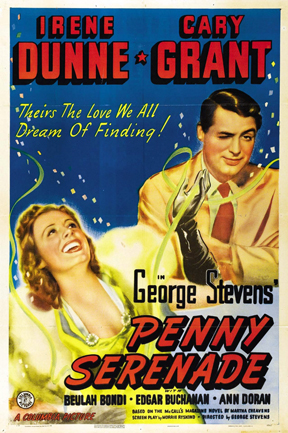
The Fabulous Forties #37: Penny Serenade (dir by George Stevens)


Penny_Serenade_1941_Poster

How many tears can be jerked by one tear jerker?

How melodramatic can one melodrama get?

These are the type of questions that I found myself considering as I watched the 36th film in Mill Creek’s Fabulous Forties box set, 1941’s Penny Serenade.

Penny Serenade opens with Julie (Irene Dunne) announcing that she’s planning on leaving her husband, Roger (Cary Grant).  Fortunately, before Julie goes through with her plan, she listens to a song called You Were Meant For Me.  Perhaps not coincidentally, the song is included on an album called The Story Of A Happy Marriage.  As she stares at the spinning vinyl, Julie starts to have flashbacks!

No, not flashbacks of the LSD kind.  (Though, interestingly enough, Cary Grant was reportedly a big fan of LSD…)  Instead, she has flashbacks of her marriage to Roger.  We see how she first met Roger while she was working in a music store.  Roger stopped by the store to tell her that a record was skipping and it was love at first sight.  However, Roger had no interest in getting married.  Or, at the least, he didn’t until Julie opened up a fortune cookie and read the fortune: “You get your wish — a baby!”

Julie continues to stare at the spinning record and we discover that eventually, she and Roger did get married.  Julie did get pregnant but, as the result of an earthquake, she lost the baby.  (Curse you, fortune cookie!  CURSE YOU!)  Meanwhile, Roger took over a small town newspaper and revealed himself to have absolutely no idea how to handle money.

Because of the earthquake, Julie will never be able to have a child.  (DAMN YOU, FORTUNE COOKIE!  DAMN YOU FOR YOUR LIES!)  However, they can still adopt!  She writes to Miss Oliver (Beulah Bondi), the head of the local orphanage.  Julie demands to be given a baby with “blue eyes and curly hair.”  Fortunately, Miss Oliver apparently has a surplus of curly-haired, blue-eyed babies but she’s still reluctant to approve the adoption.  After all, Julie is such a terrible housekeeper!  However, she is impressed by how much both Julie and Roger want a baby so Miss Oliver puts aside her concerns and allows them to have a baby for two years.

At the end of the two years, Roger and Julie have to go to an adoption hearing.  Unfortunately, the paper has gone out of business, the family has absolutely no money, and the fortune cookie has stopped giving advice.  Fortunately, Roger is Cary Grant and who can say no to Cary Grant?  Roger promises the judge that he’ll always love and take care of the baby…

But that’s not all!  The movie is not over yet.  And even as Roger makes his plea, we can’t help but think about the fact that this movie is being told in flashback and that present day Julie is still planning on leaving Roger.  Now, I’m not going to spoil the movie by going into why or revealing what happens in the end.  I’ll just say that it involves more tragedy and more melodrama.  In fact, it includes so much tragedy and so much melodrama, that it starts to get a little exhausting.  How much bad stuff can happen to Cary Grant!?

And the record just keeps spinning…because what goes up must come down, spinning wheel got to go round…

Over the course of his long career, Cary Grant only received two Oscar nominations.  Penny Serenade was his first nomination and, as a fan of Cary Grant’s comedies, it saddens me to say that Cary’s nominated performance really wasn’t that good.  Watching this film, you can tell that Cary felt that this was his chance to prove himself as a dramatic actor and, as a result, he acts the Hell out of every scene.  Of course, Cary’s undying popularity comes from the fact that he rarely seemed to be acting.  His charm was in how natural he was.  In Penny Serenade, he never seems natural.  He’s trying too hard and it’s just odd to see Cary Grant trying too hard.

If you want to see Cary Grant at his best, check out The Awful Truth.  Or maybe The Philadelphia Story.  Those are two great films that prove that Cary Grant was a great actor.  Even a rare misfire of a performance can’t change that fact.

Until next time…

Ride a painted pony, let the spinnin’ wheel spin. … Ride a painted pony, let the spinnin’ wheel turn.

The Fabulous Forties #36: Dishonored Lady (dir by Robert Stevenson)


40s

15 to go!

That’s what I find myself thinking as I begin this review of the 35th film in Mill Creek’s Fabulous Forties box set.  I’ve only got 15 more of these reviews to go and then I will be finished with the Fabulous Forties.

Oh, don’t get me wrong.  Over the past two months, I’ve seen some very good movies from the 1940s — The Black Book, The Last Chance, Trapped, and a few others.  However, I have also had to sit through things like Jungle Man, Freckles Comes Home, and Lil Abner.  The Fabulous Forties has been an uneven collection, even by the standards of Mill Creek.  However, the important thing is that I’m getting to discover films that I probably would otherwise have never known about.  I love watching movies, even ones that don’t quite work.

Fortunately, the 35th film in the Fabulous Forties does work.

Dishonored_Lady_poster

The 1947 film Dishonored Lady stars the beautiful Hedy Lamarr as Madeline Damien.  Madeline would appear to have it all.  She’s wealthy, she’s socially well-connected, she lives in Manhattan, and she has a glamorous job as the fashion editor of a slick magazine called Boulevard.

So, if Madeline’s life is so perfect, why does she end up crashing her car outside of the house of psychiatrist Richard Caleb (Morris Carnovsky)?  Madeline says it was just an accident but Dr. Caleb immediately understands that she wrecked her car as part of a suicide attempt.  He takes Madeline as a patient and we quickly learn that Madeline is actually on the verge of a nervous breakdown.  When she’s not working, she’s usually drinking.  When she’s not drinking or working, she’s having sex with almost every man she meets.

(Or, as the film primly insists, “making love” to every man she meets.)

And what’s remarkable is that, for a 1947 film, Dishonored Lady is rather sympathetic to Madeline.  While it portrays her lifestyle as being self-destructive, it doesn’t condemn her.  It doesn’t attempt to argue that her problems are a fitting punishment for her decisions, as opposed to so many other 1940s films.  Even when Dr. Caleb’s counseling leads to Madeline quitting her job, the film refrains from criticizing Madeline for wanting to have a career.  Instead, it simply suggests that Boulevard is a toxic environment, almost entirely because of the sleazy men that Madeline has to deal with on a daily basis.

Madeline ends up renting a small apartment and rediscovering her love for painting.  Speaking of love, she also falls in love with her neighbor, Dr. David Cousins (Dennis O’Keefe).  At first, she doesn’t tell David anything about her past but, when she’s falsely accused of murder, she has no choice but to tell him everything.  Will David stand by her or will he prove to be yet another disappointment?  And will Madeline be able to prove her innocence even while her past in put on trial?

I really liked Dishonored Lady.  It’s a surprisingly intelligent film and Hedy Lamarr gives a great performance in the role of Madeline.  Dishonored Lady proved to be a pleasant surprise and you can watch it below!