If you are looking for a careful plot showcasing the new challenges of a technologically advanced, post-apocalyptic earth, then Katsuhiro Otomo’s 1988 classic Akira is not a great option. The film does not try to raise any questions, the story is vague, and it revolves around characters who are empowered supernaturally, not enhanced through technology. Akira‘s legacy lies in its music, art, and shock value.
Set in a dystopian Neo-Tokyo in 2019, 31 years after the ubiquitous cataclysm uproots every tenet of modern society, Akira displays a violent, futuristic world where law and order amounts to little more than brute force. The military police force is ruthless. Suspects are executed in public spaces with no concern for who might get caught in the cross-fire. When protests turn to riots, machine guns and tanks bulldoze down all opposition to the state. In one memorable scene, a group of protesters is bombarded with tear gas, and a choking helpless civilian staggers into an unclouded space that happens to be occupied by a policeman. After a moment’s pause, he blasts him in the stomach with a smoke grenade at point blank range. The incessant violence permeates everything. Within the first ten minutes, the hero, Kaneda, has murdered a half dozen members of a rival gang for entering his turf. The antagonist, Tetsuo, while certainly not evil, does not think twice about slaughtering the millenarian following attracted to his psychic powers.
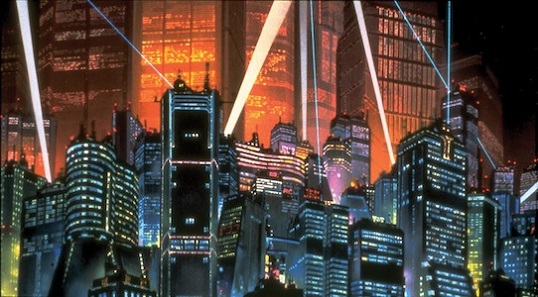
Akira keeps you attentive with an endless escalation of weirdness and destruction. At every turn, events outpace your expectations, culminating in a transformation sequence that is not even worth trying to explain. I suppose it does raise one question, and only one: “What the fuck did I just watch?” It only works, though, because the art is so distinct that it leaves little to the imagination. Akira is a visual tour through everything that the most dystopian, vulgar cyberpunk city is supposed to be.
The soundtrack, composed by Tsutomu Ōhashi of Geinoh Yamashirogumi (芸能山城組), is inescapable throughout the film. It’s a bit of a counterbalance to the grim, futuristic visuals, relying heavily on Japanese and Indonesian traditional instrumentation and avant-garde vocals. It focuses more on capturing Akira‘s supernatural side, both in style and in strangeness. The opening track, “Kaneda”, does this while racing full speed into the heart of a towering metropolis.
 Through the Shattered Lens
Pingback: Neon Dream #15: Happy End – Kaze Wo Atsumete | Through the Shattered Lens