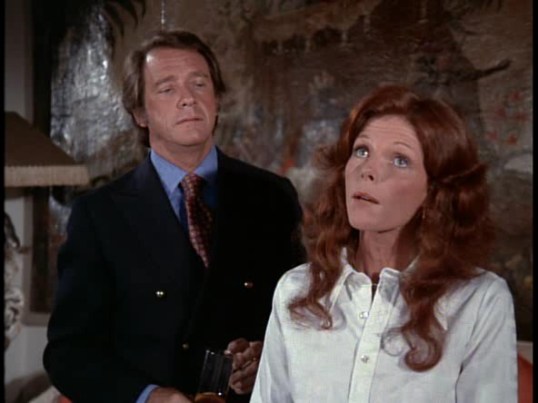
Nothing can make you appreciate a classic film more than by watching a really bad remake. As proof, I would offer up the 1973 made-for-television version of the classic 1944 film Double Indemnity. The original Double Indemnity is a classic example of film noir, one that remains intriguing and powerful over 70 years since it was first released. The remake features the exact same plot as Double Indemnity and a few of the original’s scenes are recreated shot-by-shot but it just does not work.
Part of the problem is that the remake is in color. In fact, since it was made in 1973 and for television, it’s in very bright and somewhat tacky color. Bright and vibrant doesn’t work for film noir. You need the shadows and the visual ambiguities that are unique to black-and-white. If the original Double Indemnity was full of secrets and mysteries, the remake is all on the surface. There are no secrets to be found in this remake.
That goes for the cast as well. In the original, Fred MacMurray made Walter Neff into the epitome of the bored, post-war American male. You watched him with a certain sick fascination, trying to figure out what was going on behind the blandly friendly facade. In the remake, you know that Richard Crenna is a serpent from the minute he first appears. If MacMurray’s Walter was motivated by ennui, Crenna’s Walter is just bad and therefore, far less interesting. Meanwhile, in the role of Phyllis, Samantha Eggar has none of Barbara Stanwyck’s ferocious determination. Instead, Eggar’s performance is curiously refined (which is another way to say boring).
Probably the most interesting thing about the remake of Double Indemnity is that the role of Keyes is played by Lee J. Cobb. Cobb actually gives a pretty good performance and, unlike Crenna and Eggar, he’s actually entertaining to watch. In the original film, Keyes was played by Edward G. Robinson and was roughly around the same age as Walter. They were contemporaries and friends and that made the original’s ending all the more poignant. In the remake, Cobb is quite a bit older than Crenna and, as a result, their relationship feels more paternalistic. It’s almost as if Crenna is the prodigal son who has betrayed his father and who tells his story as a way of begging for forgiveness.
But that’s probably reading too much into the remake! For the most part, the remake of Double Indemnity is bland and boring. The best thing about it is that it’ll make you love the original even more.
As for how I ended up watching the remake of Double Indemnity, it was included as an extra on my DVD of the original. Watching them back-to-back, as I did, really serves to make you appreciate Billy Wilder as a filmmaker.
 Through the Shattered Lens
Pingback: Embracing the Melodrama Part II #71: Cocaine: One Man’s Seduction (dir by Paul Wendkos) | Through the Shattered Lens