Embracing the Melodrama Part II #39: Maybe I’ll Come Home In The Spring (dir by Joseph Sargent)


maybeWay back in January, I was looking for something to have playing on TV in the background while I cleaned the house.  I went from station to station until I finally came across a movie that I had never seen before.  It featured a  young-looking Sally Field wandering through a house that was full of stuffy-looking old people.  She stepped out of the house and dived, fully clothed, into a swimming pool.  Everyone in the house was shocked.  Then, one abrupt jump cut later, a bearded David Carradine was hijacking an ice cream truck…

“What the Hell is this?” I wondered.  Checking on the guide, I discovered that I was watching Maybe I’ll Come Home In The Spring, a made-for-television film from 1971.  I put off the cleaning for thirty minutes so that I could watch the rest of the film.

(And, if you know how obsessive compulsive I am about keeping the house clean, then you know what a big deal that was for me.)

After watching the rest of the film on television, I rewatched Maybe I’ll Come Home In The Spring on YouTube.  And I decided that I so wanted to recommend this film that I ended up launching Embracing the Melodrama Part II specifically so I’d have an excuse to write about Maybe I’ll Come Home In The Spring.

Sally Field, who was 25 when this film was first broadcast but looked and sounded much younger, plays Dennie Miller.  After being raised in the oppressively conformist atmosphere of the suburbs, Dennie ran away from home and spent a year with her hippie boyfriend, Flack (David Carradine).  As we learn from several flashbacks that are almost randomly spread out across the film, Dennie’s life with Flack largely amounted to panhandling and trying to avoid the police.  Finally getting tired of living with the controlling Flack, Dennie waited until Flack was busy panhandling and then hitched a ride with a leering truck driver.

Arriving back home after being gone for a year, Dennie is welcomed back by both her father (Jackie Cooper) and her mother (Eleanor Parker).  However, Dennie finds it difficult to readjust to her parent’s conformist life style.  Meanwhile, her emotionally distant parents are uncomfortable with talking to Dennie about the previous year and instead, cho0se to act as if she never left.  Dennie’s younger sister, Susie (Lane Bradbury), both looks up to and resents Dennie.   Susie got used to a life without Dennie and now that Dennie has returned, Susie is forced back into the role of being the kid sister.

Meanwhile, Flack isn’t prepared to let Dennie go.  Fully committed to both the idea of living a life separate from conventional society and to his own self-image as being the ultimate counter-cultural alpha male, Flack travels across California, intent on tracking Dennie down and convincing her to once again leave with him.

I loved Maybe I’ll Come Home In The Spring.  While it is undeniably dated (as any 1971 film about hippies would be), it also touches on a lot of themes and issues that never go out of date.  Whether it was the complicated relationship between Dennie and Susie or Dennie’s discovery that, as a result of her year spent on her own, all of her parent’s friends now view her as being somehow “damaged,” there is so much about Maybe I’ll Come Home In The Spring that rings painfully true.

And while Maybe I’ll Come Home In The Spring does not hesitate to point out the hypocrisy of Dennie’s parents and their friends, it’s equally critical of Flack and his countercultural posturing.  In the end, you come to realize that Flack and Dennie’s father are actually two sides of the same coin.  They’re both convinced that their way is the only way and that they — and they alone — know what is best for Dennie.  In the end, Maybe I’ll Come Home In The Spring is less about mainstream vs. hippie and more about Dennie’s struggle to be an independent woman in a world that doesn’t value or appreciate female independence.

Maybe I’ll Come Home In The Spring is a good film and guess what?  You can watch it below!
http://www.youtube.com/watch?v=ERkbxRwugTw

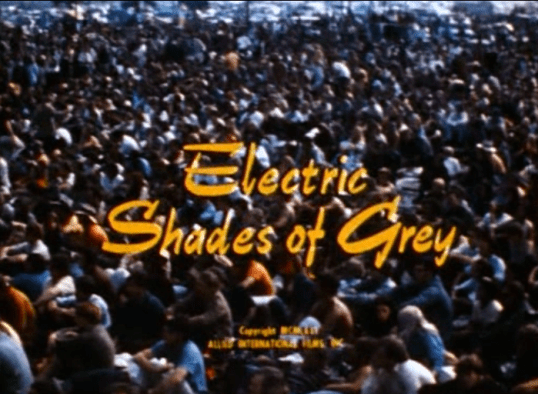
Embracing the Melodrama Part II #38: Electric Shades of Grey (dir by Stewart Merrill and William Grefe)


esgFirst things first, the 1971 film Electric Shades of Grey is not a prequel to 50 Shades of Grey.  There’s no Red Room to be found in Electric Shades of Grey.  There’s no Anastasia Steele.  There is no Christian Grey.

Instead, Electric Shades of Grey is about a man named Father John (John Darrell).  When we first meet John, he’s just another kinda long-haired, stoned-looking man wandering around an outdoor, hippie-filled concert.  He stops long enough to watch a fire-and-brimstone preacher giving a sermon about how all the hippies are going to go to Hell.

“Is that what I used to sound like?” John wonders.

John, it turns out, used to be a priest and taught at a Catholic school.  One day, he saw a group of long-haired students sitting outside, smoking weed, and drinking.  When John approached the students and reprimanded them for skipping class, one of them handed him a paper cup full of what John thought was harmless soda.  Instead, the soda was spiked with LSD and soon, John was having a bad trip.

Now, I’ve seen a lot of cinematic acid trips and most of them try way too hard.  The trip in Electric Shades of Grey is actually handled fairly well.  John sees strange faces talking to him.  Colors spin around him.  And finally, John listens to a disembodied voice that might be the voice of God or might just be a part of his trip.

One scene later and John is walking out of the church.  His hair is a little bit longer and he’s stopped shaving.  He’s no longer wearing his collar.  John has seen a new reality and now, he has to do the whole “finding himself” thing.  As John explains later in the film, he’s no longer sure if he’s even a priest any more.

John drives across America.  He picks up a hitchhiker named Sally.  He smokes weed at a commune.  He helps to deliver a hippie girl’s baby.  He meets a black doctor who is also trying to find himself.  He and his friends also meet several rednecks and other establishment types, the majority of whom have decided that they don’t like hippies.  “Hippies look like a Jill and smell like a john!  Hahahahahahahahaha!” screams one old man who then adds, “That’s pretty funny, ain’t it!?  Looks like a Jill and smells like a john…”

(No wonder everyone wanted to drop out of society…)

And, of course, people die.  Traveling John occasionally feels a bit like the Angel of Death because it seems like everyone that he hangs out with eventually ends up getting killed by people who probably voted for George Wallace in 1968.

Eventually, John has to decide — is he a dropout or is he a priest?

Electric Shades of Grey is an interesting film.  It’s very low-budget and the acting is inconsistent but, at the same time, it’s an interesting time capsule.  Like many independent, low-budget films from the late 60s and early 70s, it was shot guerilla style.  Hence, when John is seen driving down the highway, he’s on a real highway and he’s passing cars being driven by real people, the majority of whom probably have no idea that their car was immortalized in a movie.  When he stops off in a small town that’s not particularly friendly to counter-culture types, he’s stopping off in a real small town that, at the time, was probably not particularly friendly to counter-culture types.  When people passing by stop to stare at John and his new counterculture friends, these are real people having real reactions.  As a result, the film works as a time capsule.

There’s some debate about whether or not Electric Shades of Grey actually got a theatrical release.  However, it has been released (under the title The Psychedelic Priest) on DVD by Something Weird Video.

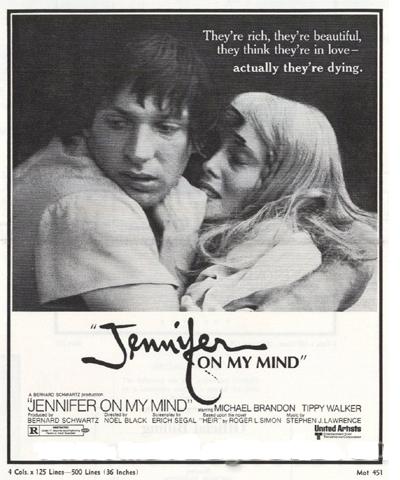
Embracing the Melodrama Part II #37: Jennifer on My Mind (dir by Noel Black)


jommThe 1971 film Jennifer On My Mind opens with a lengthy montage of black-and-white photographs of immigrants arriving at Ellis Island.  These, the film tells us, are the men and women who came to America with nothing and who fought and struggled to have something.  The film itself deals with the grandchildren of those immigrants, who, as opposed to their ancestors, now have everything and who seem to be determined to reduce it all down to nothing.

24 year-old Marcus Rottner (Michael Brandon) would appear to have everything.  Following the death of his father, Marcus has inherited the fortune that his immigrant grandfather earned.  (The ghost of his grandfather shows up at one point and smokes a joint.)  Marcus will never have to work a day in his life, owns a nice apartment, and can go to Europe whenever he feels like it.  However, Marcus does have one problem: his girlfriend Jennifer (Tally Walker) just died of a heroin overdose in his living room.  Now, Marcus has to try to dispose of the body without anyone discovering what has happened.

The film alternates between showing Marcus’s attempts to get ride of Jennifer’s body and flashbacks to his romance with her.  We see how he first met Jennifer in Venice and how he fell in love with her.  Like Marcus, Jennifer comes from a rich family.  Her parents are alive but we never see them.  (Reportedly, scenes were filmed that featured Kim Hunter as Jennifer’s mother but they were cut after a disastrous preview.)  As she leaves Venice, Jennifer tells Marcus to visit her back in the states.

Which is just what Marcus does.  Marcus and Jennifer’s relationship plays out like a romantic comedy, except for the fact that Jennifer doesn’t really seem to care that much for Marcus.  After Jennifer jumps off a roof, Marcus takes her back to Venice and tries to recreate their earlier romance.  However, Jennifer just wants to go back to New York…

About ten minutes into the film, I nearly stopped watching Jennifer On My Mind.  Both Marcus and Jennifer seemed like such unlikable characters that I couldn’t imagine spending a full 90 minutes with them.  The fact that they were both rich and spoiled didn’t help.

But I kept watching because the first part of the film was set in Venice and I love Venice!  Watching those scenes reminded me of visiting Italy the summer after I graduated from high school.  It was a great time and, despite how I felt about Marcus and Jennifer, the film still brought back some nice memories.

However, then Marcus and Jennifer returned to New York and, since I don’t really care about New York the way that I care about Venice, I again found myself tempted to stop watching.  However, it was around this time that I started to realize that Michael Brandon was actually giving a pretty good performance in the role of Marcus.  So, I decided to keep giving the film a chance.

And then the ghost of Marcus’s grandfather showed up.  And then, the film gave us a scene of Jennifer hanging out with the two traveling “minstrels.”  And I thought to myself, “This is getting unbearably cutesy…”

But then, Robert De Niro showed up!  That’s right — Jennifer On My Mind is an early De Niro movie.  When Marcus hails a cab and asks for a ride to Long Island, the taxi driver is played by none other than Robert De Niro.  And while De Niro is only in the film for a few minutes, he totally steals those few minutes.  He plays a “gypsy” cab driver in this film and, as he drives Marcus to Long Island, he rambles about his sister, his drugs, and his fear of driving Marcus to see a bunch of “squares.”  De Niro is such an eccentric and energetic presence that he brings the whole film to life.

After De Niro’s scene, there was only 30 minutes left in the film and I thought to myself, “Okay, I can give this another 30 minutes…”

Written by Love Story‘s Erich Segal and directed by Pretty Poison‘s Noel Black, Jennifer On My Mind is an uneven but oddly watchable film.  If you’re looking for quirky love story … well, I really can’t recommend Jennifer On My Mind because it never really convinces you that Marcus and Jennifer are in love.  For the most part, their relationship seems to be one of convenience.  Jennifer wants drugs and Marcus can afford them.  Marcus wants a girlfriend and Jennifer is willing to pretend.  Instead, Jennifer On My Mind is more like a parody of true romance.  Marcus spends the entire film wanting Jennifer’s body and now that he has it, he has to find a way to get rid of it.

It’s undeniably uneven; for every scene that works, there’s another one that doesn’t.  But, at the same time, it’s undeniably watchable.  Plus, you get an early performance from Robert De Niro!

Jennifer On My Mind is currently available to viewed on Netflix.


Embracing the Melodrama Part II #36: WUSA (dir by Stuart Rosenberg)


wusaI recently saw the 1970 film WUSA on Movies TV.  After I watched it, I looked Joanne Woodward up on Wikipedia specifically to see where she was born.  I was surprised to discover that she was born and raised in Georgia and that she attended college in Louisiana.

Why was I so shocked?  Because WUSA was set in New Orleans and it featured Joanne Woodward speaking in one of the most worst Southern accents that I had ever heard.  A little over an hour into the film, Woodward’s character says, “What’s all the rhubarb?”  And while “What’s all the rhu…” sounds properly Southern, the “…barb” was pronounced with the type of harshly unpleasant overemphasis on “ar” that has given away many Northern actors trying to sound Southern.  Hence, I was shocked to discover that Joanne Woodward actually was Southern.

That said, her pronunciation of the word rhubarb pretty much summed up every problem that I had with WUSA.  Actually, the real problem was that she said “rhubarb” in the first place.  It came across as being the type of thing that a Northerner who has never actually been down South would think was regularly uttered down here.  And I will admit that WUSA was made 16 years before I was born and so, it’s entirely possible that maybe — way back then — people down South regularly did use the word rhubarb.  But, for some reason, I doubt it.  I know plenty of old Southern people and I’ve never heard a single one of them say anything about rhubarb.

As for WUSA, it’s a long and slow film.  A drifter named Reinhardt (Paul Newman) drifts into New Orleans and, with the help of an old friend who is now pretending to be a priest (Laurence Harvey), Reinhardt gets a job as an announcer at a right-wing radio station.  He reads extremist editorials that he doesn’t agree with and whenever anyone challenges him, he explains that he’s just doing his job and nothing matters anyway.

Reinhardt also gets himself an apartment and spends most of his time smoking weed with long-haired musician types, the exact same people that WUSA regularly denounces as being a threat to the American way.  Living in the same complex is Geraldine (Joanne Woodward), a former prostitute who has a scar on her face and who says stuff like, “What’s all the rhubarb?”  She falls in love with Reinhardt but finds it difficult to ignore what he does for a living.

Meanwhile, Geraldine has another admirer.  Rainey (Anthony Perkins) is an idealistic and neurotic social worker who is regularly frustrated by his efforts to do good in the world.  Reinhardt makes fun of him.  The local crime boss (Moses Gunn) manipulates him.  And WUSA infuriates him.  When Rainey realizes that WUSA is a part of a plot to elect an extremist governor, Rainey dresses up like a priest and starts carrying around a rifle.

Meanwhile, Reinhardt has been assigned to serve as emcee at a huge patriotic rally.  With Geraldine watching from the audience and Rainey wandering around the rafters with his rifle, Reinhardt is finally forced to take a stand about the people that he works for.

Or maybe he isn’t.

To be honest, WUSA is such a mess of a film that, even after the end credits roll, it’s difficult to figure out whether Reinhardt took a stand or not.

Anyway, WUSA is not a lost masterpiece and I really wouldn’t recommend it to anyone.  The film’s too long, there’s too many scenes of characters repeating the same thing over and over again, and neither Newman nor Woodward are particularly memorable.  (You know a movie is boring when even Paul Newman seems like a dullard.)  On the plus side, Anthony Perkins gives such a good performance that I didn’t once think about the Psycho shower scene while watching him.

As boring as WUSA is, I have to admit that I’m a little bit surprised that it hasn’t been rediscovered.  Considering that it’s about a right-wing radio station, I’m surprised that there haven’t been hundreds of pretentious think pieces trying to make the connection between WUSA and Fox News.  But, honestly, even if those think pieces were out there, it probably wouldn’t do much for WUSA‘s repuation.  According to the film’s Wikipedia page, Paul Newman called it, “the most significant film I’ve ever made and the best.”  Paul Newman’s opinion aside, WUSA is pretty dire.

Embracing the Melodrama Part II #35: Cindy and Donna (dir by Robert Anderson)


cindy-and-donna

Mom, Donna, and Cindy

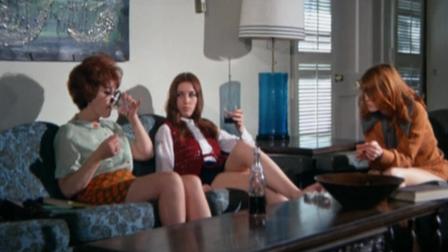
The 1970 film Cindy and Donna is yet another Crown International film about suburban malaise, out-of-control youth, hypocritical adults, and the difficulty of wearing a miniskirt without flashing the entire world.  In the grand Crown International tradition, it’s 65 minutes of nonstop sex and drugs, followed by 10 minutes of moralistic posturing and wrathful punishment.

Cindy and Donna tells the story of two half-sisters living in the suburbs.  Donna (Nancy Ison) is 17 and has several boyfriends.  Cindy (Debbie Osborne) is 15 and wishes that she had several boyfriends.  She both admires and resents her older sister.  Their mother (Sue Allen) spends most of her time drinking, which keeps her from noticing that her husband and Cindy’s father, Ted (Max Manning), is having an affair with a local stripper.

When the stripper leaves town, Ted gets drunk and ends up having sex with his stepdaughter, Donna.  Cindy happens to see this happen and, as a result, she decides that she’s going to stop worrying about being a good girl and instead, she’s just going to have a good time.  Soon, under the influence of her friend Karen (Cheryl Powell), Cindy is smoking weed and flirting with boys on the beach.  And, since this is a sexploitation film from 1970, marijuana leads to nymphomania.

Meanwhile, Ted is still trying to convince his stripper to come back home and Donna is posing for sleazy photographers and hey, it’s all a lot of fun, right?  No harm done, just a little experimenting, right?

THINK AGAIN!

This film is from 1970, after all.  And, as we all know from watching other films made around this time, there can be no pleasure without subsequent punishment.  Everyone’s fun is ruined when one of the sisters walks in on the other having sex with her boyfriend.

Needless to say, this all leads to someone getting tossed out into the street where they are promptly run over by a truck….

Plotwise, Cindy and Donna is your typical softcore exploitation film.  It’s better acted than most but otherwise, it’s fairly predictable.  And yet, I couldn’t help but enjoy it.  As I’ve stated many times in the past, I’m an unrepentant history nerd and everything about Cindy and Donna — from the clothes to the music to a few random comments about a protest on a college campus — screams 1970.  And, as a lover of melodramatic films, there was no way I couldn’t help but enjoy how every dramatic thing that possibly could happen in Cindy and Donna eventually did happen.

But, honestly (and perhaps surprisingly), the main reason that I enjoyed Cindy and Donna is because I’m the youngest of four sisters.  And, oddly enough, the sisterly dynamic between Cindy and Donna felt very honest and insightful.  Don’t get me wrong.  I’m not saying that Erin and I ever did anything close to what Cindy and Donna do in this film.  But still, once you removed the film’s more dramatic and sordid moments, there was so much about their relationship that felt real and true.

Like many films from Crown International Pictures, Cindy and Donna is available in a few dozen different Mill Creek compilations.   The next time that you’re feeling that you missed out on having a good time when you were in high school, watch Cindy and Donna and see what could have happened.

(Though, in all honestly, it probably wouldn’t have…)

CIP_Logo

Embracing the Melodrama Part II #34: Nightmares Come At Night (dir by Jess Franco)


nightmarescome2big For the past two weeks, I’ve been in the process of reviewing 126 cinematic melodramas.  Embracing the Melodrama Part Two started in 1927 with a look at Sunrise and now, 33 reviews later, we’ve finally reached the 70s.  And what else can I say about that other than to exclaim, “Yay!”

Seriously, a lot of good films were released in the 1970s.

We begin the 70s by taking a look at a film from the iconic and (to some people) infamous Spanish director Jess Franco.  Over the course of 54 years, director Jesus Franco Manera was credited with directing 203 films.  In all probability, the workaholic Franco directed a lot more than he’s been credited with.  As I wrote about Franco in my previous review of Female Vampire: “Among critics, Franco is usually either dismissed as a total hack (and/or pervert) or embraced as the living embodiment of the auteur theory.  Though no one’s quite sure how many films Franco has directed, Franco himself has estimated that he’s directed more than 200 films and, for the most part, he has financed and distributed them all on his own.  Franco has worked in every genre from thriller to comedy to hardcore pornography, but he is probably best known for directing low-budget, occasionally atmospheric erotic horror films.”

Now, I have to admit that I feel a little guilty about using a paragraph from an old review in a new review.  (And, as you may have noticed, I reviewed Female Vampire before Franco passed away in 2013.)  But, then again, it feels somewhat appropriate because Franco was famous for and unapologetic about taking bits and pieces of old and unfinished films and inserting them into new films.  That’s certainly the case with his 1970 film Nightmares Come At Night.

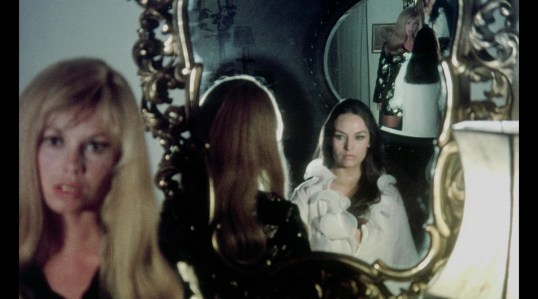
Nightmares Come At Night opens with Anna (Diana Lorys) living in an atmospheric mansion with her lover, Cynthia (Colette Giacobine).  Anna is haunted by frequent nightmares where she sees herself killing strange men with a spear.  Cynthia arranges for Anna to talk to an enigmatic doctor (Paul Muller).  Anna tells the doctor about how she was once a famous erotic dancer until she met Cynthia.  At this point, we get several lengthy flashbacks of Anna dancing in an oddly desolate club, all of which adds to the film’s ennui-drenched atmosphere.

Talking to the doctor doesn’t do Anna much good and she continues to have her nightmares except now the nightmares also seem to feature men giving lengthy monologues.  It soon becomes obvious that the neurotic Anna is being held as a virtual prisoner in the house by the dominating Cynthia.

(It’s a bit like a Lifetime movie, except everyone’s naked for 85% of the film’s running time.)

Meanwhile, we occasionally get shots of two people staring out of an unrelated window.  Eventually, we realize that they’re supposed to be Cynthia’s neighbors.  One of them is played by Franco’s frequent muse, Soledad Miranda.  (Miranda would tragically die in an automobile accident in 1970.)  Anyone who is familiar with Franco’s work will immediately notice that Miranda’s look in Nightmares was later duplicated by Lina Romay in Female Vampire.  The neighbors are obsessed with Anna.  As the film progresses, we discover that, when not looking out the window, they spend most of their time lying on a filthy mattress.  At one point, the camera zooms in for a close-up of the graffiti that’s been written on the wall over the mattress.

LIFE IS ALL SHIT, it reads.

To a certain extent, it’s pointless to say that Nightmares Come At Night is a disjointed film because almost all of Franco’s films were disjointed.  That’s actually what gave even the weakest of his films an odd and memorably dreamlike feel.  But Nightmares Come At Night is even more disjointed than usual.  That’s because Nightmares Come At Night was made out of a mix of footage shot for other films.  The scenes with Soledad Miranda were for an earlier, unfinished film.  Those scenes were combined with the footage of Anna, Cynthia, and the doctor.  The end result is a film that doesn’t necessarily much sense but you still have to admire Franco’s refusal to let any footage go to waste.

Ultimately, as with so many Franco films, Nightmares Come At Night is less about plot and all about atmosphere.  This is a film that is full of ennui and existential decadence.  It’s not one of Franco’s best films but, much like last year’s underrated California Scheming, it’s a bit of a minor existential classic when taken on its own terms.

(Please note: the trailer below is mildly NSFW.  Watch at your own risk.)