For his first eleven nights in this world, my little buddy Oliver was about as peaceful as they come. Oh, I’d heard the cautionary tales. Men driven mad by blood-curdling screams through endless sleepless nights. But not my Ollie. He’s a happy baby. Maybe his early introduction to classical music helped.
And then came the twelfth night, and stomach cramps, or indigestion, or some god-forsaken gremlin in the bowels. Whatever the malady, it was nothing I could resolve, and four hours of torture later I turned to Google in an act of sheer desperation. The only suggestion I stumbled upon that I had not already tried was white noise. If only I had some! Or did I?
“White noise” turned out to do the trick perfectly. He was sound asleep with a smile on his face within minutes, and I think Ollie has a new favorite band. Thanks Satan; you’re a godsend.
Whenever I go to Half-Price Books, I always seem to end up spending most of my time browsing the “nostalgia” section. This is where they keep all of the old paperbacks that were published long before I was born. This is where you can find old romance novels, “for adults only” novels, detective novels, and occasionally you’ll even find mainstream novels that were apparently considered to be quite daring when they were originally released. These novels usually carry cover blurbs that brag about how controversial they are and how they deal with the “real issues of today.”
Usually, these novels are pretty silly and over-the-top which is why I always seem to end up buying a lot of them. About a year ago, I bought a novel from 1959. It was by Dariel Telfer and it was called The Caretakers. The cover features a naked woman standing in front of several nurses and doctors. The cover blurb announces that The Caretakers is “A shattering novel about nurses, doctors, and patients in a state hospital where emotions readily explode!” The back cover features a pull quote from Time: “Will shock as well as arouse compassion.”
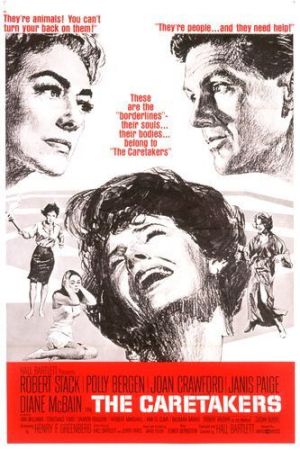
Now, I have to admit that I have yet to get around to actually reading The Caretakers. However, thanks to TCM, I recently saw the 1963 film version and it’s a film that definitely embraces the melodrama.
How melodramatic is The Caretakers? It’s melodramatic enough that it opens with Lorna Medford (Polly Bergen) stumbling into a movie theater and having a nervous breakdown. Since this film was made in 1963, her mental breakdown is represented by spinning the camera around and getting hyperactive with the zoom lens, all while Bergen shrieks and tears at her hair.
Lorna is sent to a mental hospital, where she meets several other patients and is treated by Dr. MacLeod (Robert Stack), who is a rebel. We know that he’s a rebel because everyone else at the hospital keeps telling him that he’s a rebel and complaining about his use of radical use of group therapy. Under Dr. MacLeod’s guidance, Lorna reveals that she hasn’t gotten over the tragic death of her child.
As the film progresses, Lorna gets to know the rest of the patients. They’re a mixed bunch, all played by actresses who clearly saw this as their chance to pick up an Oscar for Best Supporting Actress and were determined to make as big an impression as possible. For instance, Barbara Barrie plays Edna, who never speaks but who does enjoy setting fires and who, whenever she’s feeling persecuted, poses as if she’s hanging from a cross. And then there’s grandmotherly Irene (Ellen Corby), who is supposed to be the nice one but always looks like she’s on the verge of very sweetly shoving a pair of knitting needles into someone’s eyes.
However, my favorite patient was the cynical Marion (Janis Paige), precisely because she was so cynical and, as a result, she got all the best lines. Marion is a former prostitute who now hates all men and Paige has a lot of fun playing the role. Whenever Paige is giving one of her long, angry monologues, she practically grabs the film and refuses to let it go.
And then, of course, there’s Joan Crawford. Crawford doesn’t play a patient. Instead, she’s the head nurse and she doesn’t approve of Dr. MacLeod’s methods. Crawford announces early on that she’s been attacked by a patient in the past and her main concern is protecting her staff. She teaches a self-defense class. If you’ve ever wanted to see a middle-aged Joan Crawford flip someone over, The Caretakers is a film to watch.
And that’s The Caretakers for you. It’s one of those films that takes itself so seriously that it becomes humorous despite itself. As a result, the film is a lot of unintentional fun.
And who knows?
Maybe someday, I’ll get around to reading the book!
A funny thing happened to the Batman v. Superman: Dawn of Justice trailer that was set for a release at a special IMAX screening event next week. No one bothered to tell someone with a cellphone not to secretly record the trailer. A lo-res cam version of the first teaser trailer for Batman v. Superman: Dawn of Justice was leaked just hours after Disney released the second teaser trailer for the upcoming Star Wars: The Force Awakens.
Warner Brothers scrambled to take down the lo-res trailer and made sure to use their power to threaten with legal stuff if people continued to disseminate the illegal recording. During the 24 hours since the leak someone with a much more cooler head over at WB decided to just go the Avengers: Age of Ultron route (that film’s first teaser was also leaked ahead of a planned event) and release the hi-res version of the teaser trailer instead of waiting days for the planned screening event.
So, here’s the very first teaser trailer as Warner Bros. and DC Entertainment finally make their case that whatever Disney and Marvel can do they can do as well.
Batman v. Superman: Dawn of Justice is set for a March 25, 2016 release date.
While watching the 1963 best picture nominee, Cleopatra, I had many thoughts. The film lasts over 4 hours so I had a lot of time to think.
For instance, I often found myself impressed by the sheer size of the production. I marveled at the recreation of ancient Greece and Rome. I loved looking at the ornate costumes. I loved feeling as if I was taking a look back at what Rome may have actually looked like at the height of the Roman Empire. Making it all the more impressive was that this film was made in the days before CGI. When the film’s Romans walked through the streets of Rome, they weren’t just actors standing in front of a green screen. They were walking down real streets and surrounded by real buildings. It reminded me of the awe and wonder that I felt when I was in Italy and I was visiting the ruins of ancient Rome.
(I don’t know if any of the cast accidentally flashed everyone like I did when I visited during Pompeii on a windy day but considering how short some of the skirts on the men were, it wouldn’t surprise me if they did!)
And, as I marveled at the recreation of Rome, I also thought to myself, “How long is this freaking movie?” Because, seriously, Cleopatra is an amazingly long movie. It’s not just the film is over four hours long. It’s that the film feels even longer. Gone With The Wind, The Godfathers Part One and Part Two, Once Upon A Time In America; these are all long films but, because they’re so great, you never find yourself checking the time while watching. Cleopatra is the opposite of that. Cleopatra is a film that, at its slowest, will make you very much aware of how many seconds are in a minute.
I found myself marveling at the lack of chemistry between Elizabeth Taylor and Richard Burton. If anything, this is the most shocking thing about Cleopatra. If Cleopatra is famous for anything, it’s famous for being the film where Elizabeth Taylor (cast in the role of Cleopatra) first met Richard Burton (who was playing Mark Antony). Their affair dominated the gossip headlines. (If TMZ and YouTube had been around back then, there would be daily videos of Richard Burton punching out paparazzi.) Cleopatra was the first of many big-budgeted, overproduced films that Taylor and Burton co-starred in.
(Then again, they also starred in Who’s Afraid of Virginia Woolf, a film that is almost the exact opposite of Cleopatra.)
In the role of Mark Antony, Burton spends most of the film looking absolutely miserable. Elizabeth Taylor, meanwhile, seems to be having a lot more fun. It’s almost as if she understood what Cleopatra was going to become so she went out of her way to give the type of over-the-top performance that the film deserved. The same can also be said about Rex Harrison, who plays Julius Caesar and who, perhaps because he appears to have shared her attitude, actually does have some chemistry with Taylor.
Actually, if anyone gives a truly great performance in Cleopatra, it’s Roddy McDowall. McDowall plays the future Emperor Augustus with a mesmerizing intensity. Again, McDowall’s performance is not exactly subtle but Cleopatra is not a film that demands subtlety.
As the film finally neared its end, I found myself wondering how Joseph L. Mankiewicz went from directing two close to perfect films, A Letter To Three Wives and All About Eve, to directing this. Even more amazing, Mankiewicz had previously directed one of the best Roman Empire films ever, 1953’s Julius Caesar. (When compared to Cleopatra, the low-key and thoughtful Julius Caesar appears to have been filmed on an entirely different planet.) Well, in Mankiewicz’s defense, he was not the original director. He was brought in to replace Rouben Mamoulian, who had previously attempted to make the film with Joan Collins, Ben-Hur‘s Stephen Boyd, and Peter Finch. When Mankiewicz was brought in, the cast was replaced with Taylor, Burton, and Harrison. Between the expensive stars, the troubled production, and all of the offscreen romantic melodrama, Mankiewicz probably did the best that he could.
Today, Cleopatra is mostly interesting as an example of a film from the “Only Gigantic Productions Will Save Us From Television!” era of Hollywood filmmaking. Cleopatra started out as a $2,000,000 production and ended up costing $31,000,000. It was the number one film at the 1963 box office and it still nearly bankrupted 20th Century Fox. While the film does have some kitsch appeal, the critics hated it and it’s easy to see why.
And yes, it was nominated for best picture of the year, a tribute to the size of the production and the determination of 20th Century Fox to get something — anything — in return for their money.
Cleopatra is a bit of a chore to sit through but it can be fun if you’re in a snarky mood. It’ll do until the inevitable Angelina Jolie remake comes along.

 Through the Shattered Lens