Classical music is one of those worlds I’ve just never found the time to explore, but I knew that was going to change sooner or later. I always told myself that if I had a kid I’d first immerse him in classical and jazz. Peaceful, complex stuff that would lull him to sleep while tuning his ears with the sort of precision he’d need if he ever decided to pick up daddy’s favorite hobby. It’s what my mother did with me, and I was going to pass on the tradition.
Well, baby Oliver arrived April 7th, and every night so far we’ve been exploring my meager classical collection together. Arleigh sent me a collection of Chopin’s Nocturnes years ago, and those seem to appeal to him most. I have a funny feeling this one will be Ollie’s favorite, because I play it first and last every time we sit down to listen. 🙂
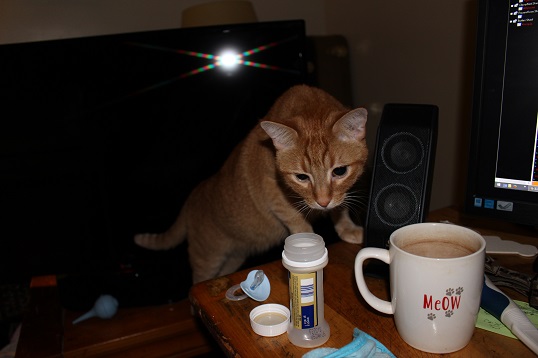
So, please welcome Shattered Lens’ newest (future) author to the fold: Oliver Winston Smith. He celebrated his one week birthday last night by staring at my cats.
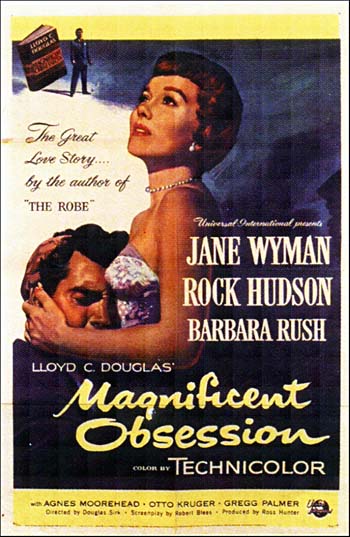
There’s a scene early on in the 1954 melodrama Magnificent Obsession in which formerly carefree millionaire Bob Merrick (Rock Hudson) meets with an artist named Edward Randolph (Otto Kruger). We know that Randolph’s brilliant because he speaks in a deep voice, tends to be unnecessarily verbose, and often stares off in the distance after speaking. Bob wants to know about a dead doctor who was a friend of Randolph’s. Randolph explains the late doctor’s philosophy of doing anonymous good works. Bob’s mind is blown. (Hudson, who was never the most expressive of actors, conveys having his mind blown by grinning.)
“This is dangerous stuff,” Randolph warns him, “One of the first men who used it went to the cross at the age of 33…”
And a heavenly chorus is heard in the background…
And that one line pretty much tells you exactly what type of film Magnificent Obsession is. It’s a film that not only embraces the melodrama but which also holds on tight to make sure that the melodrama can never escape. There’s not a single minute in this film that is not hilarious overwritten. It’s not just Randolph who tends to be portentous in his pronouncements. No — everyone in the film speaks that way!
The dead doctor is dead specifically because of Bob. Apparently, the doctor had a heart attack but the local hospital’s only resuscitator was being used to save the life of Bob who, while the doctor was dying, was busy recklessly driving a boat.
Helen (Jane Wyman), the doctor’s widow is, at first, bitter towards Bob and when Bob offers to donate $250,000 to the hospital, Helen refuses to accept his check. This leads to Bob doing a lot of soul-searching and eventually having his life-changing conversation with Randolph. Excited at the prospect of doing anonymous good works for the rest of his life, Bob tracks down Helen and tries to tell her that he’s a changed man. Helen, however, wants nothing to do with Bob and ends up getting hit by a car while running away from him. Helen survives but now, she’s blind!
Now, at this point, you might think that Bob has done enough to ruin Helen’s life. At least, that’s the way that Helen’s family views it and when Bob attempts to visit her in the hospital, they order him to go away.
Eventually, Helen comes home from the hospital and starts to adjust to a life without eyesight. One day, she meets a man on the beach and they start up a tentative romance. What she doesn’t realize, at first, is that the man is Bob! By the time she does realize who the man is, Helen has fallen in love with him. However, she feels that it wouldn’t be fair to Bob to pursue a relationship with him and she leaves him.
So, of course, Bob’s response is to go to medical school and become a neurosurgeon. Many years later, Helen has a brain tumor and needs an operation to survive.
Can you guess who her surgeon turns out to be?
Magnificent Obsession is almost a prototypical 1950s melodrama. It’s big, it’s glossy, it’s self-important, and undeniably (and occasionally unintentionally) funny. Even the total lack of chemistry between Hudson and Wyman somehow adds to the film’s strange charm. It’s hard not to admire a film that starts out over-the-top and just grows more excessive from there.
Watching Magnificent Obsession is a bit like taking a trip into a parallel, technicolor dimension. It’s strange, fascinating, and far more watchable than it should be.
“All right, Mr. De Mille, I’m ready for my close-up!”
— Norma Desmond (Gloria Swanson) in Sunset Boulevard (1950)
First released in 1950 and nominated for Best Picture, Billy Wilder’s Sunset Boulevard is one of the greatest and most influential films of all time. It’s also something of a difficult film to review because, in order for one to truly understand its greatness, it needs to be seen. A description simply will not do. You have to experience, first hand, the performances of Gloria Swanson, William Holden, and Eric Von Stroheim. You have to see, with your own eyes, the way that Billy Wilder perfectly balances drama, satire, and horror. I can tell you about how cinematographer John F. Seitz perfectly contrasts the empty glossiness of Hollywood with the dark shadows that fill the ruined mansion of Norma Desmond but, again, it’s something that you owe it to yourself to see. You need to hear the perfectly quotable dialogue with your own ears. You need to experience Sunset Boulevard for yourself.
And, while you’re watching it, think about how easily one bad decision could have screwed up the entire film. Sunset Boulevard is famous for being narrated by a dead man, a screenwriter named Joe (William Holden). When we first see Joe, he’s floating in a pool. Originally, however, the film was to open with the dead Joe sitting up in the morgue and telling us his story. Reportedly, preview audiences laughed at the scene and it was cut out of the film. And Wilder made the right decision to remove that scene. Sunset Boulevard may be famous for being a strange film but, when you actually watch it, you realize just how controlled and disciplined Wilder’s direction actually is. Sunset Boulevard may be weird but it’s never less than plausible.
Joe Gillis is a former newspaper reporter-turned-screenwriter. He may have started out as an idealist but, as the film begins, he’s now just another Hollywood opportunist. While trying to hide from a man looking to repossess his car, Joe stumbles upon a dilapidated old mansion. The owner of the mansion is none other than Norma Desmond (Gloria Swanson), a silent film star who has sent been forgotten but who still dreams of making a comeback. (When Joe tells her that she used to be big, Norma famously responds that she’s still big and it’s the pictures that have gotten small.) Norma has written a script and the opportunistic Joe convinces her to hire him as a script doctor.
Joe moves into the mansion and discovers a world that has never moved past the 1920s. Norma’s butler and former director, Max (played by Gloria Swanson’s former director Erich Von Stroheim) writes letters that he claims were sent by Norma’s fans. Norma spends her time watching her old movies. Occasionally, other forgotten silent screen stars (including Buster Keaton) drop by to play cards.
Encouraged by Joe’s vapid flattery and a mysterious phone call from a Paramount exec, Norma has Max drive her down to the studio. Greeted by the older employees and ignored by the younger, Norma visits with director Cecil B. DeMille (who plays himself). In a rather sweet scene, she and DeMille remember their shared past. DeMille obviously understands that she’s unstable but he treats her with real respect, in contrast to the manipulative Joe.
As for Joe, he’s fallen for a script reader named Betty (Nancy Olson) and wants to escape from being dependent on Norma. However, Norma has invested too much in her “comeback” to just allow Joe to leave…
Sunset Boulevard is a wonderful mix of film noir and Hollywood satire. And, though the film may be narrated by Joe and told from his point of view, it’s firmly on Norma’s side. As easy as it is to be dismissive of Norma’s delusions, she’s right in the end. It is the pictures that have gotten small and, as she proves towards the end of the film, she is still as capable of making a grand entrance as she ever was.
Joe may have been too stupid to realize it but Norma Desmond never stopped being a star.


 Through the Shattered Lens