Embracing the Melodrama Part II #17: Good Time Girl (dir by David MacDonald)


Good-Time_Girl_FilmPoster

The 1948 film Good Time Girl is currently available on Netflix and I have to admit that, based on the name alone, I was expecting it to be another somewhat campy exploitation film about juvenile delinquency, something along the lines of Damaged Lives and Gambling With Souls.

And that’s certainly how the film began.  A troubled teenager named Lyla (Diana Dors) has been arrested and is sent to the juvenile court where the concerned Miss Thorpe (Flora Robson) tells Lyla that if she doesn’t change her ways, she could end up just like Gwen Rawlings.  Who is Gwen Rawlings?  That’s what we spend the rest of this short film finding out.

The film shows how Gwen (Jean Kent) was raised in an abusive household and how, at the age of 16, she ran way from home.  The first person she met was the handsome and charming Jimmy (Peter Glenville) who turns out to be a low-level gangster.  (His pinstrip suit and mustache give him away.)  Jimmy gets Gwen a job as a hat-check girl at a club run by the enigmatic Maxey (Herbert Lom).  Gwen meets and falls in love with a musician named Red (Dennis Price) but Red explains that he’s not only too old for her but he’s married as well.  Soon, Gwen is living with Jimmy and Jimmy is regularly abusing her.  When Maxey sees that Jimmy has given her a black eye, he has Jimmy beaten up and fired.  Jimmy responds by slashing Maxey’s face and then framing Gwen for jewelry theft.

Gwen is sent to reform school, where she falls under the influence of the somewhat demonic Roberta (played, in a genuinely menacing performance, by Daniel Day-Lewis’s mother, Jill Balcon).  Reform school only succeeds in making Gwen tougher and angrier.  When a mini-riot breaks out in the cafeteria, Gwen takes advantage of the confusion and escapes.

Back on the streets and with the police searching for her, Gwen falls in with a succession of different criminals.  When she meets two military deserters, it leads to the type of tragedy that could just as easily befall Lyla if Lyla doesn’t change her ways.

This is one of those films where the worst possible thing that could happen always happens and, as a result, it’s all rather melodramatic.  But, as opposed to a film like Reefer Madness or Sex Madness, it never gets so melodramatic that it becomes implausible.  Instead, it’s actually a very watchable portrait of people living on the margins of acceptable society.  Director David MacDonald fills the screen with menacing images and the pace never lags.  The film is also full of great performances from character actors that you’ll probably recognize from countless Hammer horror films.  Herbert Lom is especially impressive as the quietly intimidating Maxey.

I wasn’t expecting much from Good Time Girl but it’s definitely worth watching.

http://www.youtube.com/watch?v=pO1wB-MMaKk

Embracing the Melodrama Part II #16: Double Indemnity (dir by Billy Wilder)


Double_indemnity

The 1944 best picture nominee Double Indemnity is probably one of the most imitated films ever made.  While it may not be the first film noir, it is one of the most influential and its plot has been duplicated in countless films.  In fact, it’s such an influential film that all one has to do is say, “Indemnity” and you automatically know that they’re talking about murder.

Most people assume that the film is the story of Walter Neff (Fred MacMurray), an insurance agent who thinks that he’s smarter and smoother than he actually is.  When Phyllis Deitrich (Barbara Stanwyck) approaches him with questions about how much her husband’s life insurance would pay off if his death was accidental, Walter immediately figures out that she’s talking about murder.  At first, Walter tells her that he’s not interested but actually he’s very interested.  Soon, he and Phyllis are lovers (though Walter, from the start, seems to know that Phyllis is just using him) and he’s plotting out her husband’s murder.  After he does kill Phyllis’s husband, Walter makes it look as if he fell from a train.  At first, the death is ruled a suicide but, just as Walter hoped, his best friend and fellow insurance agent, Barton Keyes (Edward G. Robinson), announces that it wouldn’t make any sense for a suicidal man to jump from a slow-moving train.  Instead, Keyes successfully argues that the death should be ruled an accident and, as a result, the life insurance pays out for double of its value.

However, the money makes Walter paranoid.  He starts to worry that Phyllis will betray him.  Even worse, he’s approached by the dead man’s daughter, Lola (Jean Heather).  Lola tells Walter that she believes that Phyllis not only killed her father but her mother as well.  Soon, Walter is involved with both Lola and Phyllis.  Walter claims that he feels guilty and protective of Lola but MacMurray’s wonderfully ambiguous performance leaves us wondering just how much we should trust anything that he has to say.

Now, as I said before, the film may be narrated by Walter Neff and it may be set into motion by his affair with Phyllis but ultimately, the film is not about his relationship with Phyllis.  Instead, it’s about Walter’s friendship with Barton Keyes.  When we first see Walter, he’s recording a confession specifically for Keyes to hear and the film ends not with Walter and Phyllis but instead with Walter and Keyes.

In many ways, Keyes is the opposite of Walter.  Whereas Walter is slick and amoral, Keyes is rather nerdy and ethical to a fault.  Walter respects Keyes for his brilliant mind and, to a large extent, he does what he does because he wants to prove that he’s just as smart as Keyes.  Keyes is the type of man that Walter aspires to be while Walter is the dark side of Keyes’s own obsession with mystery.  It’s only appropriate that the film ends with Walter and Keyes because, ultimately, their friendship is the heart of the film.

Double Indemnity is a classic.  Barbara Stanwyck and Fred MacMurray set the standard by which all future illicit couples would be judged.  But really, the film is stolen by Edward G. Robinson.  Over the course of his long and remarkable career, Robinson was never once nominated for an Oscar.  Watching Double Indemnity, you can’t help but wonder how such an injustice could have happened.

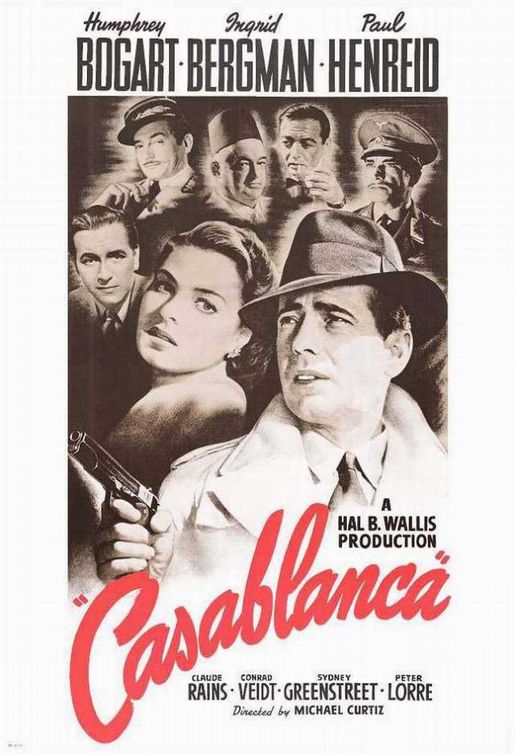
Embracing the Melodrama Part II #15: Casablanca (dir by Michael Curtiz)


CasablancaPoster-Gold

(This review contains spoilers but seriously, you should know all of this already.)

Is there anything left to be said about Casablanca?

Probably not.

As a film reviewer, I’m not supposed to admit that.  I’m supposed to come up with some sort of new, out-of-nowhere, batshit crazy way to look at Casablanca.  I’m supposed to argue that Rick was actually meant to be a survivor of abuse or that Victor Laszlo was some sort of precursor to President Obama or something.  Or, if that doesn’t work, I’m supposed to intentionally troll everyone by writing something like, “10 reasons why Casablanca is overrated” or “I hate Casablanca and I don’t care who knows it!”

But I’m not going to do that.

The fact of the matter is that Casablanca is as good a film as everyone says it is.  It is a film that everyone should see.  It is a film that quite rightfully was named best picture of 1943.  It deserves to be celebrated.  It deserves to be seen.  In fact, stop reading this review right now and go watch it.  Don’t let me waste another second of your time.

The thing with Casablanca is that it’s such an iconic film that everyone knows what happens, regardless of whether they’ve actually watched the entire film or not.  They know that the film takes place in Casablanca during World War II.  They know that Casablanca is full of refugees, spies, and people who are hiding from their past.  They know that Casablanca is policed by the charmingly corrupt Capt. Louis Renault (Claude Rains).  They know that Major Strasser (Conrad Veidt) is the Nazi in charge.  (I nearly said that Strasser was the “evil Nazi in charge” but when you identify someone as a Nazi, is it really necessary to add that they’re evil?)  They know that Rick (Humphrey Bogart) is the American expatriate who owns Rick’s Cafe Americain and that everyone comes to Rick’s.  They know that Rick’s slogan is that he doesn’t stick his neck out for anyone but they also know that his cynicism hides the fact that he’s still in love with Ilsa (Ingrid Bergman).  They know that when Ilsa shows up at Rick’s and needs him to help her husband, Victor Laszlo (Paul Henreid), escape from Occupied Europe, Rick is forced to decide whether or not to get involved in the resistance.

And, whether you’ve seen the film or not, you know that it all ends on a foggy airstrip.  Ilsa wants to stay in Casablanca with Rick but Rick tells her that she has to get on the plane with Laszlo because, if she doesn’t, she’ll regret it.  Ilsa goes with Laszlo, leaving Rick behind.

And it may have been the right thing to do but how many viewers would have done the same if they had been in Ilsa’s high heels?  Throughout the entire movie, we hear about how wonderful Laszlo is but, whenever he actually shows up on screen, it’s always a little bit surprising to discover just how boring a character Victor Laszlo really is.  Unlike the troubled and deceptively cynical Rick, there’s not much going on underneath the surface with Laszlo.  Just as Rick overshadows Laszlo, Bogart’s performance overshadows Paul Henreid’s.  Bogart and Bergman have all the chemistry and the charisma.  Henreid, on the other hand, comes across as stiff and a little dull.  But, as the film suggests, World War II was not a time for self-doubt and self-interest.  World War II was a time when the world needed straight-forward, determined men like Victor Laszlo.

And, if the world needed Laszlo and Laszlo needed Ilsa, then that meant Ilsa had to get on that plane.

That said, I’ve always liked to think that Ilsa ended up leaving Laszlo in 1945 and immediately made her way back to Morocco.  Rick and Ilsa belonged together.

But until Ilsa comes back, Rick has his friendship with Renault.  “Louis,” he says, “I think this is the beginning of a beautiful friendship.”  Did Bogart realize, when he delivered that line, that literally thousands of people would be repeating it decades later?  Bogart’s performance is probably one of the most imitated performances of all time.  Anyone who sees Casablanca thinks that they can talk about gin joints and hills of beans in Bogart’s trademark style.  Of course, they can’t and it’s a testament to the power of Bogart’s performance that it remains effective even after being endlessly imitated.

On Valentine’s Day of 2014, I saw Casablanca at the Alamo Drafthouse in Austin.  It was an amazing and romantic experience.  See Casablanca on the big screen.  It’ll make you love life and bring life to your love.

Needless to say, Casablanca is an intimidating film to review.  So, I’ll just say this: Casablanca is even better than you think it is.  If you haven’t seen it, go watch it.  If you have seen it, go watch it again.

Just resist the temptation to say, “Play it again, Sam,” in your best Bogart-like voice.

Because, seriously, Rick never actually says that line.