“Congratulations! You just destroyed government property!” —
33963 (Lee Tergesen) in Into the Dark (2014)
The quote above comes from a 14-minute short film that I was recently fortunate enough to have the opportunity to view. If you’ve read my previous reviews on this site, then you probably know that I’m not a huge fan of government property in general so, as you can imagine, that line made me smile. Within the context of the film, it also provided a brief moment of triumph for two men who have both reached a point where they have to be happy for whatever temporary victory they may happen to achieve.
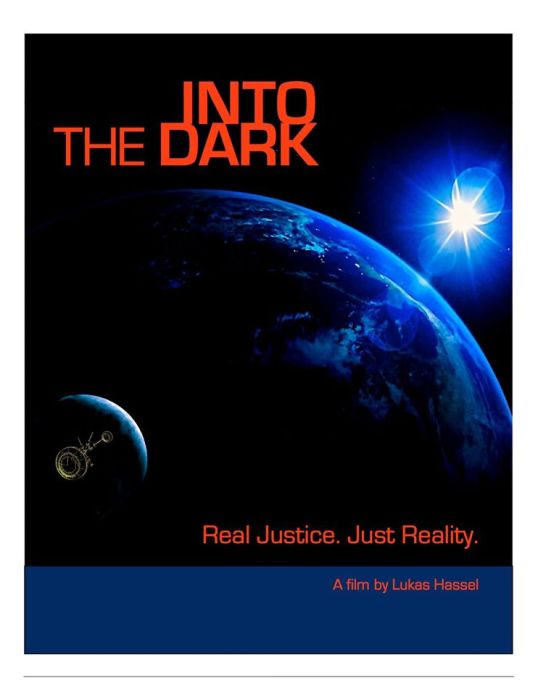
Into the Dark opens with a haunting image of an urban skyline. The moon hangs over the city and, as we watch, we briefly see that something has been launched into the night sky. That object is a small capsule that includes two men who have been strapped in back-to-back. The two men are identified not by name but by number. 58257 (Lukas Hassel, who also wrote and directed Into the Dark) is angry and shouts at the unseen people who are watching him. Meanwhile, 33963 (voiced by Lee Tergesen) gives him advise on how to turn off a strobing blue light and tells him that, no matter how loudly he shouts, nobody watching can hear a word that he’s saying. No one on Earth is interested in what these two men have to say for themselves. Instead, the audience simply wants the catharsis of seeing what happens to them.
As we listen, it becomes apparent that these two men have broken the law and this space ride is a part of their punishment. 33963 was a political revolutionary while 58257’s crimes are a bit more ambiguous. Every few seconds, a condescending computerized voice tells them to think about what they’ve done. As their punishment approaches, 33963 begs 58257 to just talk to him and to allow him to experience some sort of human interaction…
Into the Dark may take place in the future but it deals with a very modern reality: we live in a very bloodthirsty time and that’s especially true in the way that we treat those who have been convicted of breaking the law. At a time when people feel like they have less and less control over their own fates, there’s a need to punish those who break “the rules,” never mind the fact that some rules make more sense than others. At any given times, you can turn on the television and watch reality shows about cops arresting lawbreakers, attorneys prosecuting the accused, and guards watching the convicted. These shows presents us with a world where the is no difference between a murderer and some guy who happened to have a little bit of weed in his car and where the only thing that matters is that people are being held responsible for breaking the rules that it’s assumed the viewer automatically and unquestioningly obeys. These shows allow an insecure society to feel superior.
That’s one reason why Into the Dark is so memorable. The final twist, the truth of why Hassel and Tergesen are in that capsule together, is totally plausible. It’s something that we, as an audience, know is probably going to end up happening some day. When the plausibility of that twist is mixed with the emotional power of the performances of Tergesen and Hassel, the end result is a thought-provoking look at crime, punishment, and the manufacturing of televised reality.
Another thing that makes Into The Dark so memorable is that the end credits mention that the majority of this film was shot in “Lukas Hassel’s apartment.” You wouldn’t know that from watching the film, which takes wonderful advantage of the production’s low-budget. The inside of the capsule is claustrophobic and cramped in the way that you would expect an intergalactic jail cell to be small and cramped. Despite almost entirely taking place in one small set, Hassel and cinematographer Henry Lee never allow the action to get stagey. Instead, it’s a fully cinematic experience and the fact that it was shot in someone’s apartment should give hope to aspiring independent filmmakers every where.
Into the Dark is currently playing on the festival circuit. You can find out more about the film here. And you can also check out it’s Facebook page. Or, if you’re at the Queens World Film Festival on March 18th or the Maryland Film Festival on March 28th, you can check it out there as well!
 Through the Shattered Lens
Pingback: A Very Shot Review of Tooken | Through the Shattered Lens