Well, this is certainly intimidating. I know I’ve said this many time before but it deserves to be repeated: it’s often a hundred times more difficult to review a great film than it is to review a merely mediocre one. When a film fails, it’s usually easy to say why. The acting was bad. The directing was uninspired. The plot didn’t make any sense. Or maybe the film has been so overpraised that you, as a reviewer, are almost obligated to be tougher on it than you would be with any other film. However, it’s never as easy to put into words just what exactlyit is that makes a movie great.
Take the 1973 Best Picture nominee American Graffiti for instance. I could tell you that this is a very well-acted film and that it features an ensemble of very likable performers, many of whom subsequently went on to become stars and celebrated character actors. Then again, you can say the same thing about countless other films.
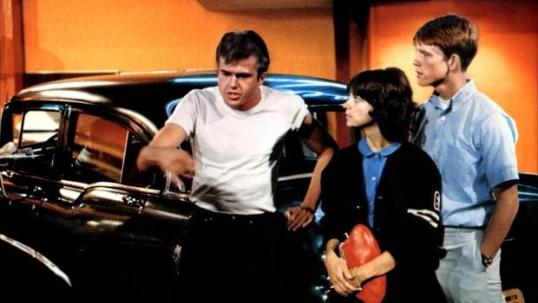
I could say that director George Lucas does such a good job putting this film together that it’s hard to believe that he’s the same man who would later be responsible for all three of the Star Wars prequels. Then again, I could also say the same thing about how odd it is that the same man who directed the entertaining Final Destination 5 was also responsible for the far less enthralling Into The Storm.
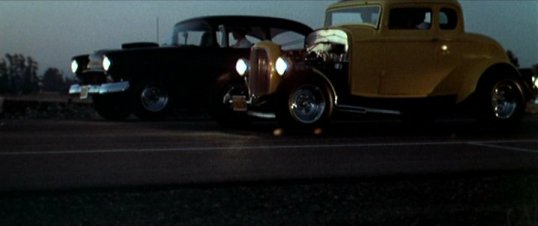
I could tell you that the film serves as a valuable time capsule in that not only does it feature a loving recreation of small town America in the early 60s but that it’s also a chance to see what Richard Dreyfuss, Ron Howard, and Charles Martin Smith all looked like when they still had hair. But then again, I also praised The Young Graduates for being a time capsule as well.
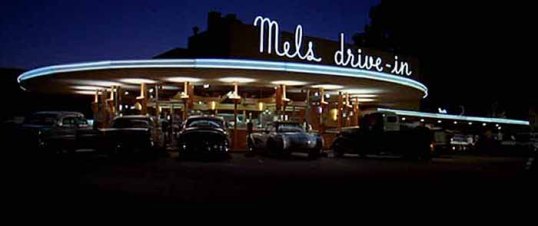
Let’s face it — it’s difficult to define the intangible qualities that make a film great. Often times, it’s a case of simply knowing it when you see it. I’ve seen American Graffiti a few times. The last time I saw it was at a special Sunday showing at the Alamo Drafthouse. And, on that early Sunday afternoon, the theater was packed with people who had paid for the chance to see the 40 year-old film on the big screen. I’m 28 years old and it’s significant that, while the majority of the audience was older than me, there were quite a few people who were younger. American Graffiti is one of those films that obviously spoke to audiences when it was first released and continues to speak to audiences today.
As I mentioned in my review of Rebel Without A Cause, films about teens tend to age quickly and, often times, one generation’s masterpiece will turn out to be a later generation’s joke. When a film like Rebel or American Graffiti survives the test of time, it’s because the film has managed to capture a universal truth about what it means to be young and to have your entire life ahead of you.
American Graffiti takes place over the course of one long night in Modesto, California in 1962. The film follows several different characters, the majority of whom have just graduated from high school. What these characters all have in common is that one phase of their life has ended and a new one is about to begin. Over the course of that one night, all of them are forced to say goodbye to their past identities and, in some instances, are forced to face their future.

For instance, there’s Curt (an amazingly young Richard Dreyfuss), a neurotic intellectual who spends the night trying to decide whether or not he actually wants to leave for college in the morning. Complicating Curt’s decision is a mysterious blonde who mouths “I love you” at him before driving away. While searching for her, Curt finds himself unwillingly recruited into the Pharoahs, a somewhat ludicrous small town gang that’s led by Joe (played, in hilariously clueless fashion, by Bo Hopkins.) Curt, incidentally, is my favorite character in the film. He’s just adorable, which admittedly is not a reaction that one often has to Richard Dreyfuss.
(Curt is also featured in one of my favorite scenes, in which he smokes a cigarette with a lecherous teacher named Mr. Wolf.)

Curt’s sister (Cindy Williams) is dating Steve Bolander (Ron Howard). Steve is the former class president and, unlike Curt, he’s very excited about leaving home. Ron Howard gives such a likable performance that it actually takes a few viewing to realize just how big of a jerk Steve really is.

And then there Terry (Charles Martin Smith) who wears big glasses and has bad skin. Terry gets to spend the night driving around in Steve’s car and manages to pick up a girl named Debbie (Candy Clark). For Terry, this is his night to actually be somebody and what makes it all the more poignant is just how obvious it is that Terry will probably never get another chance. Though he may not realize it, those of us watching understand that this is literally going to the be the best night of Terry’s life.
(Incidentally, much like Ron Howard, Charles Martin Smith would go on to become a film director and gave the world the amazingly sweet Dolphin Tale.)

And finally, there’s John Milner (Paul Le Mat). John is a little older than the other main characters. He spends most of his time in his car, driving around and getting challenged to race. He’s the epitome of late 50s/early 60s cool, with an attitude and a look that he obviously borrowed from James Dean and Marlon Brando. Over the course of the night, he is forced to deal with a bratty 13 year-old stowaway (MacKenzie Phillips) and a mysterious challenger named Bob Falfa (played by a youngish Harrison Ford, who wears a cowboy hat and speaks with a country twang).
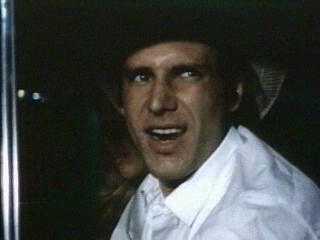
The film follows these characters through the night and then, at the end of it, we get the famous epilogue where we discover that all of the male characters have pretty much ended up exactly how we thought they would. In some cases, that’s a good thing. And in other cases, it’s not. It’s a good ending that’s kept from being great by the fact that none of the film’s female characters rate so much as even a mention.
So, what else can be said about American Graffiti?
It’s a great film.
Isn’t that enough?

 Through the Shattered Lens