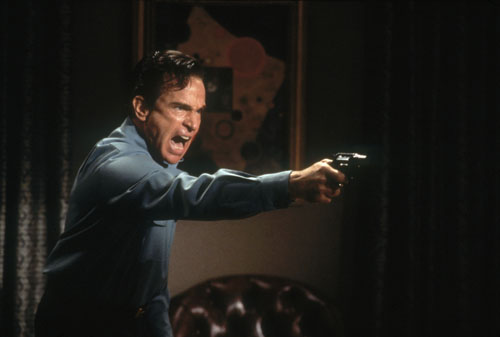
Let’s continue to embrace the melodrama with the 1991 best picture nominee Bugsy.
Gangster Benjamin Siegel (Warren Beatty) may be known as Bugsy but nobody dares call him that to his face. Siegel may be best known for his quick temper and his willingness to murder anyone who gets in his way, but Ben insists that he’s not as crazy as everyone considers him to be. Instead, Ben knows that he’s a very special person, a visionary businessman whose business just happens to be organized crime. Along with his childhood friends Lucky Luciano (Bill Graham) and Meyer Lansky (Ben Kingsley), Siegel is one of the founders of the modern American crime syndicate. Unlike his more practical-minded partners, Siegel revels in being a public figure. Bugsy examines how Siegel became a celebrity gangster and how that celebrity eventually led to his downfall.
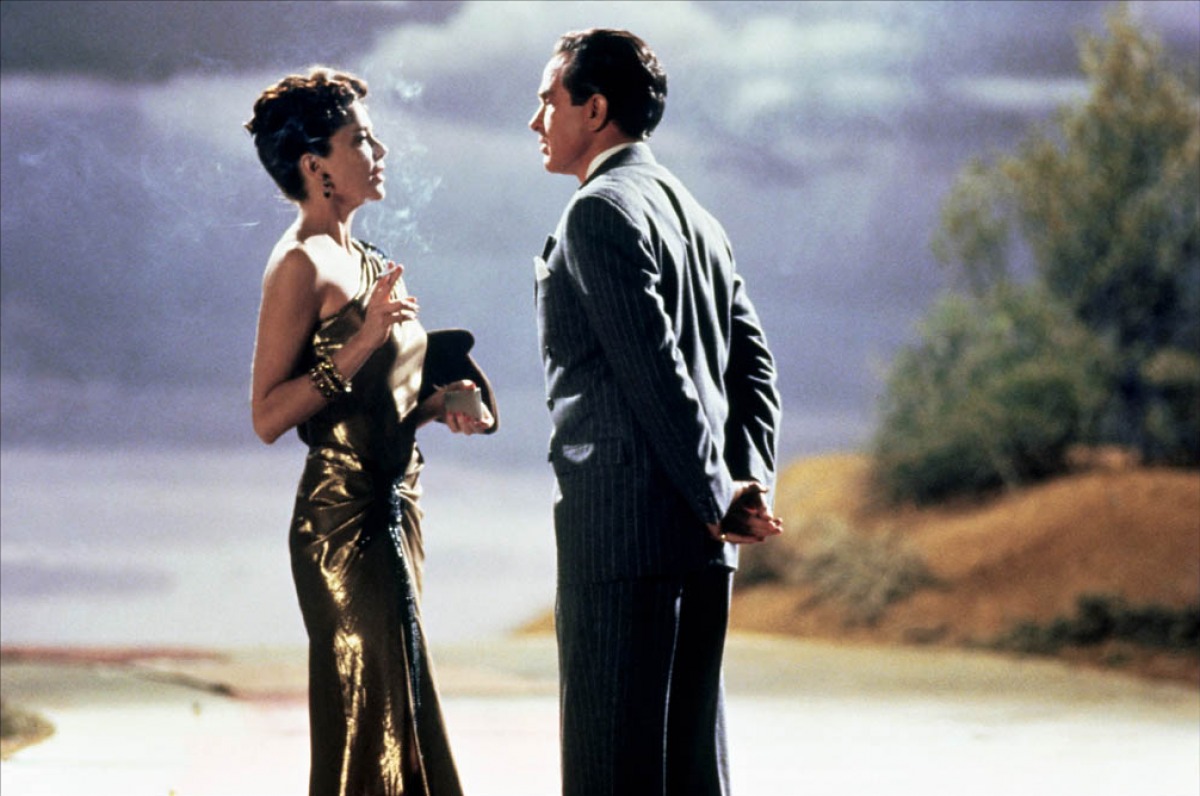
As the film opens, Luciano and Lansky send Siegel out to Los Angeles, specifically to look after their west coast business operations. Before Siegel leaves, he is specifically told to keep a low profile. So, of course, as soon as Siegel arrives in Los Angeles, he starts hanging out with actor George Raft (Joe Mantegna) and having a very public affair with actress Virginia Hill (Annette Bening). Siegel quickly falls in love with the glamour and glitz of Hollywood and starts to think of himself as being a movie star. When he’s not working with violent gangster Mickey Cohen (Harvey Keitel) to control the Los Angeles underworld, Siegel is attending film premieres and even shooting a Hollywood screen test. Back in New York, Luciano and Lansky can only watch as their childhood friend goes out of his way to defy their instructions and become the most famous gangster in America.
Eventually, Siegel goes on a gambling trip to Nevada and comes up with an idea that is destined to change America forever. With funding from Lansky and Luciano, Siegel begins construction on the Flamingo Hotel and Casino in Las Vegas, Nevada. However, Siegel’s plans are so extravagant and, in many ways, impractical that the budget soon soars out of control. Not helping matters is the fact that Virginia is embezzling money from the casino’s budget. Even after Siegel finds out, he can’t bring himself to be angry at her. He understand that he and Virginia are essentially cut from the same cloth.
However, back in New York, Luciano grows more and more frustrated with Siegel’s wasteful ways and Lansky comes to realize that he can only protect his friend for so long…
Bugsy is a big, extravagant movie that tries to be a few too many things at once. Over the course of two and a half hours, it attempts to be a love story, a biopic, a classic gangster film, an allegory for the American dream, a history lesson, a period piece, and finally, a metaphor for the act of filmmaking itself. (When Siegel complains that Luciano and Lansky don’t understand why the Flamingo has to be huge, it’s hard not to feel that he’s meant to be a stand in for every director who has ever had his budget cut by a meddling studio executive.) When a film tries to be so many different things all at once, you can’t be surprised when the end result is a little uneven. Bugsy starts out slowly but gradually picks up speed and the final part of the movie is everything that one could hope for from an epic gangster film.
The film works best as a character study of a man who, in the best American tradition, attempts to reinvent himself by moving out west. Back in New York, Ben is known as a cold-blooded and dangerous killer. However, once he arrives in Los Angeles, Ben attempts to recreate himself as a celebrity and then as a visionary. For him, the Flamingo is about more than money. The Flamingo is about being remembered for something other than his nickname. The Flamingo is his way to escape from his past. However, as Bugsy makes clear, the past can be ignored but it never goes away.



 Through the Shattered Lens