
You won’t find a much more loaded term in the entire lexicon of political rhetoric than “evil empire.” The phrase was made (in)famous when Reagan used it to describe the Soviet Union back when he had a hard-on for the apocalypse, and while some folks thought he was just being melodramatic, the “joke” he made a couple years later when he thought his mic was off about how he’d “just signed legislation outlawing Russia forever — we begin bombing in five minutes,” went some way towards throwing into stark relief why hard-line anti-communists were every bit as much a threat, if not moreso, than the dreaded “pinkos” themselves.
Fast forward a few years from that and America is thumping its collective chest and patting itself undeservedly on the back for having supposedly “won” the Cold War — uhhhhhmm, sorry, but last I checked the Soviet empire collapsed from within under its own weight — and we find out that our purported “enemy” was a starving nation that couldn’t even put bread on its own collective table, much less invade the US and destroy our much-vaunted “way of life.” In short, folks, we got hustled — the US government spent hundreds of billions on weapons (particularly nuclear weapons) we didn’t need in order to “fight” a “foe” that couldn’t even keep its own house in order. much less come and forcibly annex our own.
The lesson to be learned here? All wars — even “cold” ones — are a racket, in the immortal words of Smedley Butler, and the only “winners” are the defense contractors who profit from them.
Still, Cold War anxiety gave rise to some remarkably salient takes on the whole “dystopian future” scenario, the most famous of them in the comics world being Alan Moore and David Lloyd’s seminal V For Vendetta, which eventually became a big-budget Hollywood blockbuster once it had been stripped of all its smartest elements (and anarchist politics), and the Guy Fawkes “V” mask has ended up being appropriated not only by groups that probably do, if you’ll pardon the term,”deserve” to wear it given that they understand the story’s socio-political implications — such as the Anonymous hacker collective and various factions of the loosely-defined “Occupy” movement — but also, sadly and ironically, by far-right extremist supporters of arch-conservative/homophobe/racist American politician Ron Paul, and his even less principled, and decidedly more eel-like, son, Rand, who’s not even much of a Libertarian given his opposition to same-sex marriage and civil unions, his oft-stated desire to outlaw all abortion, even in cases of rape and incest, and his flat-out insane idea to “modify” the 1964 Civil Rights Act so that businesses can go back to discriminating against black customers if they want.
This guy’s a “champion of freedom”? Don’t make me laugh. Still, given his propensity for taking credit for work done by others, it’ll probably only be a few years before the junior senator from Kentucky claims authorship of V For Vendetta himself.
All of which brings us, in an admittedly roundabout way, to the fact that it’s about time for a “dystopian future” comic for a new generation now that the last really good one has been hijacked, at least at the margins, by the very right-wing authoritarian forces it was (bravely, for its time, I might add) braying against. And while I don’t know if writer Max Bemis and artist Ransom Getty’s Evil Empire, the first issue of which has just seen the light of day via Boom! Studios, will prove to be that book, it’s certainly off to an intriguing, if wildly uneven, start.
I freely admit to not being at all familiar with either of this title’s principal creators — the only name associated with the series so far that I recognize being FBP (a book you absolutely need to be reading) artist Robbi Rodriguez, who provides one of the variant covers to this debut installment (the main one, reproduced at the top of this review, being the handiwork of Jay Shaw) — but that’s actually a good thing in my book, since there’s a shitload of up-and-coming talent in comics that deserves much wider exposure than it’s gotten so far. Hell, truth be told I’m not all that schooled on Boom! as a publisher, apart from the fact that they have the RoboCop comics license and they put out Mike Carey and Elena Casagrande’s Suicide Risk, which is easily one of the three or four best series being published by anyone right now. A quick glance at Evil Empire‘s copyright indicia shows that it’s a company-owned, rather than creator-owned, work, and that’s not cool in my book, but oh well. Marvel and DC certainly have been been getting away with the work-for-hire hustle for decades now — it’s just depressing to see smaller publishing houses following suit, I guess.
In any case, this is at the very least a creator-driven project —it would just be nice it if were a creator-owned one, as well.
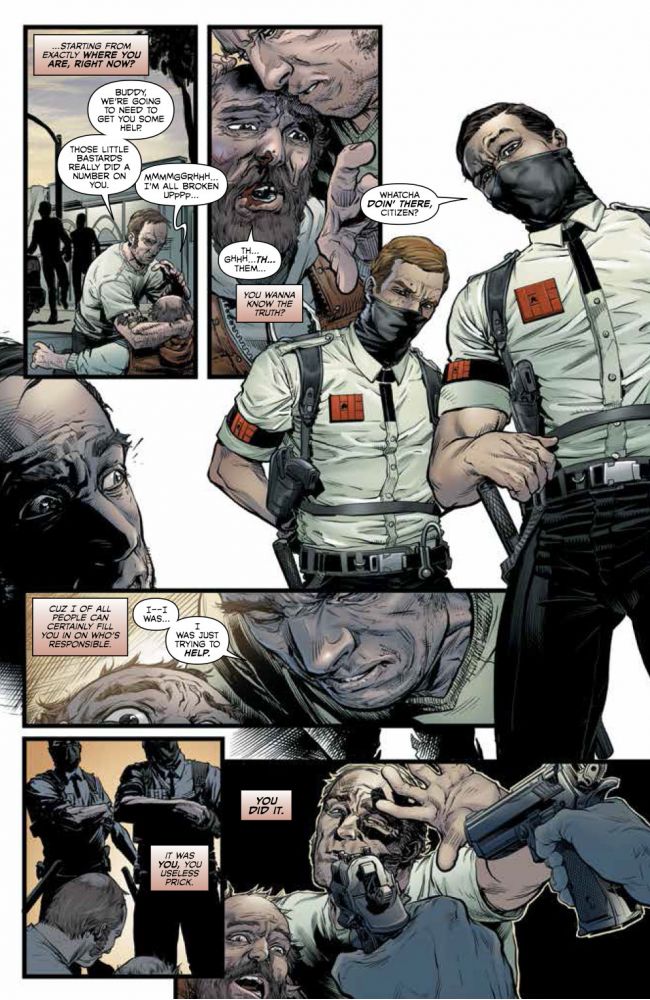
Anyway, to the story — the action starts off 25 years in the future, where things have gone to hell in the proverbial bucket. “Security” cameras monitor every citizen’s every move, armed George Zimmerman-types are given badges and prowl the streets looking for (oh, who are we kidding, creating) trouble, some unnamed corrupt dictatorial overlord runs the whole show, and various technological “bread and circuses” serve to disrupt the cowed and tired populace from the troublesome nature of reality itself.
All in all, then, not too big a reach.
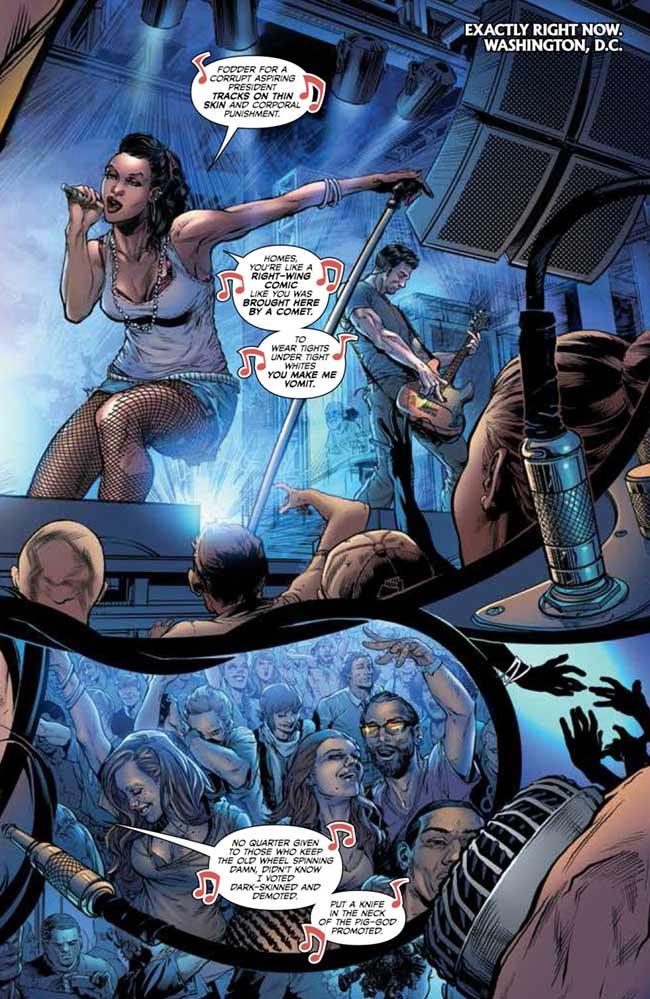
A few pages in, though, is when things start to get interesting, as Bemis and Getty begin the task of charting how we get from here to there. First up we meet politically-aware hip-hop artist Reese Greenwood, and while Bemis saddles her with some truly mind-bogglingly stupid lyrics, to his credit he also manages to establish her as a thoughtful, deeply aware character in fairly short order. She’s got no time for “the system,” as you’d expect, but she ‘s hardly the type of cardboard caricature so many “urban” African-American women in comics are these days. She seems like the sort of person you’d actually enjoy sitting down and having a conversation with, rather than a confrontational, “Invader From Mars” type.
Democratic presidential nominee Sam Duggins certainly seems to have taken a shine to her, as well. He pulls a few strings to meet her backstage after one of her shows, crashes an interview she does with MTV, surreptitiously passes his phone number to her — anything to get the young lady’s attention. Sam seems a decent-enough sort — more progressive than anybody the party would have the guts to nominate for national office in real life, to be sure (not to mention the fact that a single guy without kids wouldn’t stand a chance in a presidential election), but Reese isn’t buying his line entirely. She certainly seems to hope he’s the real deal (hey, a lot of us hoped for the same from Obama once upon a time, before his “Bush-lite” tendencies fully came to the surface), but she’s apparently seen one too many phony “leftists” turn out to be nothing but “kinder, gentler” versions of the same old corporate stooges over the course of her life to fully get on board with either of the “Big Two” political parties, even the less overtly noxious one. I can certainly relate to that.

Still, as patently dishonest as Duggins may (or may not, who knows?) be, he’s a saint compared to pious, grandstanding, loathsome Republican nominee Kenneth Laramy, your typical “family values” right-wing blowhard. Unlike Reese and Sam, Laramy is, in fact, presented as nothing but a two-dimensional collection of tired stereotypes, which is kind of a shame, but with only 22 pages of story and art to work with something’s gotta give, and hey, it’s only the first issue — and there’s plenty of reason to suspect that there’s a lot more going on with him than meets the eye.
Case in point — midway through through out opening installment, Laramy’s daughter finds her mother bleeding to death in their home with a knife in her back. This scene is handled incredibly clumsily, with hints at first being given that something’s happened to the daughter rather than the mother, and mom croaking (sorry) some incredibly wooden dialogue about something bad she did years ago as she expires (Getty also employs an admittedly unique, but frankly kinda stupid, artistic contrivance when he segues into this scenario via an attached panel-sized asterisk), but the point to take away here, plot-wise, is that there is no assailant present, so the identity of Mrs. Laramy’s murderer remains a mystery.
At her wake, though, the shit really hits the fan. Duggins shows up with Reese as his date, and while you’d expect a media circus to ensue, that’s avoided when Laramy himself finally takes to the stage — or page, as the case may be — and leaves us with one of the better cliffhanger splash-pages that I can recall in quite some time. Sure, it’s not exactly realistic for a grieving widower to be interrupted in the middle of his eulogy by a reporter asking him a fucking question — even if said widower is running for president (actually, he announces that he’s withdrawing from the race during the speech, but that’s neither here nor there) — but while the set-up may be awkward, to put it kindly (as are little touches of dialogue throughout the book, like Reese referring to Laramy’s running mate as his “runner-up” and Duggins saying that Laramy is opposing him on the “ticket” rather than the ballot, “tickets” being, colloquially speaking, something that a presidential and vice-presidential candidate are, ya know, sharing — but again, whatever) the payoff is big. Or might be. In any case, our “bad guy” candidate ends the first issue by dropping one heck of a bomb, and Bemis succeeds in leaving his readers damn hungry for answers.
Yeah, alright. Evil Empire has a long way to go before it can even be mentioned in the same breath as V For Vendetta. And Bemis’ story is more concerned with how a fascist government comes to be rather than how it’s toppled. But his set-up shows a lot of promise, and with a little bit of dialogue tightening and some deft editorial tinkering along the edges, this could really turn out to be a fun and thought-provoking ride. Sure, the story definitely has a left-leaning point of view, but at least it’s realistic in its portrayal of Democrats as “less-bad” guys rather than actual good guys, and its forward-thinking presentation of urban youth culture in general, and hip-hop culture specifically, is to be commended. Too often in comics these days people of color under the age of 30 are still portrayed as villains, and that’s certainly not the case here.
On the art side, Getty does a nice job making his characters look reasonably believable physically, and he’s pretty skilled at using facial expressions and other non-verbal cues to communicate thought and feeling. There’s no typical super-hero action — and very little action in general — for him to sink his teeth into and really show off his chops, but his panels mostly flow together pretty nicely and he keeps the reader engaged with his images throughout, which isn’t always easy in a “talky” book such as this one.
So, hey, what the heck — $3.99 is admittedly a lot to shell out for a 24-page package, especially when 2 of those 24 pages are taken up by “house ads” at the back of the book — but Evil Empire managed to hook me, warts and all, and given that its takes place in a self-contained world of its own making rather than a corporate “universe” with decades of backstory to catch up on, readers new to comics in general might find this a decent-enough introduction to the medium, particularly if they’re fans of sci-fi, thriller, or other genre entertainment with a political twist. I can’t recommend it unreservedly, given that it still has much to prove, but I’m happy enough right now to keep shoveling four bucks a month over to Boom! to see where this ride Bemis and Getty are taking us on ends up going.

 Through the Shattered Lens