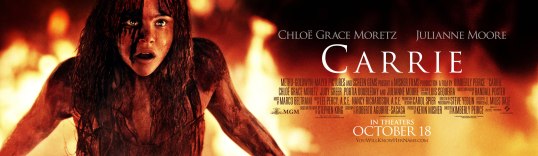
 High School can be a rough time. Growing up, we always had Freshman Day, where bullies spent the first Friday of the new semester terrorizing the newbies. I spent at least one of those years either writing in the Library for lunch or on the run between classes until a poem/love letter I wrote on behalf of a member of the Varsity Football team left me in their good graces and under their protection. Needed to tell your girl she was the best thing since Ham & Pineapple pizza, but in an eloquent way? Go ask that geek in the back row of English reading Christine with the big round glasses. Oh, the joys of High School. I can’t even imagine how intense bullying can get today with all of the social media we have. It’s easy to imagine what you could do to protect yourself if you could be as cool as Nightcrawler and make yourself teleport, fight off your foes like Batman or best of all, Force Choke the crap out of someone like Darth Vader.
In that sense, the story of Carrie is still kind of cool, and mildly disturbing.
There was a point in Stephen King’s life where Carrie almost never happened. It was because of his wife, Tabitha that the story was ever finished and that the parts focused on women and their “monthlies” (as members of my family would say) were written the way they were. Carrie got King his foot in the door and set him for other releases like The Shining, Christine and Salem’s Lot. I think next to The Shining, it might be his most remade film.
I’m not sure if there’s anyone who never saw Brian De Palma’s Carrie from 1978 with Sissy Spacek. If not, Kimberly Peirce’s version is not bad at all as an introduction to the story. It actually has at least one element from the book that was never featured in the original film (though part of me does wish that it contained the newspaper format – something like John Larroquette’s narration for The Texas Chainsaw Massacre). Carrie is simply the tale of a young girl in high school who discovers she has telekinetic powers. Eventually, she gets pushed and loses it, unleashing her abilities against anyone in her way. No version of the story has ever gone into detail on how she got them outside of the puberty angle – they’re just there.
Peirce’s version moves just as well as De Palma’s, which is interesting because supposedly they happen to be friends. The main differences lie in DePalma’s choice of nudity versus Peirce’s lack of it, and DePalma’s lack of blood (a sign of the times) compared to Peirce’s extended usage of it. Other than that, it’s roughly the same film, any closer and you’d end up with Gus Van Sant’s shot for shot version of Psycho. Half of me wonders why it needed to be remade (again), the other half says, “You know what, it wasn’t half bad.” There’s nothing essentially wrong with Carrie, but it’s really hard to talk about the Peirce Carrie Film without going back to the DePalma one.
First, Carrie’s biggest strength by far comes in it’s casting. As the leads, both Chloe Grace Moretz and Julianne Moore are great in their roles – almost better than the film deserves. Granted, it’s kind of difficult to imagine anyone messing up something as simple as this. When it comes to young horror starlets, the first two names that come to my mind are Silent Hill’s Jodele Ferland and The Hunger Games’ Isabelle Fuhrman, both of which I thought would be interesting fits here. If Katharine Isabelle was just a little younger, that would have worked too. However, I forgot that Moretz had both The Amityville Horror and Let Me In under her belt (and we won’t speak of Dark Shadows – That wasn’t horror. That wasn’t even comedy. I can’t even identify what that was). Her role as Carrie is somewhat similar to Let Me In, being more reserved here than the Kick Ass films and with good reason.
Moore’s version of Margaret White spends some time self harming herself, which was a little eerie and reminded me of Paul Bettany’s character in The DaVinci Code, punishing themselves for their sins. She’s good here, but after coming off winning an Emmy for playing Sarah Palin in “Game Change”, she looks like she’s underused here. It’s like having an actor play a superhero after becoming a great director and winning tons of accolades. A job is a job, and Moore does a great one here given what she has to work with.
The supporting cast was interesting. I didn’t expect to like Judy Greer’s gym teacher as much as I did, and Ansel Angort’s Tommy Ross was good. I hope that this film leads to bigger and better roles for him. A surprise was Chronicle’s Alex Russell as Billy Nolan, the character originally played by John Travolta. He pulls off a villain well. Portia Doubleday’s version of Kris Hargensen may actually be better than Nancy Allen was, though this could also be in part due to the way the story is written.
So, on with the plot. Carrie White (Moretz) is a reclusive loner, living with her overprotective mother (Moore). In the school shower, she has her period for the first time and not realizing what’s occurring to her (and having never been told just what to expect), naturally panics. This leads to an all out humiliation by her peers that’s even recorded. Carrie later learns about her abilities, while her nemesis, Kris is kicked from the prom and vows to take her vengeance against Carrie. Some of the main sequences are actually expanded upon, which I thought were actually good.
I think the only problem I had with Carrie was the technique used for the Telekinesis. It almost seems a little CGI heavy, but when I think about it, I’m not sure how else they could have pulled off much of what they did here without it. Additionally, Moretz’s version of Carrie uses her hands a lot, which almost makes it seems like she’s either dancing or is trying to conjure up something. It’s not a terribly bad thing and you may actually get used to it after she does it once or twice. Part of me kept expecting her to scream “Unlimited Power!” at one point but it was just a minor “Wow, that’s kind of weird.” Reaction, at least for me.
Carrie’s not really meant for little kids. Anyone who’s a fan of Moretz by way of Diary of a Wimpy Kid might not be ready to handle Carrie, but if you’ve followed any of the Kick Ass films, Carrie’s actually lighter than those. Overall, it’s one of the better remakes out there and a very short film (I’m writing this while watching the Nightmare on Elm Street remake, so I like to think I have a good basis of comparison). If you never saw the original, it might be worth a try. If you don’t wish to spend the money for the ticket, you can always watch one of the other versions and wait for this to come out on Blu-Ray.
 Through the Shattered Lens
It’s an almost scene-for-scene remake, but I like how they changed some of the themes to fit in well with the current state of high school life. You couldn’t even say that Moretz’ protrayal of Carrie was as an ugly duckling the way Sissy Spacek did the role.
Moretz’ Carrie seemed more like, as you said, the loner. She’s less the ugly duckling and more the girl afraid to transition to being a young woman.
I’m real interested to read what Lisa Marie thinks about this Carrie.
LikeLike
I like and agree with that statement, about Moretz’ Carrie fearful of that transition. In that light, the movie makes more sense as a coming of age sort of story (with strange stuff added).
LikeLike
Nice write up, can’t wait to watch it.
LikeLike
Thank you!!
LikeLike
Pingback: Trailer: Endless Love | Through the Shattered Lens
Pingback: Back to School #79: If I Stay (dir by R.J. Cutler) | Through the Shattered Lens
Pingback: Back to School Part II #30: Welcome to the Dollhouse (dir by Todd Solondz) | Through the Shattered Lens