Film Review: Magnum Force (dir by Ted Post)


Today, we continue our look at the Dirty Harry film franchise by taking a look at the second film in the series, 1973’s Magnum Force.

Despite the fact that Dirty Harry famously ended with Harry Callahan throwing away his badge in disgust, Magnum Force reveals that Callahan (played again by Clint Eastwood) is still a member of the San Francisco Police Department.  He’s got a new partner (Felton Perry, a likable actor in a thankless role) but he’s still butting heads with his superiors at the department.  He’s also still got a way with the one-liners.  When Lt. Briggs (Hal Holbrook) brags that he never once had to draw his gun while he was in uniform, Callahan replies, “A man’s got to know his limitations.”

While Callahan is busying himself with doing things like gunning down robbers and preventing an attempt to hijack a plane, a group of motorcycle cops are gunning down the town’s criminals.  They begin by killing a mobster who has just beaten a murder charge on a technicality but soon, they’re gunning down anyone who has ever so much as been suspected of committing a crime.  Alone among the detectives investigating the murders, Callahan believes that the killers are cops and, even worse, he suspects that his old friend Charlie McCoy (played by Mitchell Ryan) might be a member of the group…

Though it suffers when compared to Dirty Harry, Magnum Force is still an exciting and effective action film that is clearly a product of the same period of time that gave us such classics of paranoid cinema as The Parallax View and Three Days of the Condor.  Whereas Dirty Harry took an almost documentary approach to capturing life and death in San Francisco, Magnum Force is a film that is full of dark shadows and expressionistic angles.

In Dirty Harry, the Scorpio Killer was both an obvious outsider and an obvious force of destruction.  The film’s dramatic tension came from the fact that he was so clearly guilty and yet nothing could be done to stop him.  The villains in Magnum Force are the exact opposite of Scorpio.  As chillingly played by David Soul, Robert Urich, Tim Matheson, and Kip Niven, the killer cops are distinguished not by their otherness but by their total lack of individuality.

In the film’s best scene, they confront Harry in a parking garage and basically tell him that he’s either with them or against him.  Sitting on their motorcycles, wearing their leather jackets, and with their grim faces hidden behind their aviator sunglasses, these cops are the ultimate representation of  faceless fascism.  After listening to their excuses, Harry asks if they consider themselves to be heroes.

“All of our heroes are dead,” one of them replies, delivering the film’s best line.

Obviously, Magnum Force was made to be an answer to those critics who claimed that Dirty Harry was a fascist film and it is a bit jarring, at first, to see Harry “defending” the system.  (“I hate the goddamn system but until something better comes along…”)  When Harry tells the killer cops, “I’m afraid you’ve misjudged me,” it’s not hard to see that this is the same message that Eastwood meant to give his critics.

However, what makes the killer cops in Magnum Force such interesting villains is that they are, ultimately, tools of the system that they’re attempting to destroy.  By killing off criminals as opposed to arresting them and putting them on trial, the killer cops are minimizing the risk of the flaws inherent in the system being exposed.  Hence, by defending the system, Harry is helping to expose and destroy it.

When I told Jeff that I was planning on watching and reviewing all of the Dirty Harry films, he suggested that I watch them in reverse-order.  His logic was that, since the films tended to get worse as the series progressed, watching them backwards would allow me to end my project on a happy note as opposed to a note of bitter disappointment.  I took his advice and I’m glad I did.  While I disagree with him about whether or not The Dead Pool is a better film than Sudden Impact, I do have to agree that the first two Dirty Harry films are dramatically better (and quite different in tone) from the ones that subsequently followed.

Tomorrow, we’ll look at the third film in the series, 1976’s The Enforcer.
Which Way Forward For The “Batman” Movie Franchise? Take Eleven : Other Principal Players


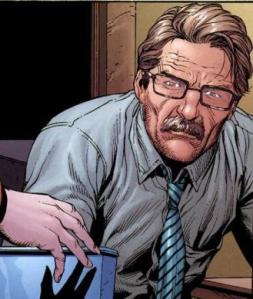
Hello once again, friends, and welcome to yet another in this seemingly endless series on relaunching the Batman franchise for the silver screen. Our introductory graphic this time around comes from the rather lackluster Batman : Earth One graphic novel, which I don’t really recommend anyone actually read, but I’m kicking things off with this picture because it’s a pretty accurate depiction of how I’m thinking Jim Gordon ought to look in this movie, and where this story falls for him chronologically in terms of his career. More about which in a very brief moment —

So, as we left things yesterday, Bruce Wayne was on his way back to Gotham, having headed west Boxcar Willie-style and spent most of the trip daydreaming about his past, giving us a pastiche of origin/background scenes to either tell us what we already know about his origins or tease us with aspects we may not be as familiar with. It seems to me that this point in our hypothetical Batman I  would be a pretty good time to introduce our other key cast members before lunging into the media circus that will await Batman in his “civilian” identity when he “officially” returns home.

First off I think police commissioner Jim Gordon (who, it should be noted, will be holding the “top cop” job from the start of this series) merits a quick intro, and while I hate to say “any scene showing him to be a good cop at this point will do,” the truth of the matter is — any scene showing him to be a good cop at this point will do. I’m thinking a little confrontation with his former partner, the hopelessly corrupt Lieutenant Flass, would serve our purposes well, maybe with Gordon on the right side of a set of cell bars and Flass on the wrong side, with some dialogue between them along the lines of Gordon near-taunting Flass about being sent upriver along with the rest of Carmine Falcone’s men, while Flass retorts limply with something like “way to sell out your old partner, Jimmy-boy, you got to the top on the backs of 80 good cops you sold out,” and Gordon responding with “80 cops, maybe, but good cops? Don’t kid yourself, Flass — anyway, just came to say goodbye, Harvey Dent will be seeing you in court in a few hours, and he’s batting .1000 with his conviction rate.”

Which will, of course, naturally lead to a scene showing Harvey Dent, maybe eating a bowl of cereal at home, with his wife, Gilda, in the background. He’s got a newspaper opened up next to him on the table, and Gilda asks who’s on his docket that day. He mentions the names of four Falcone deputies, including Flass. She says he must be feeling confident since he doesn’t have any legal briefs in front of him. “Just catching up on what’s happening around town?” She takes the paper and says “what is happening around town — besides you and Gordon finally cleaning up all the garbage?” At this point she takes a look at the article he was reading and says “ahhhh, the notorious cat-burglar — is she on your radar screen next?” “No need to be jealous, honey, the truth is she won’t be on my radar screen until Jim and his boys actually catch her,” all of which, of course, will lead us to —

A rather shabby-chic, semi-Bohemian-looking apartment in an obviously run-down part of town, where, dawn breaking, a lithe figure slinks in through an open window in a rather skin-tight outfit. She shoos about a dozen cats aside before reaching into a sewed-in compartment on her costume and taking out a couple pearl necklaces, diamond rings, and a wad of large bills, which she quickly locks away in a safe in her closet. A disembodies voice asks “Selina? Is that you? And we see the voice belongs to a 16-or 17-year old girl who’s still in bed, a few cats laying around her. Selina removes her mask and goggles, leans over her young charge, kisses her on the forehead, says “ssshhhh — yes, it’s me — just back from work — go on back to sleep, you’ve still got an hour or so before school,” and with that, we’ve “met,” at least in passing, the three most significant supporting cast members in our series not named Alfred.

So that’s the intros out of the way — next up we’ll have the much-talked-about-on-this-blog-already “return” of Bruce Wayne to Gotham, so please check back tomorrow if you’re interested in the details of just exactly how all that’s going to play out!

VGM Entry 58: Illusion City


VGM Entry 58: Illusion City
(Thanks to Tish at FFShrine for the banner)

Illusion City never saw an English translation. Micro Cabin first released it in December 1991 for the MSX turboR, and this was rapidly followed by versions for the PC-9801/PC-88VA (January 1992), FM Towns (July 1992), Sharp X68000 (July 1992), and a bit later the Sega CD (May 1993).

http://www.youtube.com/watch?v=l7Ec6UbzNqg

On a completely irrelevant note, I finally looked up why they called it the Towns, and apparently Fujitsu named their 1989 PC after 1964 Nobel Prize in Physics winner Charles Hard Townes. Aaanyway, Illusion City had a soundtrack to rival the SNES legends, and that’s about all you’ll ever find concerning the game in English. It *gasp* doesn’t even have an English Wikipedia page.

The music collections you’ll find scattered across youtube–and these are relatively abundant–showcase the MSX turboR version, so I will to. Two years behind our current historical progression or three years after the original release of Snatcher, I thought it best to bring the game up now since they’re occasionally compared. The two have next to nothing in common concerning gameplay, but they are both cyberpunk, and I gather they have some common plot features. (Not that I would know, short of digging up a fan translation.)

http://www.youtube.com/watch?v=hQw7MA8ogeA

Illusion City is not a visual novel. It’s an RPG. The best you’ll find concerning what style of RPG are a few stills here and there; I am thoroughly convinced that no Illusion City gameplay video exists on youtube. You’ll find plenty of videos of the introduction, and there’s an ending/credits roll video out there for the Sega CD version. That’s about it. But with these credits, conveniently originally in English, and a last resort Google Translate of the game’s Japanese Wikipedia entry, we can piece together its authorship easily enough.

The music was composed by Tadahiro Nitta (the same Nitta responsible for Micro Cabin’s Final Fantasy MSX port), Yasufumi Fukuda, and Koji Urita (Kouji Urita in the credits). These are the names listed on the wiki, and the Sega CD credits clearly distinguish them (“Music Compose”) from composers contributing new material to the port (“Mega-CD Special Music”). This latter group consists of Hirokazu Ohta, who “arranged and computer programmed” the intro and end-game music, and Yasufumi Fukuda, who added new combat music. Lastly the credits list Hirotoshi Moriya and Masato Takahashi under “sound” for the “Mega-CD Work Staff”.

There we go: clean and concise credits. How often does that happen on a Japanese PC game port?

http://www.youtube.com/watch?v=fFyje2308vI

In so far as this is the first cyberpunk RPG I know of (the Phantasy Star series comes to mind as a similar comparison), Tadahiro Nitta, Yasufumi Fukuda, and Kouji Urita had their work cut out for them. Where Masahiro Ikariko and company were able to score Snatcher more or less like a movie, Illusion City required themes for all of the contrivances of a standard RPG. The sort of poppy vibe with which Tokuhiko Uwabo flavored Phantasy Star II, to use a game I’ve previously showcased, can’t fly in cyberpunk–if that is in fact what kind of game Illusion City is, as many have claimed. It needed something a bit more dark and grimy.

Whether they really pulled it off is debatable, but if “City Noise” (3:37 in the present video) is in fact the main town theme then they definitely had the right idea. Oh, it’s not dark on the scale of Snatcher, but I get the sneaking suspicion anyway–mainly from the Sega CD intro and outros–that this is more of a futuristic adventure game with cyberpunk overtones than Akira-worship. It definitely succeeds in creating a futuristic RPG soundtrack to a far greater extent than what I’ve heard of Phantasy Star, and it’s got a decently dark edge.

oldskoolgamertje on youtube has provided a complete soundtrack of the MSX version for your enjoyment. Cheers.