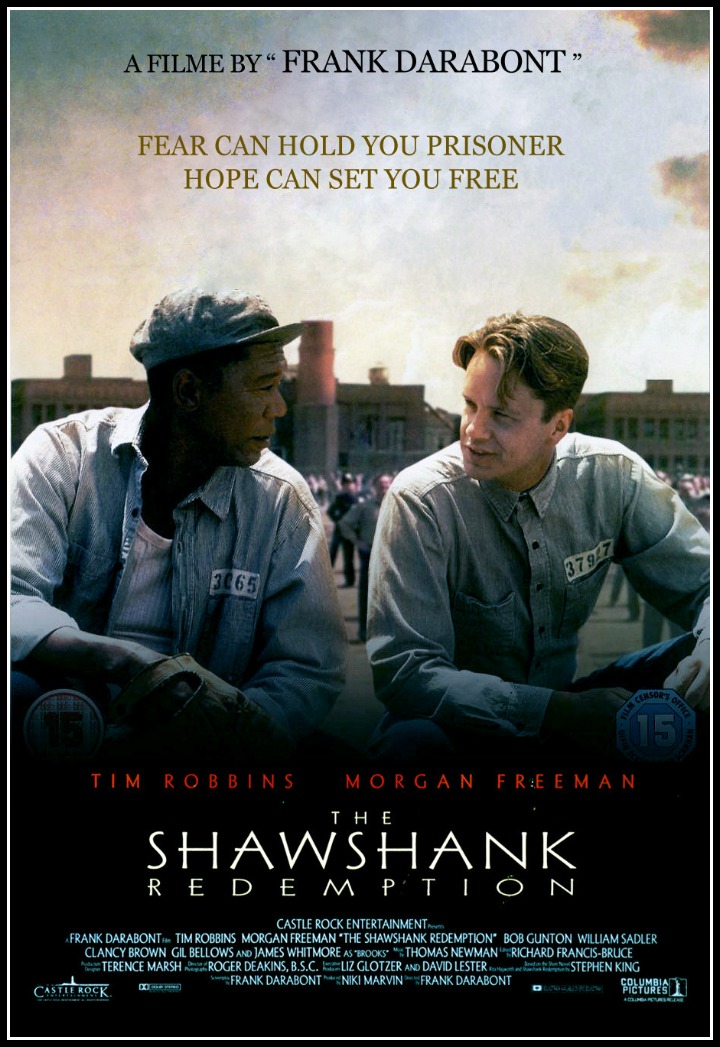
“Remember, Red. Hope is a good thing, maybe the best of things, and no good thing ever dies.” — Andy Dufresne
1994 was the year that men finally got their version of Fried Green Tomatoes and Beaches. We men we’re always perplexed why so many women liked those two films. Even when it was explained to us that the film was about the bond of sisterhood between female friends and how the march of time could never break it we were still scratching out heads. In comes Frank Darabont’s film adaptation of the Stephen King novella Rita Hayworth and Shawshank Redemption.
Using a script written by Darabont himself, the film just takes the latter half of the novella’s title and focuses most of the film’s story on the relationship between the lead character of Andy Dufresne (played by Tim Robbins) who gets sent to Shawshank Penitentiary for the crime of killing his wife and her lover and that of another inmate played by Morgan Freeman. The film doesn’t try to prove that Andy is innocent even though we hear him tell it to the convicts he ends up hanging around that he is. The relationship between Andy and Red becomes a great example of the very same bond of sisterhood, but this time a brotherhood who are stuck in a situation where their freedom has been taken away and hope itself becomes a rare and dangerous commodity.
Darabont has always been a filmmaker known for his love of Stephen King stories and has adapted several more since The Shawshank Redemption, but it would be this film which has become his signature work. It’s a film that’s almost elegiac in its pacing yet with hints of hope threaded in-between scenes of men clinging to sanity and normalcy in a place that looks to break them down and make them less human. It’s nothing new to see prison guards abusive towards inmates in films set in prisons, but in this film these scenes of abuse have a banality to them that shows how even the hardened criminal lives and breathes upon the mercy and generosity provided by the very people who were suppose to rehabilitate them.
While the film’s pacing could be called slow by some it does allow for the characters in the film, from the leads played by Robbins and Freeman to the large supporting cast to become fully formed characters. It doesn’t matter whether it’s Clancy Brown playing the sadistic Capt. Byron Hadley to James Whitmore as Brooks Hatlen the inmate who has spent most of his life in Shawshank and whose sudden parole begins one of the most heartbreaking sequences in the film. The whole cast did a great job in whatever role they had been chosen to play. Freeman and Robbins as Red and Andy have a chemistry together on-screen that makes their fraternal love for each other very believable that the final scenes in the film doesn’t feel too melodramatic or overly sentimental.
The Shawshank Redemption was a film that lost out to Forrest Gump for Best Picture, but was a film that would’ve been very deserving if it had won the top prize at the Academy Awards. It was a film that spoke of hope even at the most degrading setting and how it’s the very concept of hope and brotherhood that allows for those not free to have a sense of freedom and camaraderie. Darabont’s first feature-length film remains his best work to date and one of the best Stephen King adaptations which is a rarity considering how many of his stories have been adapted. So, while the fairer sex may have their Fried Green Tomatoes, Beaches and the like, we men will have ours in the fine film we call The Shawshank Redemption.
 Through the Shattered Lens