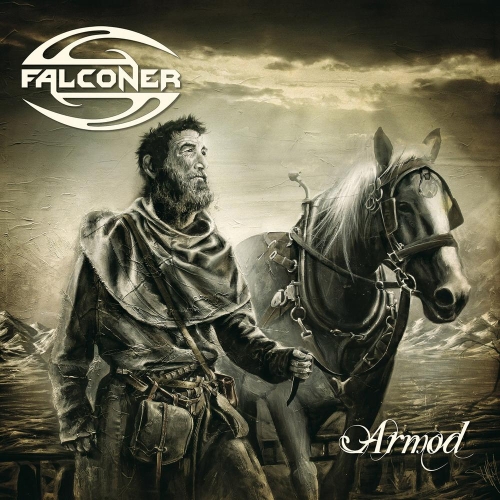
Review: Falconer – Armod


Falconer is a band I’ve been encouraged to listen to for close to a decade now, and a few song samples aside I did a fine job of ignoring them. The term “power metal”, for all the fabulous bands associated with it, is something of a caution sign. I see it and brace myself for either high-pitched whiny singing or operatic vocals excessive to the point of being cheesy, coupled with completely generic, repetitive riffs that without fail give way after the second chorus into the guitar solo equivalent of a mid-life crisis mobile.

Song: Svarta Änkan

Thankfully, Armod is not that kind of power metal album. You might think it is briefly on the first track, but there are early signs of deviation. Within 45 seconds Mathias Blad softly explodes onto the stage with a vocal performance reminiscent of Vintersorg’s work with Otyg. Not too much later (around 1:20) the guitarist changes course, mimicking the vocals with deep and pronounced tones that likewise resemble Otyg. Sure, the structure of the song follows a power metal standard, complete with a slightly overdone guitar solo that you hear coming a mile off, but Mathias’s singing, his choice of Swedish over English, and that folk metal style guitar that accompanies him and takes the spotlight around 5:15 all point to something more.

Song: Herr Peder Och Hans Syster

That something fully manifests in the second track, Dimmornas Drottning, but I’m going to go ahead and post Herr Peder Och Hans Systerinstead, it being my favorite on the album. It lacks the violin that distinguishes Dimmornas Drottning (another feature reminiscent of Otyg), but the vocals and guitar pair up just perfectly from start to finish. And with the exception of a mild reminder in the chorus, you would never know the band had heard of power metal let alone performed it for ten years. It’s about as folk metal as you can get with nothing but guitars, drums and vocals.

Song: Griftefrid

What’s really great about Armod though is that it’s not a folk metal album either. It will go down as folk/power metal, and rightly so I suppose, but what I’m really hearing is a conscious melding of styles. When I say some of the songs remind me of Otyg, it goes beyond a mere coincidental resemblance. I think their music was actively influential on the creation of this album. Likewise, Griftefrid offers up the power of black metal-influenced symphonic acts like Equilibrium because, I think, Falconer actively listens to music of that sort and made a conscious effort to integrate it into their own sound.

Song: Eklundapolskan

The end result is one of the most stylistically diverse albums I’ve heard all year, and it is diverse in the best possible way. This is the sort of album you could have never experienced in the dark ages of the 90s, when people still had to hunt down new music in person and pay hard cash for every release. I could be wrong, but I think Falconer really did their research on this one.

The album’s only down side is a set of “bonus” tracks at the end, comprised of songs from the album proper remixed with English vocals. Skip them, I beseech you. The Swedish vocals are the centerpoint of this album, around which all of the various metal trends Falconer incorporate coalesce.

A Quickie With Lisa Marie: Planet of the Apes (dir. by Franklin J. Schaffner)


(BEWARE!  SPOILERS!)

With Rise of the Planet of the Apes coming out in August, I figured why not go ahead and review the original Planet of the Apes films.   No, I don’t mean the terrible Tim Burton film.  I’m talking about the old school sci-fi series from the early 70s.  For the next five days, I’ll be reviewing each installment of this landmark series of monkey-centric  Let’s start at the beginning with 1968’s Planet of the Apes.

The plot of Planet of the Apes is pretty well-known.  Arrogant earthman takes off from Earth, goes through some sort of time portal, and crash lands at some point in the far future.  Our “hero” finds himself on a planet where all the humans are mute savages and society is dominated by equally arrogant, talking apes.  (“A planet where apes evolved from man!?”)  Eventually, the Earthman reveals that he can speak, he escapes captivity, and — accompanied by his mute concubine — he enters what the Apes call the forbidden zone.  And, once in the forbidden zone, he discovers “his destiny” as old Dr. Zaius puts it.

It’s difficult to review a film like the original Planet of the Apes because the film itself has become a part of American culture.  Even if you’ve never seen the film, you feel as if you have.  Whether you’ve seen the famous ending or not, you know that it features Taylor (Charlton Heston) on his knees in front of the ruins of the Statue of Liberty, raving and cursing while the mute and confused Nova (Linda Harrison) watches.  Everyone understands the significance of such famous lines as: “Take your stinking paws off of me, you damn, dirty ape!” and “Goddamn you all to Hell!” regardless of whether they’ve actually seen them delivered.

Of course, it can be argued that the fact that the film has become such a part of our culture is proof of the film’s quality.  However, I would argue that the proof of the film’s quality comes from the fact that it remains a watchable and entertaining film despite having become such a part of the culture.  It says a lot that a film can stay enjoyable despite being respectable.

Why does the film still work despite  the film’s main selling point — the surprise ending — being neautralized by the passage of tinme?  A lot of the credit, I think, has to go to the apes themselves.  Even under all that makeup, Roddy McDowall as Cornelius, Kim Hunter as Zira, and especially Maurice Evans as the iconic Dr. Zaius all manage to create interesting and intriguing characters who just happen to be apes.  Before long, you forget about the makeup and instead, you’re more interested in seeing how Zaius is going to handle this latest challenge to his society.

That challenge, of course, comes from Charlton Heston.  Everyone is always quick to make fun of Heston as an actor and it’s true that his range was limited.  Frequently, the men he played came across as the type of chauvinistic, pompous heroes that were never quite aware of the fact that everyone was secretly laughing at him.  And it is true that Heston has several of those moments here in Planet of the Apes.  Even his famous final scene is, to be honest, almost painfully over the top. 

And you know what?

In this film, it works perfectly.  I don’t know if an actor has ever been more perfectly cast than Charlton Heston was in Planet of the Apes.  In the role of Taylor, Heston basically spends the entire movie acting like a complete and total pompous ass.  Whether he’s recording a “fuck you” message for Earth at the beginning of the film or if he’s arrogantly dismissing Zaius before entering the Forbidden Zone, Heston comes to epitomize every single thing that we tend to dislike in our fellow human beings.  As played by Heston, Taylor is the perfect clueless hero and a lot of the film’s perverse pleasure comes from watching this paragon of masculinity and superiority repeatedly humbled.

And that, ultimately, is why Planet of the Apes remains a watchable film so many decades after it was made.  Good satire never goes out of style.

Let’s Second Guess The Academy: 1990 Best Picture Nominees


Let’s be honest — the Academy Awards are rarely presented to the best in film.  That’s part of why I love them — you can spend a lifetime debating and second guessing the films, performers, and craftsman. that the Academy annually chooses to recognize with an Oscar.

With that in mind, here’s the first entry in a  little something that I like to call Let’s Second Guess The Academy.

In this post, I’m focusing on the contest for Best Picture of 1990.  In that contest, the Academy nominated five films — Awakenings, Dances With Wolves, Ghost, The Godfather Part III, and Goodfellas.  In the end they named Dances With Wolves the best film of 1990.  Were they right?

You tell me.

And now, let’s make things really interesting by considering which films you would have nominated if those five nominees had never been made.  Vote for up to five and let’s show the Academy how it’s done.

A Quickie With Lisa Marie: Sanctum (dir. by Alistir Grierson)


Earlier this year, I said that — based on the trailer alone — Sanctum appeared to be a terrible film.  At the time, a few people disagreed with me.  “Yes,” they said, “the trailer is a collection of clichés and the plot looks incredibly predictable and the selected dialogue is so tin-plated that it probably attracts radio waves but this is just an adventure film.  STOP BEING SO GODDAMN JUDGMENTAL, LISA MARIE!”

Well, needless to say, that made me shut my little ol’ mouth all nice and quick.

Anyway, Sanctum opened in theaters on Super Bowl weekend and, if I remember correctly, it didn’t even play for a full week.  It was such a box office bomb that it was yanked out and replaced by a Miley Cyrus film on Tuesday.  Again, that’s if my memory serves correctly.  As a result, I didn’t get a chance to see this film in the theaters.  Instead, I had to wait to see it OnDemand.  Was it as bad as I expected?  Well, it wasn’t quite the disaster I was expecting but, at the same time, I still find myself resenting having to admit that I actually “demanded” to see Sanctum.

There are two misconceptions that need to be cleared up about Sanctum.  One is that it’s a James Cameron film.  Cameron is credited as being executive producer because his 3-D cameras were used to film the movie.  (Also, I’ve read that he is a friend of Andrew Wright, who co-wrote the script.)  However, the film itself was directed by Alister Grierson who tries to give everything a Cameronesque feel.  In Grierson’s defense, he succeeds in that all of the characters are forgettable and that you’re never actually surprised by anything that happens on-screen. 

The other is that the film is, as we’re told during the opening credits, based on a true story.  Actually, it’s based on the fact that Andrew Wright apparently likes to swim around in caves and he once got trapped with a party he was leading and nearly drowned.  However, nobody in his party died and I’m guessing that, at some point, someone may have actually said something half-way witty.  As a result, that incident doesn’t really seem to have much to do with anything seen during Sanctum.  As a lover of grindhouse and exploitation films, the blatant falsehood of the “Based on a true story” credit doesn’t bug me.  In fact, it was my favorite part of the film.

Anyway, Sanctum is about a bunch of cave divers who get stuck in a flood and have to swim and dive their way to safety.  It actually starts out pretty well, with a lot of aerial footage of Papua New Guinea and the initial cave diving scenes are genuinely exciting.  But then, eventually, the story has to start up and everyone start to talk and the actors have to breathe some life into the cardboard characters and the whole film becomes so determined to be nothing special that it starts to get genuinely annoying. 

Eventually, the cave ends up flooding and I guess you’re supposed to wonder — who will survive?  Will it be model Victoria (Alison Parkinson), who keeps panicking because she’s a woman?  Or how about Victoria’s boyfriend (played by Ioan Gruffod), who is rich and unlikable?  How about George (Dan Wylde), who is getting older and serves as a mentor/sidekick to the group?  Or maybe it’ll be Luko (Cramer Crain), who is a native who specifically decides to stick around to save all the white foreigners.  Or how about the crusty, veteran diver (Richard Roxburgh, who has apparently never met a line he couldn’t shout into pointlessness) who has a strained relationship with his headstrong song (Rhys Wakefield) who just happens to be trapped down there with them all?

Seriously, who’s going to survive!?

Anyway, if it seems like I’m being really hard on this film, it’s because there’s enough hints of what the film could have been that it makes you resent, all the more, what the film eventually turned out to be.  As I said before, even at its worst, the film is beautiful to look at.  Admittedly, I’m both scared of water and intensely claustrophobic but, even taking that into account, the early scenes of the cave flooding and the characters fighting for survival are well-directed and genuinely frightening.  This is a film that is at it’s best when characters are drowning because it means they can’t speak and we don’t have to listen to anymore of that terrible dialogue.

In the end, Sanctum goes to show that sometimes, you should trust the trailer…