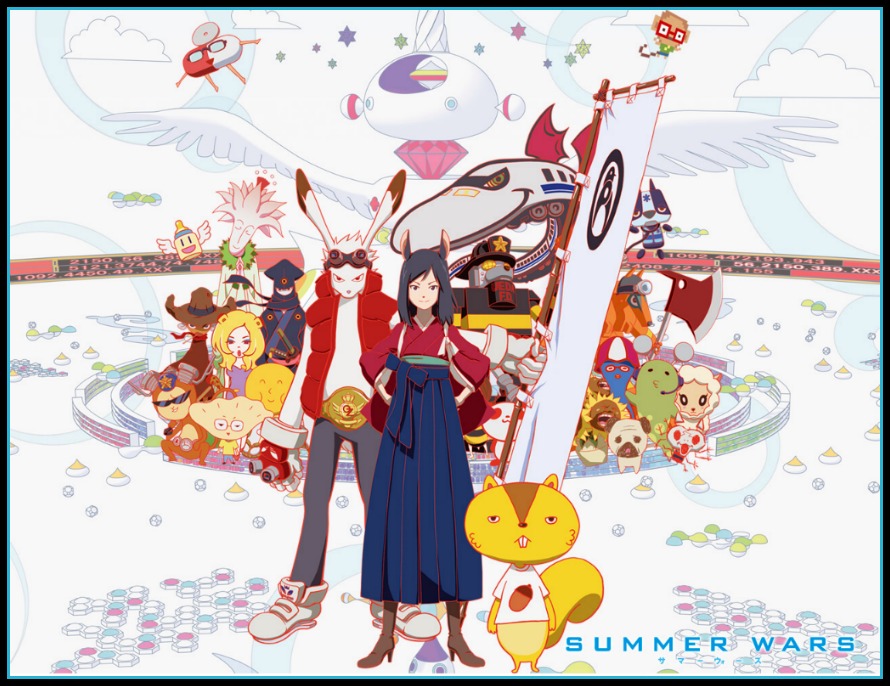
Anime films have been the type to make a major crossover from Japan to the United States when it comes to the US mainstream audience. While anime series typically still remain the realm of the hardcore fans of the genre the stand-alone films get much more love from mainstream critics and audiences in addition to the hardcore. One such film which looks to have made a successful mainstream crossover to the United States was the anime film Summer Wars which was originally released in Japan in August 1, 2009. The film saw it’s American debut at film festivals around the country in 2010, but since I saw it in late May 2011 I consider it a 2011 release for me thus qualifying it as one of the best films of 2011.
Summer Wars was the project of director Hosada Mamoru whose previous stand-alone anime film, The Girl Who Leapt Through Time, was well-received by fans and critics alike. Working from a screenplay by Okudera Satoko (adapted from a story written by Hosada himself), Summer Wars was a nice blend of science-fiction, romance and Japanese slice-of-life. The story begins with the introduction and explanation of the OZ on-line community which becomes a major focal point to the film’s story and the many characters in it. OZ was explained as an on-line, social networking community which has become so ingrained in the world community that everything anyone does was done through it’s portals. Think of OZ was an amalgamation of Facebook, Second Life, iTunes, Netflix and every other social networking site all working under one umbrella. It’s a virtual world where people just don’t socially interact through games and chat lobbies, but also a place where every real-world store has a portal where people could purchase things online. It’s also become a palce where governments from local cities to whole countries have set-up their own areas that would control their cities and countries’ infrastructures. It’s Facebook on steroids.
One of the film’s main characters happens to work as a part-time moderator for OZ. Koiso Keiji also happens to be a 17-year old math whiz who would become instrumental in the story to come. The bulk of the story has Keiji being invited by a high school friend in Shinohara Natsuki (explained to him as a job she needs for him to do) to come with her to her family estate where he ends up meeting the rest of Natsuki’s very extended family and also it’s soon-to-be 90-year old matriarch in Jinnouich Sakae. This part of the film makes up the romance and it’s comedic aspect as Keiji gets introduced by Natsuki to her great grandmother Sakae as her boyfriend and future fiance much to Keiji’s surprise. As Keiji tries to awkwardly play along with Natsuki’s plan the second part of the film’s story kick’s in as he inadvertently assist someone or something into hacking into OZ and begin a sequence of events which threatens every account in OZ, but later on even threaten the world.
This part of the story actually worked quite well due to the recent major hacking of Sony’s Playstation and Qriocity networks which gave hackers access to tens of millions of account users’ info. It was hard not to think about this real-life event as something similar (albeit much more massive and danegrous in scope) occurred in Summer Wars. The fact that the film was completed in 2009 and the Sony hack happened just a month ago was real life copying fiction instead of the other way around. It’s this part of the story’s plot which added to the thrilling aspect of the film as Keiji and others (mostly the extended Jinnouichi Clan he meets) try to take on the cause of the OZ hack (which we quickly learn wasn’t a person but an advanced A.I. program released by the U.S. Army into OZ to test it’s capabilities not knowing it would become self-aware and hard to control).
Weaving in and around this science-fiction are some of what makes some Japanese anime so easily accessible to those outside of Japan. We see a slice-of-life that, at first looks to be typical Japanese daily life, but as the story moves along becomes something that everyone would recognize and have some sort of kinship with no matter their race or culture. It’s the theme of family togetherness even through adversity and the occassional disagreements between family members. It’s here we see Natsuki’s great grandmother Sakae show the need for the family to always find time to sit down and eat dinner together no matter what problems each and everyone may be having. It’s these very serene, at times quite hilarious, scenes of family life with the Jinnouichi Clan that Summer Wars will tug at audiences’ heartstrings and cause more than just a few to tear up. Some have said these scenes were too maudlin and corny, but I look at that complaint as people trying to project their own cynical nature on what was really an honest look at family life and how keeping a family together through adversity (both big and small) becomes a reward unto itself.
The Japanese voice cast did quite a good job bringing their animated characters to life from the main leads in Keiji, Natsuki and Sakae right up to the little children who added some levity to the situation. While I try to always watch anime with the Japanese language on with English subtitles for Summer Wars I also watched it with the English-voice dubbing. I was surprised to hear that the English-dubbed version was not as bad as most anime dubs and was actually quite good. Summer Wars looks to boast a who’s-who of English dub voice actors which probably lent itself to a quality dubbing in the end.
Summer Wars was produced by one of Japan’s major animation studios with Madhouse and the look of the film bears this out. The virtual world which made up OZ looked beautiful and made great use of CGI-animation. The avatars used by OZ account members were inventive and a menagerie of characters that all looked to be very distinct each and everytime a new one came on the screen. The animation for the real-world aspect of the film used traditional hand-drawn animation. While it didn’t have the sheen and flash of most anime series the flat-look and natural color scheme used for scenes when outside OZ lent a sense of realism and the natural that made it easier to get into the film. These two contrasting animation styles really helped in pointing out just how different OZ was to everything else.
Hosada Mamoru’s direction keeps everything from becoming a jumbled mess as the film juggles not just two major plot threads concurrently but smaller subplots involving certain individual family members of the Jinnouichi Clan. It’s a testament to his handling of the film that we’re never lost as the film’s story unfolds. Whether it’s the fake relationship between Keiji and Natsuki becoming something more real to the prodigal son coming back to the family after a self-imposed exile of ten years right up to a high school baseball tournament involving one of the family’s younger members who also happens to be a star pitcher.
In the end, Summer Wars should be seen as a landmark film that officially heralds the arrival of one of anime’s great filmmakers. With the untimely passing of Satoshi Kon there’s been a scramble within the anime community to find his heir apparent. Hayao Miyazaki will continue to be one of anime’s godfathers and pillar of quality work, but amongst the younger generation there was really no one stepping up the way Satoshi Kon did in so short a time. I think with Summer Wars it wouldn’t be too farfetched to say that Hosada Mamoru has also stepped up to join Miyazaki as one of the creative geniuses in the anime world. It also shows younger anime filmmakers that there is success to be had doing anime outside the usual mecha, mahou shoujo and shonen series which remains the backbone and meal-ticket for animation studios in Japan.
Summer Wars is an anime film that I’d highly recommend to all whether they’re fans of anime or have no idea what an anime was. This anime is that good and one that deserves to be called just film without the anime tag. It will be interesting to see what Hosada Mamoru comes up with next. I, for one, can’t wait to see what it is. Also, I recommend people watch this on Blu-Ray. The difference in how the animation comes across between Blu-Ray and DVD is leagues apart.
Original Japanese Trailer
 Through the Shattered Lens