The Bottom Line
A top notch multi-player experience sometimes marred by its terrible community.
Unfocused Ramblings
When a friend of mine first told me about League of Legends during its Beta period in 2009, my interest was piqued, but I’d been drawn in by World of WarCraft, and it wasn’t until early in 2010 when I finally took the time to download the free client and begin playing League of Legends with my friends. I wish I hadn’t waited. Even years after I stopped playing WarCraft 3 or The Frozen Throne for their own merits, I had continued to occasionally play a game or two of Defense of the Ancients: All Stars. As powerful as the World Editor was in WarCraft 3, there were still always going to be limitations on how far Defense of the Ancients could progress solely as a custom map within a game published by someone else. The natural evolution of course was for some of the developers of Defense of the Ancients to go to work for Riot Games to produce their own title; an experience totally under their control but based on the same style as the wildly successful custom maps that preceded it.
If you liked Defense of the Ancients, the odds are pretty strong that you’re going to love League of Legends. It incorporates most of the things that made Defense of the Ancients great, and eliminates some of the inherent weaknesses of working within a real-time strategy engine. After all, WarCraft 3 is designed to have a little inherent command latency, and the engine itself limits what kinds of spells and special powers (as well as the physical skinning of) any and all heroes. Moreover, the core game-play statistics can’t be changed for the benefit of a single custom map (obviously), so League of Legends is a much more polished experience. Now we have Ability Power as a core game-play stat to increase the power of spells and helping to balance the scales between powerful physical damage heroes and heroes with ridiculous spell abilities in the late-game, among a thousand other things.
Okay, for the rest of you who didn’t waste many hours of your lives playing Defense of the Ancients, what is League of Legends? It’s a duel between two teams of either three or five champions supplemented by a limitless army of minions. Each champion is a heroic figure with five unique special abilities (as well as a variety of “core” game statistics, like movement speed, attack range, damage dealt, total armor, etc.) and your objective is to breach the defenses of the opposing army by knocking out their defensive towers to gain access to their base, and ultimately, to destroy the opposing Nexus, a capitol building, which ends the game in victory. Your Champions gain experience points to progress through 18 levels (at each level gaining or improving one of their special abilities) as well as harvest gold pieces which are used to buy items that enhance your Champion in various ways. Along the way to victory or defeat, obviously, you will be opposed by the Champions of the other team, controlled by other human beings. They represent your true opposition, and you’ll have to overcome them if you plan to win the day.
Playing matches levels up your Summoner (that is, the personification of the player) and allows you access to a tree of “Masteries” which offer little bonuses to various things that your Champions can do, as well as access to customizable “pages” of Runes. Each match you select a Rune page from your book, which provides fully customized benefits to your Champion such as increased Mana regeneration, a higher chance to dodge enemy attacks, and more. Your multiplayer games also net you access to “Influence Points” which can be used to buy new Champions as well as Runes inside of the League of Legends store. You can download the client and play the game for free even to this day, but Riot also allows players to purchase “Riot Points” from their store which can be used to purchase champions, alternate skins for them, and other bonus content within the store as well. New content is added very frequently, and the product is at a consistently high quality, which really speaks well of Riot Games and its staff of developers.
The Big Question
Aside from ‘why did it take even this long to create a title like League of Legends‘ ? The question absolutely must be: Where do we go from here? It’s a common theme amongst my game reviews; I know. It’s an important question, though. League of Legends is an impressively complete experience. The developers have adequately explored core game-play mechanics, and the game and its objectives themselves are somewhat non-negotiable. Obviously we can continue to enjoy new Champions and Items eternally, but this isn’t truly a source of growth. A third question might be, “where did all the trolls come from” ? One thoroughly maligned aspect of League of Legends is the community, many of which are players that came from Defense of the Ancients, who are a surly, foul-mouthed lot. It’s hard to defend the community, and people with a thin skin might want to avoid this game.
Overall Game-Play: 9.0
The game play very occasionally suffers from graphical or camera glitches. Since they’re always correctable (if only by recalling to base in some cases) it’s not a game-breaking problem, but it’s also the only real criticism I have for a game-play system that is very tight for the most part. Because the interface is designed intentionally for the player to command only their own Champion, you don’t end up targeting another unit and losing control of your hero (as could happen frequently within the WarCraft 3 engine). The four ‘active’ hot keys are consistent amongst every Champion (Q, W, E, R, matching the skills from left to right on your interface) and aren’t competing with internal game commands (as occasionally happened in WarCraft 3). In addition, there’s no inherent latency, so commands are executed crisply and cleanly (barring lag, of course) which makes so-called ‘skill shots’ (that is, abilities which must be aimed and strike the target to take effect) much more common and much more use-able than they ever were before.
The match-making system, champion selection screens, and other framework for the game also deserves a notable mention. Although it’s gone through a couple of iterations by now, the system works very well. New users will learn their way around quickly.
Story 6.0
Although the game obviously has no single player aspect to it, the creators still actually took the time to create a world in which the game is set. Each Champion comes with their own piece of back-story that fits into a larger overall narrative about a world in turmoil, the various nations within, and their larger-than-life heroes – who obviously bring their talents to the institutional League of Legends to test themselves against other such powerful figures. It’s obviously not a focus of the title, but the story is cohesive, and to my mind, appreciated. It’s nice to have a little understanding of who my favourite Champion is, how s/he gained their powers, and what their goals are. Of course, it’s all just fluff, and you can ignore all of the story elements of the game and never miss a beat in terms of game-play.
Graphics 7.0
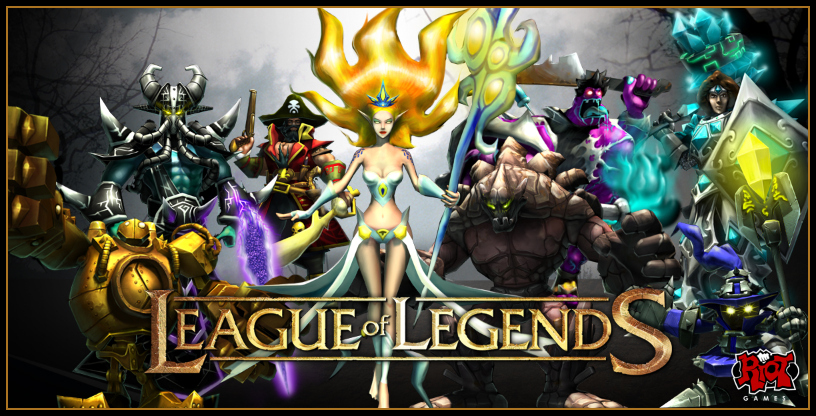
The graphics are of the cell-shaded variety and look very nice. The most impressive graphics are, of course, the skins of the Champions themselves. Given how many custom looks are available for your Champions and the sheer number of Champions that now are available in the game, I have to give a little nod to Riot. Of course, there’s no real place in the game for incredibly flashy or ultra-realistic graphics, so you won’t see anything in-game that’s going to blow you away. That having been said, all of the models are nicely crafted, and the game’s graphics definitely have a polished feel. The graphical performance is smooth and doesn’t break, and the look and ‘feel’ is consistent across the character models despite their diversity.
Sound 7.0
The sound in this case comes from combat and spell sounds, a relatively quiet announcer (who nonetheless is unfailing in her ability to identify key gameplay situations), and a simple score. Oh, and the unique voice acting for every single one of the League’s champions. Obviously this last part is what you’re going to deal most with, as your Champion responds to everything from you initially selecting them before the game begins to moving about, attacking, or casting spells. We’re not treated to an epic score in the background that fires our passions as we play, but the sound, like the graphics, is a polished effort that doesn’t disappoint.
Multi-Player 9.0
Well, in this case, there is literally no single player aspect to the game, so I suppose this could stand as an overall score for the title. Personally, I find little to complain about. The most important thing for you to know, though, is that Riot is dedicated to keeping this game updated, changing, and improving. I touched on this briefly in my open, but it’s important to expound on the point. Riot patches League of Legends frequently, tweaking abilities and items in order to provide the most balanced experience. Just as importantly, the stream of new Champions is very steady, which ultimately is the only method by which the game can expand. Obviously, there’s not much (if anything) that is going to change about the way the game is played from start to finish, so everything is in the details here.
 Through the Shattered Lens