Review: The Wild Geese (dir. by Andrew V. McLaglen)


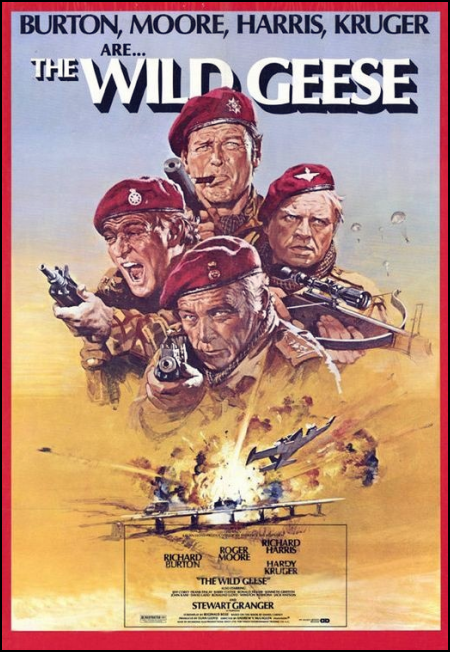
1978’s action war film The Wild Geese is an adaptation of Daniel Carney’s unpublished novel about a group of mercenaries on a mission during the turbulent revolutionary times that beset Central Africa during the 1960s and early 70s. The film features an all-star cast of British actors, a true who’s who of the era. Under the direction of Andrew V. McLaglen, The Wild Geese manages to be an action-packed and well-told film with memorable performances.

The character Colonel Allen Faulkner, played by Sir Richard Burton, is loosely based on the real-life mercenary legend Michael “Mad Mike” Hoare. Hoare not only inspired this central character but also served as the film’s military and technical advisor. Adding to the film’s authenticity, one of the actors portraying a mercenary, Ian Yule, had served with Hoare in his mercenary company. This infusion of real-life experience gives the film a vivid sense of art imitating life and lends credibility to its portrayal of mercenary warfare.

The story begins with a meeting between Faulkner and British banker Sir Edward Matheson about a rescue mission in the fictional Central African nation of Zembala. The first third follows Faulkner’s recruitment of a 50-man mercenary team, including his reluctant old friend Rafer Janders (Sir Richard Harris). The film portrays the mercenary company training and preparing for the mission before being inserted behind enemy lines. The second half details the rescue of their target: a deposed African leader about to be executed by the man who overthrew him.

During the second third of the film, the action intensifies. Though tame by today’s standards, the sequences were energetic and well-shot for their time. The mercenaries are shown not as idealized heroes but as pragmatic soldiers who use ruthless tactics—such as cyanide gas and poisoned crossbow bolts—that may shock modern audiences. This realism reflects Hoare’s influence and presents mercenaries as professionals doing a dangerous job for pay, blurring the moral lines of warfare. Betrayal during the mission tests their survival in enemy territory.

Burton and Harris deliver excellent performances as hardened war veterans, while a younger Sir Roger Moore adds roguish charm as the Irish pilot Shaun Fynn. Strong supporting roles include Hardy Kruger as Pieter Coetzee, an initially racist Afrikaner who gains new perspective on the continent’s upheaval, and Stewart Granger as the principled banker Matheson.

Though relatively small budgeted compared to other war epics of the era, The Wild Geese carries an epic feel and should have appealed more to American audiences. Unfortunately, financial difficulties with the production company affected its U.S. release. Over time, video and DVD releases built it a cult following among war and mercenary film fans, a subgenre often dominated by lesser films. McLaglen’s straightforward direction keeps the film’s pacing steady, and the story balances action with political and philosophical themes in its final act.

The Wild Geese stands as a rare gem in war cinema that delves into a little-known subgenre. With strong performances by knighted British actors, a former Hitler Youth, and real-life mercenaries as extras, the film distinguishes itself from the many flawed war movies flooding late-70s and early-80s cinema. Its roots in actual mercenary experiences, highlighted by Hoare’s real-life involvement and character inspiration, make it a compelling and underappreciated classic for aficionados of the genre.
Review: Night of The Hunted (dir. by Jean Rollin)


When, at that age of 22, I first saw Jean Rollin’s Night of the Hunted, I cried as much as the first time I saw Titanic at the age of 12.  In both cases, the tears were inspired by a “doomed” love story.  The main difference between the two films is that I don’t cry over Titanic anymore.  But Night of Hunted still brings me to tears every time I see it.

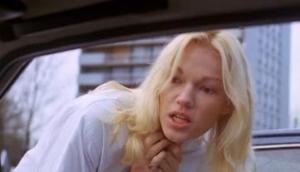
The film opens with the image of a terrified young woman (Brigitte Lahaie) running through a dark forest until she eventually reaches a highway.  She’s picked up by a young man (Vincent Gardere) who, being a guy, proceeds to take her back to his apartment in Paris.  She confesses that she can’t remember who she is, why she was running, or even being picked up by the young man in the first place.  Saying that she needs some sort of memory to fill the emptiness, she proceeds to make love to Gardere.  Gardere, being a guy, doesn’t object.

However, he does make the mistake of later leaving Lahaie alone in the apartment afterwards.  As soon as Gardere leaves, Lahaie forgets ever meeting him and why she’s even in the apartment in the first place.  Even as she tries to figure out what’s going on, the apartment is visited by a doctor who tells Lahaie that she is his patient and that she needs to go with him to a “clinic” where he can treat her.  No longer remembering her encounter with Gardere, Lahaie agrees.

Needless to say, the “clinic” turns out to be what Lahie was so desperately trying to escape just a few hours before.  We learn that Lahie is merely one of several hundred people who, months earlier, were exposed to a biological warfare experiment gone wrong.  Now, as a result, her brain is slowly dying one cell at a time.  The clinic is actually a government-run prison where she and her fellow victims have been sent to be forgotten about and to eventually die.  Lahie finds herself surrounded by men and women who, as they slowly lose everything that made them unique, revert back to their most primal instincts.  While Gardere tries to find her, Lahie struggles to survive just one final night in both the clinic and in the prison of her own fading mind.

Director Jean Rollin is best known for his sexually-themed vampire films but the Night of the Hunted is not as huge a departure for him as it may first seem.  One of Rollin’s reoccurring themes is the importance of our memories, no matter how idealized they may sometimes be and this theme is present in every frame of Night of the Hunted.

The lead role is played by Rollin’s frequent muse and collaborator, Brigitte Lahaie.  Because the majority of Lahaie’s career has been spent making adult films, she’s never gotten the due she deserves as an actress.  Playing a difficult role here, Lahaie is the movie’s greatest strength.  She brings a real sincerity and empathy to her role and its impossible to imagine this movie working without her.  If nothing else, this movie is a wonderful display of Lahaie’s often underrated talent. 

Rollin made the film for very little money and used a cast made up almost entirely of nonprofessionals and French adult film veterans.  So, yes the film does sometimes have a grainy look and the editing is definitely jagged.  When the characters shoot at each other, it is obvious that they’re firing toy cap guns.  To me, however, this works in the film’s favor.  The raw quality of the film perfectly mirrors that constant fear and confusion that Lahaie and her fellow prisoners live in.  No, the film is not technically perfect but a flawed masterpiece is preferable to uninspired technical perfection any day.

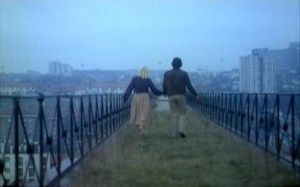
Despite working with a miniscule budget, Rollin captures some haunting images in this film.  Never has Paris looked as desolate as in this movie.  One of Rollin’s trademarks has always been his own fascination with architecture and, as a result, the cold skyscraper where Lahaie is held prisoner almost becomes a character itself.  I’ve always considered Jean Rollin to be horror cinema’s equivalent to Jean-Luc Godard and, with its images of a sterile city run by passionless autocrats, Night of the Hunted brings to mind Godard’s Alphaville.

 The film’s most haunting image comes at the end and it is this image that brings tears to my eyes every time.  Whatever flaws the film may have, Night of the Hunted has one of the best final shots in the history of cinema.  Even if everything preceeding it had been worthless, this movie would be worth sitting through just for the stark beauty of the final shot.  Night of the Hunted ends on a note that manages to be darkly sad and inspiringly romantic at the same time.  It’s an ending that makes Night of the Hunted one of the most romantic films of all time.

Night of the Hunted was released in 1980 and, like the majority of Rollin’s films, was never released in the States.  Redemption, however, has released it on DVD (which is how I first saw it in 2008.)   While the transfer is undeniably rough, that actually gives the movie a documentary-like quality that works in its favor.  The film is in French with English subtitles.   As is so often the case with subtitles, a lot of the film’s nuance is sacrificed in translation.  Fortunately, the combination of Rollin’s visual sense and Lahaie’s lead performance more than makes up for it.