Here are the latest teasers for AMC’s Fear the Walking Dead! As you can see, the walkers have arrived! (The show itself will arrive in August.)
Okay, probably not.
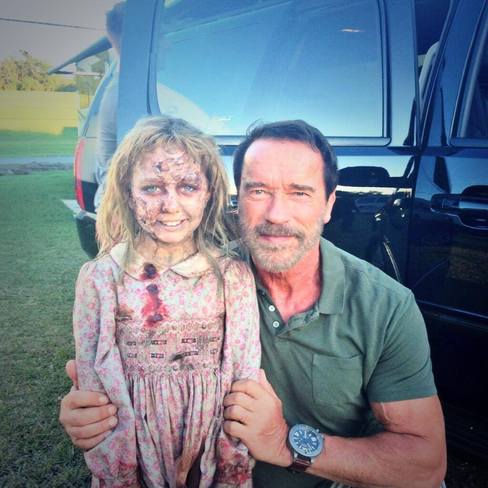
But still, the former governor of California has been getting some unexpectedly good buzz for his performance in the upcoming film zombie film Maggie. In a role that reportedly emphasizes honest emotion over crowd-pleasing action, Schwarzenegger plays a small-town farmer whose daughter (Abigail Breslin) has been infected with a zombie virus. The trailer, which was released today, seems to hint that Maggie is going to be a bit more thoughtful than your average Arnold Schwarzenegger zombie film.
Maggie is scheduled to be released on May 8th and, hopefully, it won’t be too overshadowed by the 2nd weekend of Avengers: Age of Ultron.
(After reading my review, please be sure to check out Arleigh’s thoughts on Zombi 2!)
Two questions:
1) Do you love Zombie movies?
2) Have you seen Lucio Fulci’s 1979 film Zombi 2?
If your answer to the first question was yes, then you should definitely have had the same answer for the second. Along with launching the long and extremely influential genre of the Italian zombie film and being one of the best zombie films ever made, Zombi 2 is also one of the best horror films ever made.
First off, a few words about that title. Zombi was the Italian title for George Romero’s Dawn of the Dead. Zombi was a huge hit on Italy and, in that shameless way that is beloved by all Italian horror fans, producers Fabrizio De Angelis and Ugo Tucci decided to take advantage of Zombi‘s success by naming their upcoming zombie film Zombi 2. And, while I have always liked to think of Zombi 2 as being a prequel to Romero’s Dead trilogy, Zombi 2 is actually in no way related to Dawn of the Dead.
It has often been assumed that Zombi 2 was directly inspired by Dawn of the Dead. While Romero’s film certainly provided more of an influence than just providing a title, Zombi 2 was actually in production before Dawn of the Dead opened in Italy. And, ultimately, Zombi 2 is a far different film from Romero’s film. Eschewing the social commentary and satire that ran through Dawn of the Dead, Zombi 2 is instead a work of pure horror. They’re both excellent films but Dawn of the Dead ultimately inspires debate while Zombi 2 inspires nightmares.
Opening with a previously dead body being shot in the head as it slowly sits up on a stretcher and ending with a haunting vision of apocalypse, Zombi 2 is coated in a palpable atmosphere of doom. A boat floats into a New York harbor and the two cops who investigate are greeted by a lumbering and hungry corpse. Tisa Farrow plays the daughter of the boat’s owner. When she and a reporter (Ian McCulloch, giving a likable and bemused performance that often finds him playing straight man to a bunch of decaying corpses and which provides a nice run up for his openly subversive performance in Zombie Holocaust) team up to find her father, their investigation leads them to an isolated island where the haunted and alcoholic Dr. Menard (Richard Johnson, bringing so much gravity and self-loathing to his role that he literally elevates the entire film) is struggling to deal with an outbreak of zombies. Along with a boat captain (Al Cliver) and his girlfriend (Auretta Gay), McCulloch and Farrow try to escape the island before they end up joining the ranks of the undead…
As a director, Lucio Fulci was known for bringing his own unique visual flair to the horror genre. Fulci, perhaps more than any of the other great Italian horror directors working during the Italian horror boom of the 80s and 90s, literally brought nightmares to cinematic life. As a result, Zombi 2 is probably one of the most visually memorable zombie films ever made. From the minute that McCulloch, Farrow, Cliver, and Gay arrive on the island, you can literally feel the oppressively hot wind and dusty wind that blows through every scene. When the dead walk across the desolate landscape, Fulci emphasizes the decayed state of these zombies, forcing the audience to consider just how fragile the human body truly is. The fact that the undead manage to be so pathetic and so dangerous at the same time only serves to make them all the more frightening. When a group of conquistadors come back to life, Fulci films it from their point of view and, for a few minutes, we literally are one of the undead, clawing our way out of a grave. Needless to say, Fulci doesn’t shy away from the gore of a zombie apocalypse either. His zombies are ravenous and destructive. The Walking Dead may be bloody but it’s got nothing on Zombi 2.
Along with the conquistador scene, Zombi 2 is especially remembered for two scenes, both of which showcase the best of both Fulci and Italian horror.
One is the scene where Dr. Menard’s wife (Olga Karlatos) is menaced by zombies after taking a shower. Even after she slams the bathroom door, a zombies hand breaks through the door and grabs her by the hair and starts to pull her through the jagged hole in the door. As she is slowly pulled to her doom, her eyeball is pierced by a splinter of wood. It’s definitely an over-the-top moment, the type of thing that we expect from an Italian horror film. But, as over-the-top as it may be, it’s also incredibly effective and terrifying. It’s a scene that lets us know that there is no escape from our fate. It’s a scene that reminds us that the zombies will always win because there is no way to lock out death.
(In fact, it’s such an iconic scene that almost all of Fulci’s subsequent films would feature a character losing an eye. Adding a certain poignancy to his trademark scenes of ocular destruction was the fact that Fulci, himself, was diabetic and reportedly often feared that he would lose his eyesight.)
The other is a scene that always seems to bring a smile to the face of anyone who see it. That’s the scene where a zombie gets into a fight with a shark while Auretta Gay swims nearby. Again, it’s a bit ludicrous but it’s also incredibly effective. If nothing else, it invites us to wonder how — if a shark can’t beat a zombie — can there be any hope for humanity?
The answer, of course, is that there isn’t. Ultimately, in the world of Fulci’s film, whether by causes natural or unnatural, we’re all destined to become one of the zombies.
(This review is cross-posted over at Fourth-Day Universe where all of October has been Zombie Month!)
So, I think it may be fair to say that of most of the posters on this great site, I am probably the one who least enjoys the horror genre…or at least is never as excited about it as everyone else. It isn’t that I do not like horror films – there are quite a few I really love – but I just expect a lot from them. Probably – unfairly – more than I expect from other films. Why? Because I honestly think that when done right, horror films can be some of the most emotionally affecting films from any genre. But when done wrong – as I think far too many of them are – it just feels cheap and manipulative – and as someone who loves film, who loves how they can generate empathy and tell interesting stories, it always just feels like a slap to the face.
This love/hate relationship usually makes me hesitant to watch most horror films, which of course is an issue come October. This month is wall to wall horror from 12:01AM on the 1st – to midnight on Halloween. With this comes the pressure to watch a ton of horror films, and although in the past I have watched a few, I’ve never taken part in any sort of marathon that so many bloggers partake in this time of year…until now. This is part one – of what I hope will be a month long series – of quick reviews for horror films I watch this month. I hope to watch at least one a day.
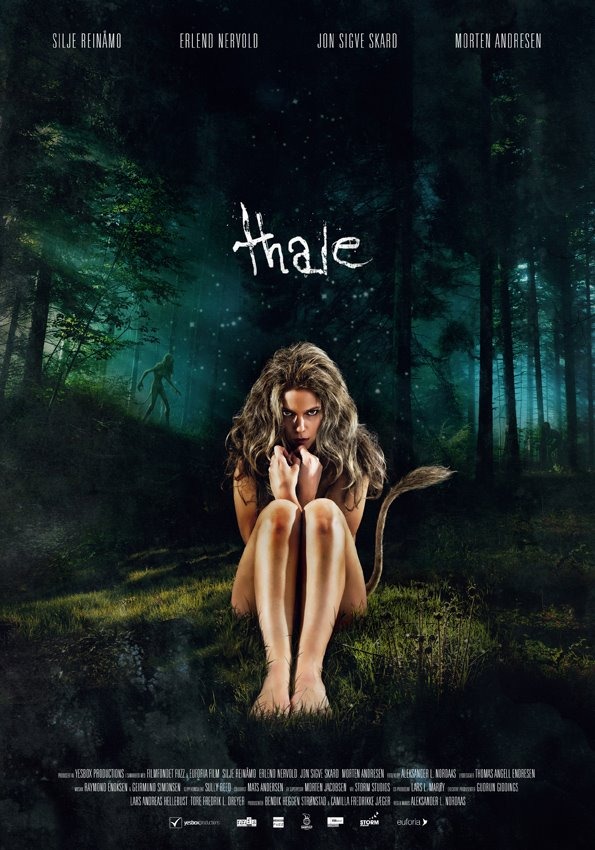
October 1st: ‘Thale’ (dir. Aleksander Nordaas)
A very low budget Norwegian fantasy/horror film, with a lot of interesting ideas, that sadly doesn’t execute on enough of them to reach any level of greatness…which I think was possible.
‘Thale’ is about two friends, working in a crime scene cleaning service, who stumble upon a hidden basement at one of the locations they have been hired to clean. Within they find a lab of sorts, and a beautiful young woman who is unable to speak – and is most certainly more than she appears to be. The result is a rather unique horror film with fantasy elements; one that thrives on atmosphere for the first hour or so, building a genuine level of suspense and mystery. It is an intriguing story, one that is slow to build but never boring. There is certainly a lot under the surface.
The only real issue I had was that there is narration throughout that tries a bit too hard to add depth to the story, both narratively and thematically, without much success. Mainly because the exposition within would benefit more from a ‘show don’t tell’ approach – and also because the actual narrative comes off as so simple that many of the themes expressed through the narration have nothing to do with what we have actually been shown.
This isn’t too big of an issue really, and I can’t fault it for trying to give more meaning to the story, but had it executed on some of the ideas it alludes to under the surface than maybe this wouldn’t have been an issue at all – especially if it had been a half hour longer, and explored the fantasy element in more detail.
Still, the performances are very good and – given its very low budget – so are the effects and overall production. It certainly has its flaws, but it still warrants a recommendation.
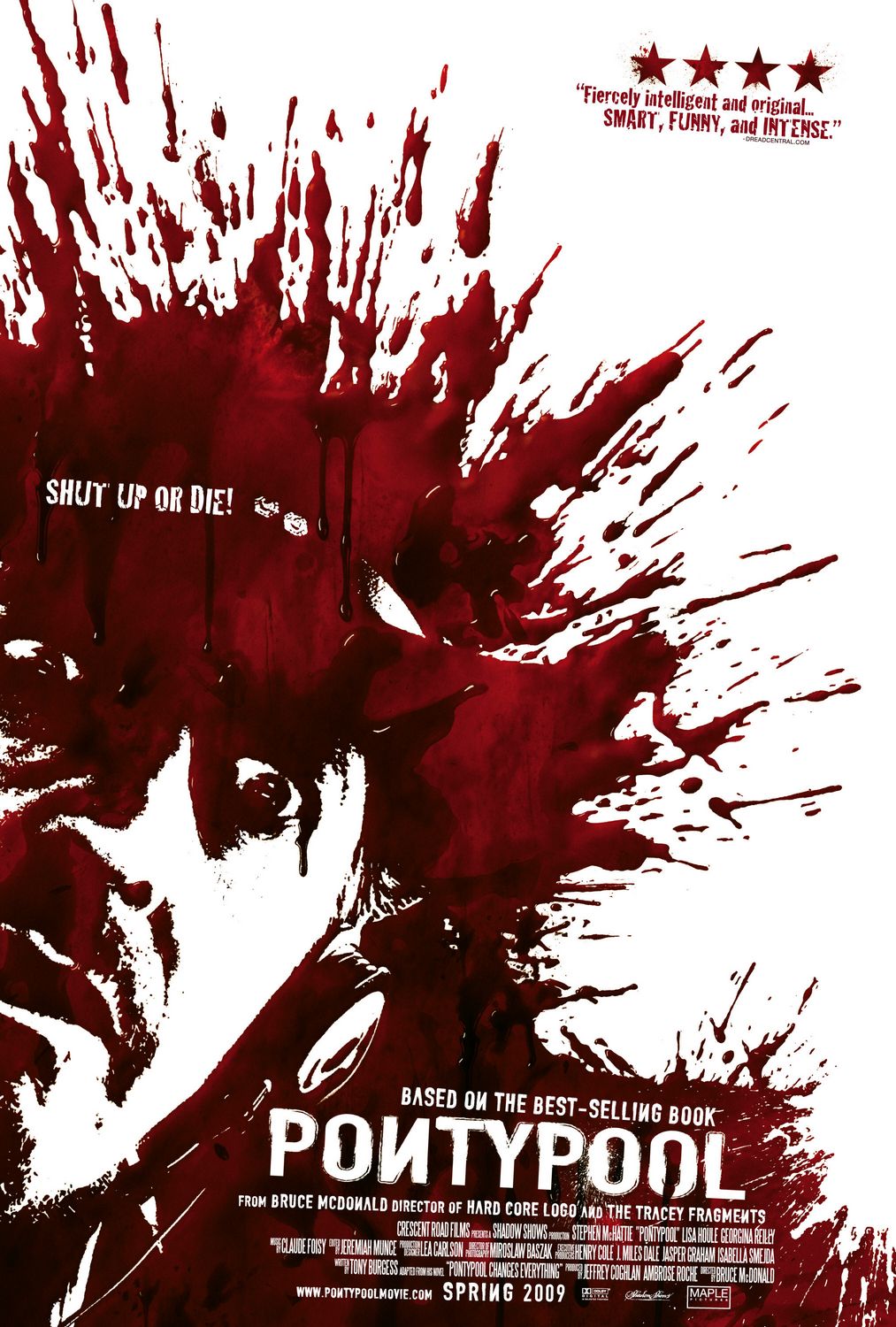
Oct. 2nd: ‘Pontypool’ (dir. Bruce McDonald)
‘Pontypool’ is a mostly lean – though often convoluted – and creative horror film that builds slowly and contains just the right dash of humor. It is at times essentially ‘Welcome to Night Vale’ in film form.
It stars Stephen McHattie as an ex-shock jock who has reached a point in his career where he is stuck doing an early morning radio gig in a small Canadian town. He is quick to try to cause a stir, but his producer reminds him that the listeners just want to know the weather. As the morning slowly passes by the station begins to get weird reports of people, herds of people, swarming the streets. Whats seems to them to initially be a joke begins to turn into a life or death emergency situation where a virus is infecting the town, keeping the workers at the studio locked indoors, trying to figure out how it all started.
This isn’t the scariest horror film you will ever see, neither is it the most suspenseful – yet the development of the story, the unraveling mystery and the urgency of the performances make it an absorbing viewing experience. Things do start to get a little convoluted as we begin to better understand how the “virus” infecting people is being spread. The film seems to be making it up as it goes, and ironically it can’t seem to think of the rights words to explain what is actually happening.
But it does managed to create an interesting subtext on how language has been simplified and diminished by gossip, social websites and the media. It would also probably benefit from multiple viewings. But for now, I recommend you at least watch it once.
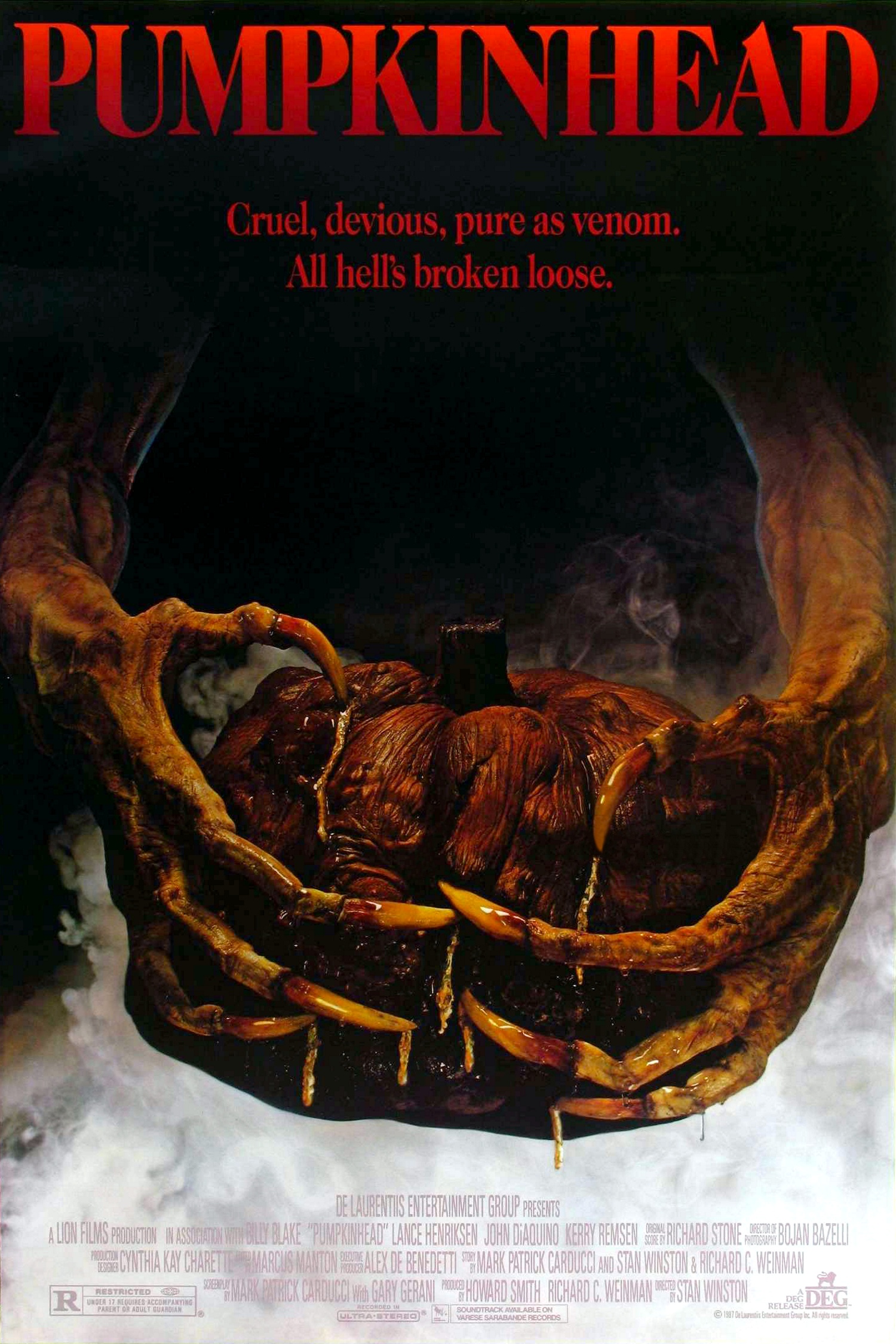
Oct. 3rd: ‘Pumpkinhead’ (dir. Stan Winston)
‘Pumpkinhead’ is a creepy, cliche and cheesy as hell horror film about revenge, that manages to overcome all its faults with its brilliant creature design, a great central performance, and an emotional core that gives all the supernatural violence some resonance. The result isn’t a masterpiece – by any stretch – but it is a damn near perfect horror film for Halloween/October – especially with its eerie supernatural aesthetics.
The film stars Lance Henriksen as Ed Harley, a single father raising his son on a farm in the south. One day a group of teens (including a few blondes and a douchey “bad boy”) arrive in town. Their destination? A cabin in the woods…of course. On their way they encounter Harley at a local store he owns, which accidentally results in his son being killed by one of the teens in a dirt bike accident. The group heads for the cabin, fearing the repercussions, while Harley tracks down a creepy old lady who, according to local legend, can summon a demon-like creature to avenge the wrong doing done to a man.
From there we get a rather unoriginal creature feature – as the demon, called Pumpkinhead, hunts down the group of teens one by one. What kept this interesting, for me, was the structure of the events of the film and the development of Henriksen’s character. Henriksen is a great actor, and the bond that is built between him and his son, and the emotions he displays as he struggles with his son’s death and the revenge he seeks, manages to ground the film and gives it enough of an emotional relevancy to excuse the cheesiness of the supernatural horror elements – and some truly shitty dialogue.
On top of that are the great spooky horror aesthetics and atmosphere – moody lighting, fog…pumpkins – as well as the awesome design of the Pumpkinhead by special effects legend Stan Winston (‘Aliens’, ‘Terminator’) – who actually directed the film. It all adds up to an above average horror flick that I recommend everyone watch this October.
I did not see Warm Bodies when it was first released back in February. I was certainly aware of the film, having been bombarded with the trailer since December of 2012. and I assumed that I would see the film but, for whatever reason, I simply could not work up the enthusiasm necessary to actually see it.
Perhaps it was because the concept — a zombie love story — simply seemed too cutesy and, as much as I love zombie movies, they’re not exactly what I want to watch on Valentine’s Day. The fact that the movie was being called a “zombie twilight” didn’t help. (Don’t get me wrong. The Twilight films are a very guilty pleasure of mine but that still doesn’t make the comparison a selling point.)
As a result, as much as I thought I would end up seeing Warm Bodies in the theaters, I never got around to it. Instead, I waited until Warm Bodies premiered on Cinemax earlier this month to watch it and you know what?
I was surprised to discover how much I loved it.
Warm Bodies takes place after the zombie apocalypse has decimated America. The undead wander through the ruins of society while the few remaining humans have barricaded themselves in a heavily guarded enclave. Leading them is Col. Grigio (John Malkovich) who continually tells his citizens that the only way to survive is to kill every zombie that they see. As Grigio explains it, the zombies may look human but they have no humanity left.
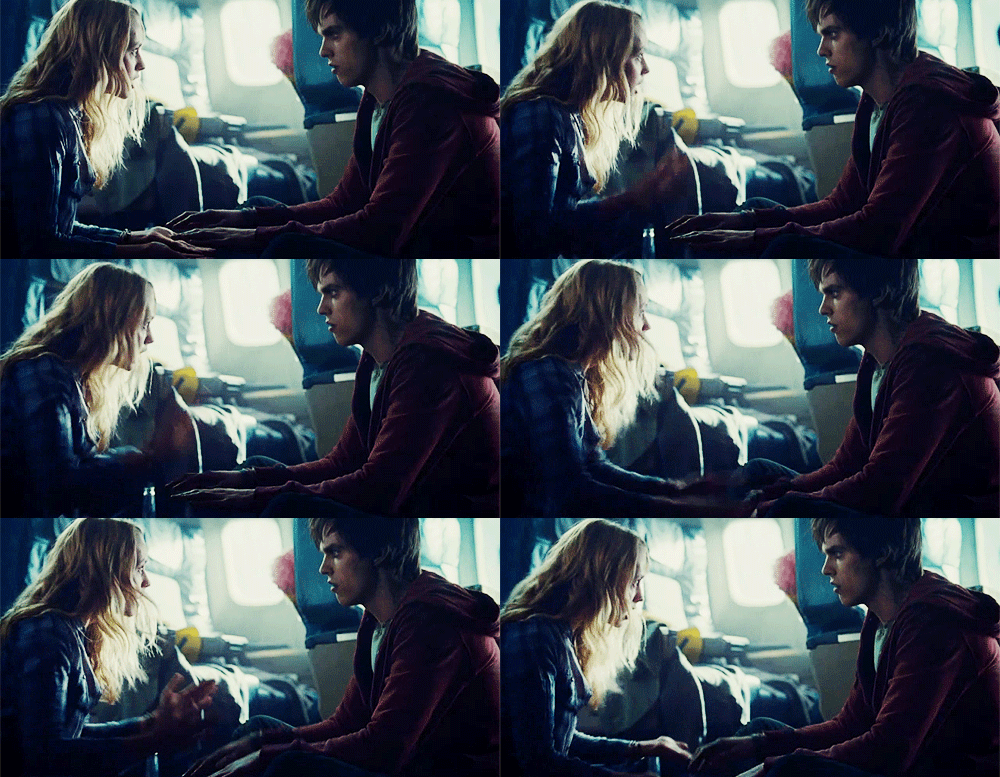
This would probably come as news to R (Nicholas Hoult), a zombie whose day consists of wandering around an airport, looking for people to eat, and occasionally acknowledging his friend M (Rob Corddry) with a grunt. R spends most of his time thinking about how bored he is with being a zombie and wondering who he once was. That’s one reason why R enjoys eating brains because, by doing so, R gets to enjoy the memories of his victims and, for just a brief few moments, he can know what it’s like to be human.
Things change for R when he and a group of zombies come across humans that are searching the city for medical supplies. R spots one of the humans, Julie (Teresa Palmer), and finds himself immediately drawn towards her. However, R is also shot in the chest by Julie’s boyfriend, Perry (played by Dave Franco, the younger brother of my beloved James Franco). R responds by attack Perry and eating his brain, which causes R to experience all of Perry’s memories of Julie. Now in love with Julie, R saves her from the other zombies and takes her back to the airplane where he makes his home.
As Julie and R bond, R finds himself slowly becoming more and more human. Yes, that’s right — the cure to the zombie apocalypse is love. Now, that may sound predictable or simplistic and I guess it is. But you know what? I’m a romantic and I loved it! It helped that both Palmer and Hoult have a really likable chemistry. Even before R’s heart starts to beat again, they make a really adorable couple.
Unfortunately, the more R tries to act human, the more the other zombies want to eat him. This is especially true of the Boneys, zombies who have decayed to the point of just being skeletons and who prey on anything that happens to have the slightest trace of a heartbeat. Meanwhile, Julie’s father — Col. Grigio — remains firmly convinced that the only cure for zombification is a bullet in the head.
Though there are moments of horror in Warm Bodies (mostly involving the Boneys, who are genuinely scary), the film is mostly concerned with telling an audience-friendly love story. As I watched the film, I occasionally found myself wishing that the movie has been directed by someone like James Gunn, who would have brought a bit more of a satiric bite to the film.
And yet, despite being occasionally frustrated by how (literally) bloodless the film was, I loved Warm Bodies.
What can I say? It’s an incredibly sweet and romantic movie and, as much as its fashionable to be cynical, who can resist a good love story? If anything truly elevates Warm Bodies above being just another supernatural romance, it’s the performance of Nicholas Hoult. Even when he’s just stumbling around with a blank face and uttering meaningless groans, Hoult makes R into a likable flesh eater. As sweet as the idea of love bringing life to the dead may be, it’s Hoult’s intelligent performance that makes both the idea and the romance feel real.
And that’s why I loved Warm Bodies.
Below is the trailer for the new zombie comedy Deadheads, which played to sell-out crowds at the Austin Film Festival. I’m usually a little bit hesitant whenever I see horror and comedy being mixed together because for those two genres to mix, a perfect balance must be struck. Otherwise, you end up with a horror film that’s too funny or a comedy that’s too scary. Still, I’ve heard good things about Deadheads from my friends in Austin and the trailer would seem to suggest that, at the very least, the film has a good heart and I hope it picks up a national distributor in the near future.
(Special thanks to frequent Shattered Lens commenter Jake Moore for alerting me to this trailer!)
Lisa Marie picked her favorite scene from Lucio Fulci’s classic Zombie (aka Zombi, Zombie Flesh Eaters) and now I counter with my own favorite scene from this film.
This scene has a simple set-up. The wife of the doctor researching zombification on the island of Matool gets herself in a sort of a pickle. Zombies have laid siege to her island home and most of her servants have either fled into the night or have become zombie chow. She’s barricaded herself in a room as zombie begin to batter down doors to get to her. It’s in the sequence where she has thought herself safe as she’s barricaded the door to her room when the hand and arm of a zombie breaks through the door (for some reason quite flimsy and prone to splintering) and grabs her by the hair and begins to pull her out through the splintered hole in the door.
I could continue to describe the scene, but I think it’s better for people to see why this scene is the one I love from Lucio Fulci’s Zombie.
“When the dead come for you, there’s no place left to run.”
Most zombie films tend to be average at best, often falling into outright mediocrity. Because this subgenre is relatively easy to create, many aspiring filmmakers believe they can produce the next standout hit with just an HD camera, a modest budget, and a cast drawn from friends and family. Naturally, this formula has led most zombie movies to occupy the low end of the horror genre in terms of quality. However, every so often, a truly exceptional film emerges. Edgar Wright’s Shaun of the Dead became an instant classic by blending horror with comedy, and Zack Snyder’s remake of Romero’s Dawn of the Dead delivered intense, action-packed thrills.
The 2009 French horror film La Horde—directed by Benjamin Rocher and Yannick Dahan—leans toward Snyder’s style. It strips away societal commentary, opting instead for raw action and relentless gore. This might suggest a mindless movie, but La Horde proves to be as engaging and nihilistic as Snyder’s film, perhaps even more so by its conclusion.
The directors spare no time on exposition, diving straight into the plot. The story follows a group of French police officers—most likely narcotics agents—who plan to take revenge on a Nigerian crime lord responsible for killing one of their own. Their chosen battlefield is a dilapidated high-rise apartment complex in a crime-infested district of Paris. However, their operation quickly unravels when the ambush goes disastrously wrong. What begins as a gritty crime thriller transforms abruptly into an apocalyptic battle for survival, as the police and rival gang members are forced to join forces against a sudden zombie outbreak sweeping through Paris and possibly beyond.
Once the zombies arrive, the film shifts into high gear. The action and gore come fast and furious, skillfully choreographed and unflinching. Secondary characters are swiftly dispatched, leaving only the most capable to fight their way through a tenement overrun by fast, aggressive zombies akin to those in Snyder’s Dawn of the Dead or Boyle’s 28 Days Later. Though some purists might balk at sprinting zombies, they fit perfectly with the film’s frantic pace. Notably, the film does not attempt to explain the outbreak’s origin, leaving audiences as disoriented as the characters, glimpsing only fragmented news reports for context.
The remainder of the film is an intense descent through the building, with the survivors battling floor by floor in search of an exit and safety at a nearby military base. Choosing characters familiar with violence—cops, criminals, and a hardened local survivor—grounds their fierce will to survive in realism. Even the lone resident they encounter brings useful skills born from a violent past.
While La Horde does not offer complex character development, its finely tuned action scenes keep the audience fully engaged, masking the story’s simplicity. By the film’s end, viewers are likely to forgive any flaws, having been thoroughly entertained. A few characters, such as the composed officer Oussme (Jean-Pierre Martins) and the crime lord Markudi (Eriq Ebouaney), achieve extra depth, but most are archetypes serving the survival narrative. Still, this works well given the film’s focus on high-stakes survival.
Though La Horde never secured a major U.S. release, it gained attention on the international genre festival circuit starting in 2010. While it may primarily appeal to zombie and horror aficionados, it also offers plenty for action fans. Its brutal, relentless energy earns it a strong recommendation as an exhilarating experience from start to finish.
So, I’m currently still working on my review of Black Swan, which I saw this weekend and loved so much that I ended up having an asthma attack at the end of it. But anyway, as we wait for me to discover articulation, why not check out 6 more of my favorite grindhouse and exploitation film trailers?
1) Deathdream (a.k.a. Dead of Night)
Now, this is an interesting debut film from the prolific Canadian director Bob Clark (the man who later gave the world both Black Christmas and A Christmas Story). A young soldier is killed in Viet Nam and shows up back in his hometown one night later without a soul. The allegory is pretty obvious but it’s still effectively done and crawls under your skin. This film was also one of Tom Savini’s early films. The soldier’s father is played by John Marley who later appeared in The Godfather with a horse’s head in his bed.
2) Delinquent Girl Boss: Worthless To Confess
I’ve never seen this movie. I just like the title.
Director Lucio Fulci made this film around the same time he was making his more famous zombie films but it never got the same attention, despite starring David Warbeck. I love the cat — he’s so cute and he reminds me of my own cat. Plus, he’s quite effective at killing people.
Apparently, this is a nunsploitation film from Japan! That nunsploitation was a very popular genre in Italy, Spain, and Ireland makes sense when you consider that those are three of the most Catholic countries on the planet. But Japan?
The trailer for the 1971 Italian lesbian vampire film goes on for a bit too long but I think it has nice atmospheric feel to it (the same can be said of the film itself).
6) The Dead Pit
Since we started with a zombie film, let’s end with one as well. The Dead Pit is pretty silly but I enjoyed it and would happily star in a remake. Plus, the trailer’s line about “the thickness of the door” just amuses me on so many levels.
Old school Italian horror films are, often times, a collection of “what the fuck” moments. Here’s one of my favorite “what-the-fuck” moments from one of the ultimate “what-the-fuck” movies, 1980’s Burial Ground: The Nights of Terror.
(By the way, contrary to rumor, Peter Bark, who plays the kid in this clip, was not a midget. He was just a really ugly 16 year-old.)