Hi there and welcome to October! This is our favorite time of the year here at the Shattered Lens because October is horror month. For the past three years, we have celebrated every October by reviewing and showing some of our favorite horror movies, shows, books, and music. That’s a tradition that I’m looking forward to helping to continue this year.
Let’s start things off with the 1986 epic, Raiders of the Living Dead!
I reviewed this film last year but to recap, it’s the story of a creepy boy, a laser gun, a reporter, and a bunch of zombies. There’s a mad scientist involved, too. There always is. The movie opens with a truck being hijacked and then the action shifts to a power plant and, honestly, I have no idea what any of it means. Technically, Raiders of the Living Dead is not exactly a good film but it is a film unlike any other that you’ve seen. If nothing else, it’s a film that you watch and you can’t help but admire the fact that it somehow got made and went on to find a small but kind of appreciative cult audience. It’s just a very strange film and a good one to start October with, no?
Plus, it has got the greatest zombie-centric theme song ever! The opening credits alone are worth the price of admission (which, incidentally, is free because those of us at the Shattered Lens love you!)
The 1986 film Raiders Of The Living Dead is not an easy movie to describe. It’s a film that somehow manages mix terrorists, zombies, journalists, movie theaters, a sociopathic kid who somehow invents a death ray, and the Three Stooges. If that makes it sound like something you want to see …. well, good. You should see this movie, just so you can say that you’ve had the experience.
On the plus side, Raiders of the Living Dead opens with one of the most brilliant songs that I’ve ever heard. Seriously, take a listen and then ask yourself why Olivia Cooke was covering Bob Dylan in Life Itself instead of this song:
So, I know what you’re asking. “What’s this movie about?”
I’m not really sure. Here’s what I can tell you.
The movie opens with a truck apparently being hijacked. At least, I think it was a hijacking. A guy jumped in a truck and drove off with it and then some police cars started following him down a country road so I’m going to assume that some sort of law was broken. Anyway, the truck gets away because a dump truck pulls in front of the police cars. The dump truck driver isn’t an accomplice or anything. He’s just having engine trouble. I guess the cops just decided they had wasted enough time chasing the other truck so they decided to just sit around and watch the dump truck driver work on his engine.
Suddenly, we’re in a nuclear power plant! Oh my God, a terrorist is trying to blow the place up! That will lead to an environmental catastrophe and …. oh never mind. Two SWAT guys just showed up and shot the terrorist with a taser and then the terrorist stumbled into a circuit box and got electrocuted so I guess that’s a god thing.
Now, I’m not sure how either of these scenes are connected to the rest of the film. In fact, we soon abandon the nuclear power plant so that we can send time with Jonathan (Scott Schwartz, the same kind who got his tongue stuck to the flag pole in A Christmas Story) and his grandfather, Dr. Corstairs (Robert Allen). Dr Corstairs is having trouble with whatever the 80s equivalent of a DVD player is and he gives it Jonathan to see if he can fix it. Somehow, Jonathan turns it into a death ray and accidentally atomizes his pet hamster. Jonathan never seems to be too upset over killing his pet, which leads me to suspect that Jonathan is a sociopath.
Meanwhile, there’s a reporter named Morgan (Robert Deveau), who drags his girlfriend with him to an old farmhouse in the middle of the night. He says that he’s investigating something for a story but I think he just has a thing for farmhouses. Anyway, they get attacked by zombies. Morgan escapes. His girlfriend doesn’t. Morgan never seems to be too upset about it, proving that Morgan is as much of a sociopath as Jonathan.
Anyway, Morgan goes into hiding, which in this case means getting a room in a nearby boarding house and looking for clues at the library. He also gets a new girlfriend named Shelley (Donna Asali). They go to a Three Stooges film festival together. They watch a Three Stooges short which means that viewers of Raiders of the Living Dead also have to watch it. This actually happens more than once.
Anyway, it’s all somehow connected to a mad scientist who is creating zombies out in a deserted prison somewhere. I’m not really sure how it all connects and neither is the film. Jonathan’s death ray does kind of play a role in resolving the whole zombie subplot but to be honest, I was so curious about why no one was freaking out about a kid having a death ray that it was sometimes hard to focus on just what exactly was going on at the prison.
So, this is a very strange film. Apparently, it was shot over a lengthy period of time, with footage being shot until the production ran out of money and then filming resuming whenever some more money came in. That probably explains why Raiders of the Living Dead seems to actually be five or six films in one. As bad as the film is, I am going to give it a cautious recommendation just because it’s so damn weird that I think everyone should experience it at least once.
Did H.P. Lovecraft enjoy movies? I’d love to think that he did but in all probability, he didn’t. After all, Lovecraft frequently wrote, in both his fiction and his personal correspondence, that he found the modern world to be “decadent.” He was not a fan of technological development, viewing it as being the source of civilization’s decline.
In all probability, Lovecraft did not enjoy the movies. When The Mummy was first released in 1932, it’s probable that Lovecraft did not rush out to a local Providence movie theater and buy a ticket.
And, really, that’s a shame. Of the many horror films released by Universal Pictures in the 1930s, The Mummy was perhaps the most Lovecraftian. The bare bones of the film’s plot could have easily been lifted from one of Lovecraft’s stories: a group of rational and educated men are confronted with an ancient evil that defies all reason. When the title character is brought back to life by a man foolishly reading from the fictional Scroll of Thoth, one is reminded of not only the Necronomicon but also of the dozens of other fictional-but-plausible texts that have appeared in the works of both Lovecraft and his successors. Just the sight of the Mummy coming back to life causes one man to have an immediate nervous breakdown, a fate shared by almost every Lovecraft protagonist who was unfortunate enough to learn about Cthulhu, Azathoth, and the truth concerning man’s insignificant place in the universe.
The story of The Mummy goes something like this: In ancient Egypt, a priest is caught trying to bring his dead lover back to life and, as punishment, he is mummified alive and locked away in a tomb. Centuries later, a group of explorers discover the tomb. The mummy comes back to life and, ten years later, he abducts the woman (played by the very beautiful Zita Johann) whom he believes to be the reincarnation of his former love.
I’ve watched The Mummy a few times and one thing that always surprises me is how little we actually see of the Mummy as a mummy. After he’s accidentally resurrected by Ralph Norton (Bramwell Fletcher), the Mummy steps out of his sarcophagus and stumbles out into the streets of Cairo, leaving a now insane Norton to giggle incoherently about how the mummy just stepped outside for a walk. That is pretty much the last time that we ever see the Mummy wrapped up in bandages. When we next see the Mummy, he’s going by the name Ardath Bey and he bears a distinct resemblance to Boris Karloff.
Karloff gives one of his best performance as the sinister and calculating Bey. Of all the horror films that were released by Universal in the 1930s, The Mummy is perhaps the only one that can still be considered to be, at the very least, disturbing. That’s largely due to the fact that, as played by Karloff, Bey is the epitome of pitiless and relentless evil. I’m always especially shaken by the scene in which Bey uses his magical powers to make a man miles away die of a heart attack. It’s not just the fact that Bey has the power to do something like this. It’s that Bey seems to get so much enjoyment out of it. There’s a sadistic gleam in Karloff’s eyes during these scenes and his expression of grim satisfaction is pure nightmare fuel.
Just compare Bey to the other Universal monsters: The Invisible Man was driven insane by an unforeseen side effect of his formula. Frankenstein’s Monster was destructive because he didn’t know any better. The Wolf Man spent five movies begging people to kill him and put him out of his misery. And while Dracula was certainly evil, he had as many limitations as he had power. He couldn’t go out in daylight. He was easily repelled by both crosses and garlic. He often didn’t do a very good job of hiding his coffin. Ardath Bey, on the other hand, was not only evil but apparently unstoppable as well.
The rest of the cast is pretty much overshadowed by Karloff but fans of the old Universal horror movies will enjoy picking out familiar faces. They’ll recognize David Manners from Dracula. Edward Van Sloan also shows up here, fresh from playing Van Helsing in Dracula and Dr. Waldman in Frankenstein. But ultimately, it is Karloff who dominates the film and that’s the way it should be. There’s a reason why Boris Karloff could get away with only his last name appearing in the credits. He was an icon of both cinema and horror and The Mummy reminds us why.
For a film that was first released 84 years ago, The Mummy holds up surprisingly well. There have been countless movies about homicidal mummies over the years but none have yet to match the original.
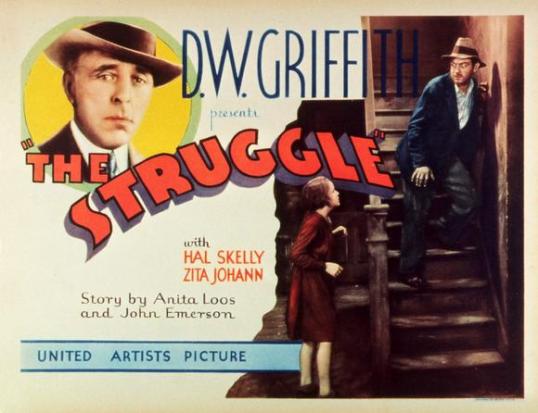
Like a lot of the films directed by cinematic pioneer D.W. Griffith, the 1931 film The Struggle is currently available on Netflix. As a result of his direction of the film Birth of the A Nation, Griffith is a controversial historical figure but it cannot be denied that he was one of the most ambitious, talented, and innovative of the silent filmmakers. Unfortunately, like a lot of the great figures of silent film, he did not survive the transition to sound. Griffith directed two sound films. Abraham Lincoln is overly theatrical while The Struggle … well, bleh.
The Struggle tells the story of a married couple whose marriage is threatened by the husband’s alcoholism. Florrie (Zita Johann) only agrees to marry Jimmie (Hal Skelly) on the condition that he stop drinking. And, for several years, Jimmie doesn’t touch a drop of liquor. But, under pressure at work and struggling to support his family, Jimmie finally breaks down, steps into a speakeasy (this film was made during prohibition), and has a drink. Soon, Jimmie is a full-blown alcoholic, wandering the streets of New York while little school children shout, “He’s a beggin’ bum!” at him. Will Jimmie’s life be turned around as the result of hearing a sermon the radio? Or will he just keep drinking himself to death?
This was the last film on which Griffith was credited as being director. (Reportedly, he was an uncredited co-director on San Francisco.) It’s obviously a heart-felt work but, outside of the harrowing shot-on-location scenes of the unshaven Jimmie stumbling down the streets of the Bronx, the film is too overly theatrical and the performances are too stiff and unconvincing to really work. Griffith was still a visual stylist but, watching The Struggle, it’s obvious that he never learned how to work with speaking actors. As well, dialogue that would have worked on a title card came across as being over-the-top and preachy when actually uttered aloud.
That said, The Struggle has some interesting historic value, especially for those of us who tend to take the Libertarian point of view when it comes to the war on drugs. The Struggle opens with a scene that is set at a garden party in 1911. We listen to various conversations being held at each table. Two people debate whether the Biograph Girl is named Mary Pickford or Mary Packard. A man declares that Woodrow Wilson will never be President because he’s a college professor. (This is all the 1931 equivalent of that scene in Titanic where Billy Zane says that a painting was done by “Somebody Picasso. I’m sure nothing will ever become of him….”) Suddenly, scandal hits the garden party as it’s discovered that a woman has had too much to drink and is now drunk. Everyone at the party, on their own, shuns the woman and she is properly shamed.
The film jumps forward to 1923. Prohibition is now the law of the land and we find ourselves in a speakeasy. The thing that we immediately notice is that there are a lot more people in the speakeasy than were at that garden party and every single one of them is drunk. And, since liquor in now illegal, it’s no longer being bought from safe and trustworthy sources. Instead, it’s now being brewed in a back room. One bootlegger holds up a bottle of prohibition liquor and announces it to be poison before then sending it out to be drunk by the Jimmies of the world.
The film’s point, of course, is that community is a lot better when it comes to policing itself than the government is. The Struggle may not be a great film but it certainly has the right message.


 Through the Shattered Lens