Our regular review of Check It Out! will not be posted tonight so that we might bring you this special program….
My retro television reviews will return next week. For now, we present you with The Gymnast, a short film from 1980 about a teenage girl named Jenny who wants to be the best gymnast in the world but who is going to have to learn some important lessons about hard work and humility beforehand. I could relate to this film because I was the same way about dancing when I was a teen. Of course, I never learned any lessons about hard work or humility and I’m all the better for it.
That said, this isn’t a bad little film. Zina Bethune gives a good performance as the hard-pushing coach and there’s plenty of gymnastic action as well. I’m going to guess this was probably made to appeal to teens who would presumably have found a bunch of new heroes watching the 1980 Summer Olympics. Jimmy Carter, however, had other plans.
Now, without any further ado, here is …. The Gymnast!
Welcome to Late Night Retro Television Reviews, a feature where we review some of our favorite and least favorite shows of the past! On Mondays, I will be reviewing CHiPs, which ran on NBC from 1977 to 1983. The entire show is currently streaming on Freevee!
This week, Ponch and Baker are ordered to make life difficult for the Teamsters!
Episode 1.12 “Aweigh We Go!”
(Dir by Ivan Nagy, originally aired on December 22nd, 1977)
No, that’s not a typo. The name of this episode is indeed “Aweigh We Go.” It makes sense once you watch the episode.
Things get off to a classic CHiPs start, with Baker and Ponch chasing some rich scumbag in a fancy sportscar. The driver doesn’t think he has to slow down or pull over, even when he’s being pursued by the cops. He’s such a reckless driver that he nearly sideswipes a station wagon that is towing a boat. The boat gets loose and crashes into a beauty salon. No one’s hurt but Ponch is excited when he discovers the boat’s for sale. He starts making plans to buy the boat from its owner (Sean Morgan), a guy who is named Sven Larson for no particular reason.
Unfortunately, Ponch makes the mistake of mentioning his plans in front of Sgt. Getraer. Getraer proceeds to buy the boat out from under him. Ponch, needless to say, is miffed and Getraer finally agrees to co-own the boat with Baker and Ponch.
That’s not the only surprise that Getraer has up his sleeve. Because of an officer shortage, he is forced to send Ponch and Baker to work at a weighing station for a week. Under the sarcastic command of Capt, Vogt (played by Bruce Glover, who is best-known for playing Mr. Kidd in Live and Let Die), Baker and Ponch learn all about how to weigh trucks to make sure that they are in regulation. Interestingly enough, the episode devoted a lot of time to showing how a weighing station works. You could probably argue that it actually spends too much time on it. Myself, I have family in the trucking industry so I found it interesting to see what they would have had to deal with in the 70s. I imagine all of the nitpicky rules and regulations are probably even worse today.
Of course, there’s still time for the usual CHiPs shenanigans. Ponch and Baker chase down and arrest a hijacker played by a rather sinister Gerald McRaney. And they rescue a baby from a crashed car. As usual, the emphasis is on all of the members of the Highway Patrol working together to keep the world safe for drivers.
As for the boat, it sinks the first time Ponch tries to take it out on the water. Oh, Ponch! Usually, I’m pretty critical of Erik Estrada’s scenery chewing performance on this show but I will admit to laughing at his rather frantic facial expression as he watched the boat sink.
This was a pleasant episode. I stand with the truckers!
I was either 10 or 11 and I was at a big family gathering in Arkansas. I was at my aunt’s house. My great-grand uncle was sitting in a corner of the living room and watching the TV. Because he was nearly blind, only an inch or two separated his face from the screen. And, because he was almost deaf, the television was blaring. When we first arrived, he was watching what sounded to be a cartoon but, after a few minutes, he changed the channel.
Apparently, whatever channel he was watching was showing a program about the Great Depression because my great-grand uncle snorted a little and yelled (not because he was mad but because he was deaf), “Some people like Roosevelt! I say he was a dictator!”
That blew my young mind. It wasn’t because I necessarily knew that much about Franklin D. Roosevelt, beyond the fact that he had been President. Instead, it shocked me because that was the first time that I had ever heard anyone call a U.S. President a dictator. It was the first time that I truly understoodd that not everyone shared the same opinions, especially when it came to politics and history.
Looking back, so many of the things that define me as a person — my skepticism about conventional wisdom, my mistrust of authority, and my tendency to dismiss “experts” — are the result of that day, that documentary on the Great Depression, and my great-grand uncle’s opinion of Franklin D. Roosevelt.
(Want to know why I hate it when the headlines of clickbait articles say stuff like, “Neil deGrasse Tyson gave his opinion on the movies and it was glorious?” Blame me great-grand uncle. Nobody was going to tell him FDR wasn’t a dictator. Nobody’s going tell me what’s glorious. I’ll make up my own mind.)
And, let’s face it — FDR is a controversial figure. Most of what you read about Roosevelt is positive but if you glance under the surface, you realize that the legacy of the New Deal is far more ambiguous than most people are willing to admit. You realize that there are serious questions about whether Roosevelt knew about the upcoming attack on Pearl Harbor. You discover that Roosevelt wanted to reform the Supreme Court so that it would be a rubber stamp for the executive branch. And, of course, his decision to run for a third term set up exactly the type of precedent that — if not for a constitutional amendment — could have been exploited by the wrong people.
And, yet, as ambiguous as his legacy may be, how can you not be inspired by FDR’s personal story? He went from being a dilettante who was often dismissed as being an intellectual lightweight to being four-times elected President of the United States. In between running unsuccessfully for vice president in 1920 and being elected governor of New York in 1928, Roosevelt was crippled by polio. It’s always been a huge part of the Roosevelt legend that his battle with polio transformed him and made him into the President who led the country during the Great Depression and World War II.
It’s an inspiring story, regardless of what you may think of Roosevelt’s political ideology or his legacy of government intrusion.
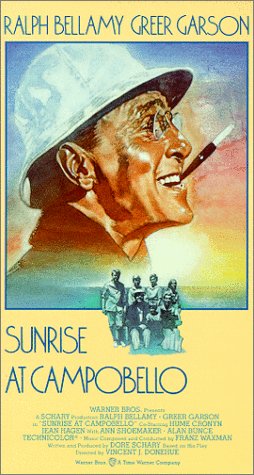
It’s also a story that’s told in our 15th entry in Shattered Politics, the 1960 film Sunrise at Campobello. This film opens with FDR (played by Ralph Bellamy) as an athletic and somewhat shallow man who, while on a vacation with his family, is struck down my polio. The film follows he and his wife, Eleanor (Greer Garson), as they learn how to deal with his new physical condition. Throughout the film, Roosevelt remains upbeat and determined while Eleanor remains supportive and eventually — after being out of the public eye for three years — Roosevelt gets a chance to relaunch his political career by giving a nominating speech for Gov. Al Smith at the Democratic National Convention.
(A little bit of history that everyone should know: Al Smith was the first Catholic to ever be nominated for President by a major political party.)
Sunrise at Campobello is one of those films that tends to show up fairly regularly on TCM. It’s a well-acted film with Ralph Bellamy and Greer Garson really making the aristocratic Roosevelts into sympathetic and relatable characters. At the same time, whenever I’ve watched the film, I’ve always been struck by how long it seems. (The movie itself is only 144 minutes, which means its shorter than the average Christopher Nolan flick but it’s one of those films that seems longer than it actually is.) Sunrise at Campobello was based on a stage play and it’s directed like a stage play as well, with little visual flair and emphasis on dialogue and character. The end result is a film that I can’t really recommend for the casual viewer but one that is, at the very least, interesting for students of history like me.

 Through the Shattered Lens