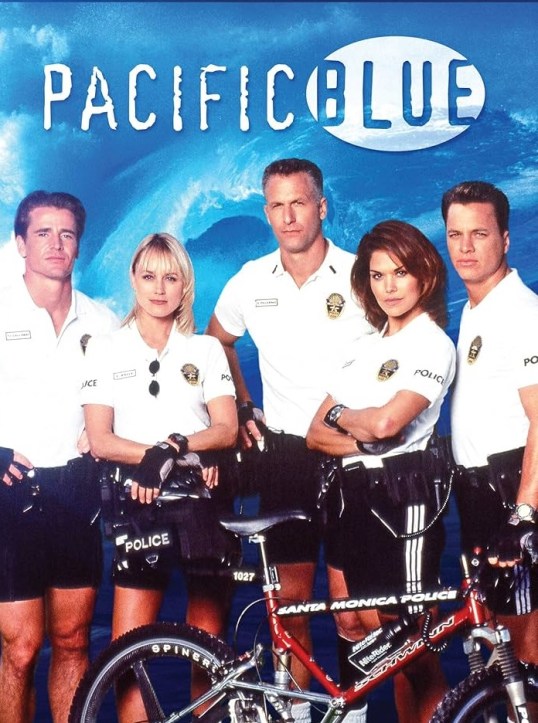
Welcome to Late Night Retro Television Reviews, a feature where we review some of our favorite and least favorite shows of the past! On Tuesdays, I will be reviewing Pacific Blue, a cop show that aired from 1996 to 2000 on the USA Network! It’s currently streaming everywhere, though I’m watching it on Tubi.
It’s time for more bicycle action.
Episode 2.17 “Runaway”
(Dir by Charles Siebert, originally aired on January 19th, 1997)
A teenage girl (Boti Bliss) is missing on the boardwalk. Maggie Garrity (Justina Vail), who runs the local shelter, is looking for her. When she asks the bike patrol for help, TC is dismissive up until he looks up from his paperwork and sees Maggie. I’ve noticed that this is a patten with the bike patrol. It’s rare that they do anything until they see it will involve hanging out with an attractive members of the opposite sex.
TC recruits Chris to help him put up flyers. Chris rolls her eyes because, seriously, why should a member of law enforcement be concerned with a teenage girl who has been abducted by a pimp (Gene Lythgow) and his psycho girlfriend (Ami Dolenz)? Personally, I would dread working for Chris because she never stops complaining. It says a lot about this show that the we’re nearly done with the second season and Chris still doesn’t have a personality beyond being whiny.
TC falls for Maggie but Maggie’s a nun! After they manage to rescue the missing girl, TC asks Maggie if maybe she could stop being a nun for a new nights so that they could go out on a date. Maggie says that it doesn’t work like that. What I find interesting is that TC has no problem casually asking Maggie to give up her vows just because he wants to date her. Hey, TC — this is why you’re single!
Meanwhile, Palermo has new expensive bicycle. What a dork. When the bike gets stolen, Victor has to find it. Palermo sure is mad about his missing bike. What a loser.
Well, here we are! It’s January 1st. In just a few days, the Oscar nominations will be announced and then, on February 9th, the winners will be revealed! From now until the day of the ceremony, I will be taking a look at some of the films that were nominated for and won Oscars in the past. As of this writing, 556 films have been nominated for best picture. I hope that, some day, I will be able to say that I have seen and reviewed every single one of them.
Let’s start things off with the 1978 Best Picture nominee, Coming Home!
Coming Home takes place in California in 1968. While hippies stand on street corners and flash peace signs, teenagers are being drafted and career military men are leaving for Vietnam and people continue to tell themselves that America is doing the right thing in Indochina, even though no one’s really sure just what exactly it is that’s going on over there. At the local VA hospital, the wounded and the bitter try to recover from their wartime experiences while struggling with an often heartless bureaucracy and feelings of having been abandoned by their country.
When Marine Corps. Capt. Bob Hyde (Bruce Dern) is deployed to Vietnam, he leaves behind his wife, Sally (Jane Fonda). Told that she can no longer live on the base while her husband is overseas, Sally gets an apartment, a new car, and eventually a new hairdo. She also gets a new friend, Vi Munson (Penelope Milford). Vi smokes weed and is critical of the war in Vietnam. It doesn’t take long for Sally to start to enjoy the idea of being free and not having to cater to Bob’s every whim. Sally even ends up volunteering at the local VA hospital.
That’s where she meets Luke (Jon Voight, looking youngish and incredibly sexy), a bitter but sensitive vet who, having gone to Vietnam and returned to the U.S. as a paraplegic, is now outspoken in his opposition to the war. Luke is also friends with Billy (Robert Carradine), who is Vi’s shell-shocked brother. When Luke and Sally first meet, they collide in a hallway and Sally gets a bag full of urine spilled on her. It’s only later that Luke and Sally realize that they knew each other in high school and soon, they’re having an affair. Luke, who is as gentle a lover as Bob is brutish, brings Sally to her first orgasm in a sensitively-directed scene that should be studied by any and all aspiring filmmakers.
Unfortunately, the problem with having an affair while your husband is away is that, eventually, your husband’s going to come back. Bob returns from Vietnam and he’s no longer the confident and gung ho officer that he was at the start of the film. He now walks with a pronounced limp and, like Luke, he’s angry. However, whereas Luke has channeled his anger in to activism, Bob tries to keep his emotions bottled up. (He does take the time to give the finger to a few protesters and, considering how obnoxious most of the protesters in this film are, you can’t help but feel that Bob may have had a point.) When Bob discovers that Luke and Sally have been having an affair, he snaps….
Meanwhile, Billy is having a hard time readjusting to life, Vi is getting picked up by sleazy men in bars, and there’s a ventriloquist who shows up a few times. There’s a lot going on in Coming Home and, at times, it feels like the film’s trying to cram in too much. The film often seems a bit disjointed, with semi-documentary footage of Voight hanging out with real paraplegic vets awkwardly mixed in with didactic scenes of Sally turning against the war.
That the love story between Sally and Luke is so effective has far more to do with the performances of Jane Fonda and especially Jon Voight, than it does with anything in the film’s script. Indeed, the script itself doesn’t seem to be too concerned with who Luke and Sally were before they collided in that hallway and it also doesn’t seem to be all that interested in who they’ll be after the end credits role. As written, they’re just plot devices, specifically created and manipulated to express the film’s antiwar message. But then you see Jon Voight’s haunted eyes while he’s listening to a group of vets discuss their experience or you hear the pain in his voice while he talks to a bunch of high school students and it’s those little moments and details that tell you who Luke is. By that same token, Jane Fonda does a good job of showing each stage in Sally’s liberation, even if you can’t help but feel that the main reason Sally becomes an anti-war feminist is because she’s played by Jane Fonda.
Of course, in the end, the entire film is stolen by Bruce Dern. You actually end up feeling very sorry for Bob Hyde (and, to the film’s credit, you’re meant to). It would have been very easy to just portray Bob as being a close-minded pig but the film respects his pain just as much as it respects Luke’s anti-war activism and Sally’s need to be free. In the end, you actually feel worse for Bob than you do for either Luke or Sally. Bob is as much a victim of the war as anyone else in the film.
Coming Home was one of the first films about Vietnam to ever be nominated for best picture. Jane Fonda and Jon Voight both won Oscars but the film itself lost to a far different look at the war in Vietnam, The Deer Hunter.

 Through the Shattered Lens