Late Night Retro Television Reviews: Highway to Heaven 1.8 “A Divine Madness”


Welcome to Late Night Retro Television Reviews, a feature where we review some of our favorite and least favorite shows of the past!  On Thursdays, I will be reviewing Highway to Heaven, which aired on NBC from 1984 to 1989.  The entire show is currently streaming on Tubi and several other services!

This week, things get a bit silly on the highway.

Episode 1.8 “A Divine Madness”

(Dir by Michael Landon, originally aired on November 7th, 1984)

Oh, this episode.

Years ago, a ruthless land developer named Arthur Krock (Ron Moody) built a castle for his beloved wife.  Tragically, his wife passed away and Arthur had a nervous breakdown.  Now, he spends all of his time in his castle and he believes that he actually is King Arthur.  He says that he’s waiting for the return of his Guinevere.  Only Marian (Helen Kleeb), his loyal maid, has remained with him over the years.  He, of course, calls her Maid Marian even though that’s a Robin Hood reference and not anything from the Arthurian legends.

Though the elder Arthur Krock is still the head of his company, the day-to-day business is handled by his son, Arthur Krock, Jr. (played by a young and beardless Jonathan Frakes).  Bitter over his unhappy childhood, Arthur, Jr. is just as ruthless as his father once was.  Arthur, Jr. has a 12 million dollar deal to force a woman named Gwen (Jean Allison) off of her land and he’s determined to get it done, even if it means displacing all of the dogs that she and her veterinarian son (Scott Stevenson) look after.

Arthur, Sr.’s daughter, Linda (Ellen Maxted), hires two new handyman and you can probably already guess that they’re going to be Jonathan and Mark.  Working around the castle, Jonathan arranges for Arthur, Sr. to meet Gwen.  When Arthur, Sr. discovers that Gwen is short for Gweneviere, he announces that she can stay on her land.  Arthur, Jr. goes to court to get his father declared incompetent.

Can you guess what happens?  Well, if you think that Arthur, Sr. hires Jonathan to be his lawyer and then announces in court that he has not been the father that he should have been …. you’re absolutely correct!

When people talk about Highway to Heaven being a campy or cheesy show, it’s usually episodes like this that they’re talking about.  Unabashedly sentimental in its approach, this episode suffers from the fact that Arthur, Jr. has a point.  Arthur, Sr. is clearly mentally ill and allowing him to run the company is totally unfair to his employees and the people who have invested in his business.  Just because Arthur, Jr. isn’t particularly likable, that doesn’t make him incorrect.  If the episode had merely portrayed Arthur, Sr. as an eccentric who didn’t want to have to deal with the pain of the real world, that would be one thing.  But this episode has Arthur, Sr. living in a literal castle, sitting on an actual throne, and referring to his son as being Lancelot.  It’s all just a bit too much and Ron Moody’s over-the-top performance doesn’t particularly help.  To the show’s credit, it does eventually acknowledge that Arthur, Sr. needs some help but still, the whole thing just feels a bit …. well, silly.

Next week, Jonathan and Mark help a movie star become a better father!  Hopefully, he doesn’t think that he’s Prester John or Robin Hood or anyone like that.

Horror On The Lens: The Twonky (dir by Arch Oboler)


In this 1953 satire, a philosophy professor named Kerry West (Hans Conried) buys a television.  (Remember, this was a time when televisions were still a relatively new phenomena.)  Imagine Kerry’s surprise when he discovers that his television can walk, talk, light his cigarettes, clean the house, and make money materialize out of nowhere!

Sounds great, right?

The only problem is that this TV is not only a bit possessive but it also uses its powers to brainwash people and rob them of their individuality!

Technically, The Twonky is more a comedy than a horror movie.  In fact, it’s really not scary at all.  But it is a lot of fun and it’s interesting to see how a filmmaker in the 50s dealt with television’s growing role in American society.

Enjoy!

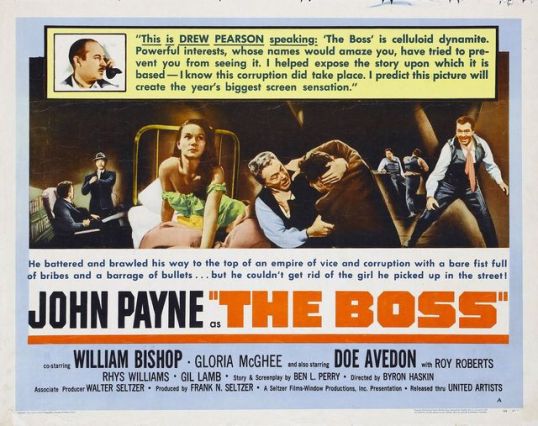
Shattered Politics #12: The Boss (dir by Byron Haskin)


The Boss

After you’ve watched The Phenix City Story, why not go over to Netflix and watch another obscure but hard-hitting B-movie, The Boss?

First released in 1956, The Boss came out a year after The Phenix City Story but they both serve as good companion pieces to each other.  Whereas The Phenix City Story shows what it’s like to live in a city dominated by corruption and crime, The Boss shows how a city could get that way in the first place.

The Boss opens in 1919, in an unanmed midwestern city.  (A title card informs us that the city is a “middle class city.”)  World War I has ended and the returning soldiers are marching in a parade throughout the city.  Leading the march is Capt. Matt Brady (John Payne), a humorless war hero.  Marching behind him are a group of soldiers who all seem to hate his guts, even after Bob Herrick (William Bishop) attempts to defend him.  It appears that Matt was a strict officer during the war and Bob was the only one of his men who didn’t hate him.  Of course, a lot of that is because Bob was a childhood friend of Matt’s.  They both grew up in the city together.  To be exact, their home was in the third ward.  As Bob explains, the Brady family rules the third ward.

Matt’s older brother, Tim (Roy Roberts), is the 3rd ward’s alderman.  After the parade ends, Tim explains that he expects Matt to follow in the family business.  However, Matt doesn’t want anything to do with politics.  Instead, he just wants to marry Elsie (Doe Avedon) and live a normal life.  In fact, Matt says, he’s got a date with Elsie that night.

However, before Matt can go on that date, he ends up getting attacked and beaten up by some of the soldiers from the parade.  He’s late for his date and when Elsie refuses to forgive him, Matt ends up going out and getting drunk.  After getting into a few more fights, he meets an insecure woman named Lorry (Gloria McGhee) and announces that they’re getting married whether she wants to or not.

The next morning, Matt wakes up to discover that he now has a wife, Elsie never wants to see him again, and that Tim has dropped dead of a heart attack.  Bruised and hungover, Matt suddenly finds himself forced to take over the family business.

The film jumps forward a few years.  Matt is now the most powerful man in the city.  He decides who get elected to which office and, with the help of the Mafia, he’s made a lot of money for himself.  Bob, meanwhile, has married Elsie and is now Matt’s attorney and unofficial second-in-command.  Meanwhile, Lorry lives in a huge mansion that she never leaves.

It took me a while to get into The Boss.  In fact, I nearly stopped watching after the first twenty minutes because it didn’t ever seem like there would be a moment when Matt would be anything other than surly, drunk, and bruised.  But then, once Tim drops dead, the movie becomes a bit more interesting.  If you remember John Payne for anything, it’s probably for being the nice but kind of boring lawyer from the original Miracle on 34th Street.  So, it’s interesting to see him here, playing a crude and perpetually angry man who always seems to be on the verge of punching someone out.  He gives a good performance and occasionally you even feel a little sorry for Matt.  For everything he does wrong, he’s still essentially the same guy who wanted to marry a school teacher and live out in the suburbs.

Of course, I’m a history nerd so my favorite scenes in The Boss were the ones that dealt with real moments from history, like the scene where Matt panics when he hears about the 1929 Stock Market crash.  Even better, though, is a brief sequence that takes place at a political convention.  Though no names are uttered and the party is never specifically identified, it’s obvious that Matt is meant to be at the 1932 Democratic Convention and the candidate that is asking for Matt’s support is obviously meant to Franklin Roosevelt.  When Roosevelt is nominated without Matt’s support, Matt can only bitterly observe that he wishes he was from Chicago because then he could own a President.

Would a movie made today have the guts to say such a thing about FDR?  I doubt it.

The Boss is currently available on Netflix.  If you’re into politics and history (and maybe even political history), be sure to watch it before it goes away.