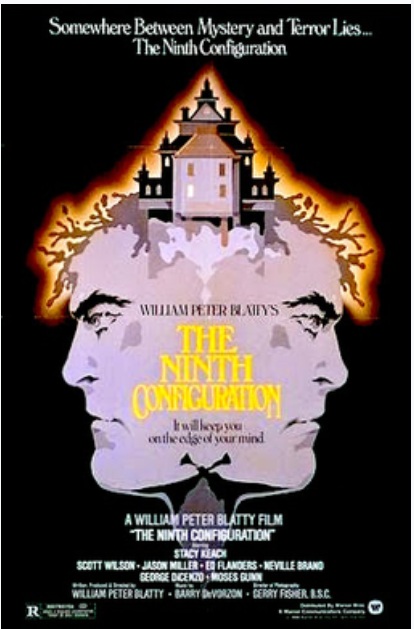
The Unnominated #20: The Ninth Configuration (dir by William Peter Blatty)


Though the Academy of Motion Picture Arts and Sciences claim that the Oscars honor the best of the year, we all know that there are always worthy films and performances that end up getting overlooked.  Sometimes, it’s because the competition too fierce.  Sometimes, it’s because the film itself was too controversial.  Often, it’s just a case of a film’s quality not being fully recognized until years after its initial released.  This series of reviews takes a look at the films and performances that should have been nominated but were, for whatever reason, overlooked.  These are the Unnominated.

Some films defy easy description and that’s certainly the case with 1980’s The Ninth Configuration.

The film opens with a shot of a castle sitting atop of a fog-shrouded mountain.  A voice over tells us that, in the early 70s, the castle was used by the U.S. government to house military personnel who were suffering from mental illness.  Inside the castle, the patients appear to be left to their own devices.  Lt. Reno (Jason Miller) is trying to teach dog how to perform Shakespeare.  Astronaut Billy Cutshaw (Scott Wilson) is haunted by the thought of being alone in space and refuses to reveal why he, at the last minute, refused to go to the moon.  The men are watched over by weary and somewhat sinister-look guards, who are played by actors like Joe Spinell and Neville Brand.

Colonel Kane (Stacy Keach) shows up as the new commandant of the the castle.  From the first minute that we see Kane, we get the feeling that there might be something off about him.  Though he says that his main concern is to help the patients, the man himself seems to be holding back secrets of his own.  With the help of Colonel Fell (Ed Flanders, giving an excellent performance), Kane gets to know the patients and the guards.  (Despite the objections of the guards, Kane says that his office must always be unlocked and open to anyone who want to see him.)  He takes a special interest in Cutsaw and the two frequently debate the existence of God.  The formerly religious Cutshaw believes the universe is empty and that leaving Earth means being alone.  Kane disagrees and promises that, should he die, he will send proof of the afterlife.  At night, though, Kane is haunted by dreams of a soldier who went on a murderous rampage in Vietnam.

The film start out as a broad comedy, with Keach’s smoldering intensity being matched with things like Jason Miller trying to get the dogs to perform Hamlet.  As things progress, the film becomes a seriously and thoughtful meditation on belief and faith, with characters like Kane, Billy, and Colonel Fell revealing themselves to be quite different from who the viewer originally assumed them to be.  By the time Kane and Cutshaw meet a group of villainous bikers (including Richard Lynch), the film becomes a horror film as we learn what one character is truly capable of doing.  The film then ends with a simple and emotional scene, one that is so well-done that it’ll bring tears to the eyes of those who are willing to stick with the entire movie.

Considering all of the tonal shifts, it’s not surprising that the Hollywood studios didn’t know what to make of The Ninth Configuration.  The film was written and directed by William Peter Blatty, the man who wrote the novel and the script for The Exorcist.  (The Ninth Configuration was itself based on a novel that Blatty wrote before The Exorcist.)  By most reports, the studio execs to whom Blatty pitched the project were hoping for another work of shocking horror.  Instead, what they got was an enigmatic meditation on belief and redemption.  The Ninth Configuration had the same themes as The Exorcist but it dealt with them far differently.  (Because he wrote genre fiction, it’s often overlooked that Blatty was one of the best Catholic writers of his time.)  In the end, Blatty ended up funding and producing the film himself.  That allowed him complete creative control and it also allowed him to make a truly unique and thought-provoking film.

The Ninth Configuration was probably too weird for the Academy.  Though it received some Golden Globe nomination, The Ninth Configuration was ignored by the Oscars.  Admittedly, 1980 was a strong year and it’s hard to really look at the films that were nominated for Best Picture and say, “That one should be dropped.”  Still, one can very much argue that both Blatty’s script and the atmospheric cinematography were unfairly snubbed.  As well, it’s a shame that there was no room for either Stacy Keach or Scott Wilson amongst the acting nominee.  Keach, to date, has never received an Oscar nomination.  Scott Wilson died in 2018, beloved from film lovers but never nominated by the Academy.  Both of them give career-best performances in The Ninth Configuration and it’s a shame that there apparently wasn’t any room to honor either one of them.

The Ninth Configuration is not a film for everyone but, if you have the patience, it’s an unforgettable viewing experience.
Previous Entries In The Unnominated:

  1. Auto Focus 
  2. Star 80
  3. Monty Python and The Holy Grail
  4. Johnny Got His Gun
  5. Saint Jack
  6. Office Space
  7. Play Misty For Me
  8. The Long Riders
  9. Mean Streets
  10. The Long Goodbye
  11. The General
  12. Tombstone
  13. Heat
  14. Kansas City Bomber
  15. Touch of Evil
  16. The Mortal Storm
  17. Honky Tonk Man
  18. Two-Lane Blacktop
  19. The Terminator

Horror Book Review: The Exorcist by William Peter Blatty


Which is better, the movie or the book?

That’s a question that’s often asked and I think the knee jerk reaction is always to say that the book was better but that’s certainly not always true.  There are a few notable cases where the film has been dramatically better than the book.  Just check out The Godfather, if you don’t believe me.  Occasionally, you’ll run into something like the recent two-part adaptation of Stephen King’s It.  The first film was dramatically better than the novel while the second film was significantly worse.

And then occasionally, you’ll have a case where the book and the movie are equally good, albeit for different reasons.  That’s the case with William Peter Blatty’s 1971 novel, The Exorcist.

The book and the movie both tell the same story.  Perhaps because Blatty served as both the writer and the producer of the film version, the movie sticks closely to the basic plot of his novel.  Regan McNeil, the daughter of an atheist actress named Chris McNeil, is possessed by a demon called Pazuzu.  It falls to Father Merrin and Father Karras to perform an exorcism.  Unfortunately, Merrin is old and in bad healthy while Karras fears that his faith might not be strong enough to defeat the demon.

Though the plot does remain the same, there are, of course a few differences between the film and the book.  As befits a novel written by a screenwriter, the book gets a bit more gossipy when detailing the production of Chris’s film.  The book also spends a good deal more time on Inspector Kinderman’s investigation into the deaths of characters like film director Burke Dennings.  In the film, Kinderman only appears in a few scenes.  In the book, he’s as important a character as Karras and it’s rather obvious that he was Blatty’s favorite character to write.  (It’s not a surprise that Kinderman was subsequently the main character in Legion, which was filmed as The Exorcist III and which starred George C. Scott as Kinderman.)  The book also spends a good deal more time on Karras’s crisis of faith.  In the film, Karras was portrayed as being initially hesitant to accept that Regan was possessed.  In the book, Karras researches the history of exorcisms and considers almost every other alternative before committing himself to performing the exorcism.  When the book was first published, those scenes were included to make the reader themselves question whether or not Regan was actually possessed.  Modern readers, however, already know that answer to that.

Myself, I appreciated the extra time that the novel spent with Kinderman and Karras.  As written by Blatty, they’re both engaging characters and Karras’s crisis of faith is actually handled with a good deal more skill in the book than in the movie.  If the movie is a nonstop roller coaster of terror, the book is a bit more thoughtful.  Whereas the movie shocks you into accepting its premise, the book actually tries to convince you that demons are real and that they’re responsible for the evil in the world.  (The books opens with a series of quotes from real-life dictators and mobsters.)  The movie aims for your gut while the book’s horrors are often more cerebral but they both get under your skin and inspire you to make sure that every door is locked and every window is closed.  Not that any of that would protect you, of course.  Both the movie and the novel understand that the scariest thing about what happens to Regan is that it’s out-of-her-control and could, in theory, happen to any of us.  Demons are going to do whatever they can.  Both the book and the film are fantastically effective and worthy of being known as horror classics.

This October, definitely be sure to watch The Exorcist and The Exorcist III.  Hell, maybe even watch The Exorcist II.  It’s not that bad!  (Okay, well, actually, it is.  But still, it’s kind of …. fun, in its way.)  But also take the time to read the books.  Doing one without doing the other is only getting half the story.

Horror Scenes I Love: The Exorcist III


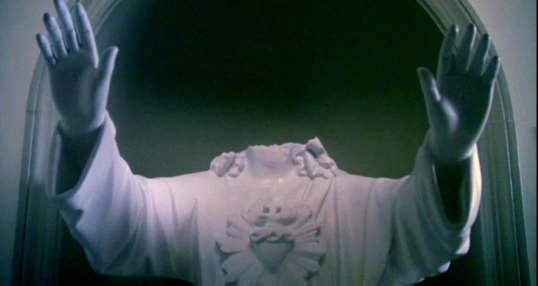
ExorcistJEsusWilliam Peter Blatty took on the directing reins for the third film in the series. I’m going to take a huge leap of faith that he was none too happy with how the first sequel turned out.

The latest “Scenes I Love” the Horror Edition comes from Blatty’s The Exorcist III and it’s actually a very effective jump scare that truly comes out of nowhere. I chose this particular clip because of how well Blatty frames and sets up the pay off. Some may argue that this third film in the series was a mixed bag but one thing it had was genuine scares making up for not being as disturbing as the first film.

I recommend watching this particular scene in a darkened room with headphones on to better appreciate the sound.

Horror Film Review: The Exorcist (directed by William Friedkin)


When I first read Arleigh’s idea that we devote October to reviewing horror films, I knew immediately that there was no way I could let the month pass without saying a few words about one of the true classics of the horror genre, the 1973 best picture nominee The Exorcist.

Based on an equally scary novel by William Peter Blatty and directed by William Friedkin, The Exorcist is one of those films that has become so iconic that even people who have never seen it know what the movie is about.  Chris McNeil (Ellen Burstyn) is an agnostic actress who is shooting a film about student protestors on a college campus.  Her 12 year-old daughter, Regan (played by the future Grindhouse queen Linda Blair), spends her time playing with a Ouija Board and talking to her friend “Capt. Howdy.”  Unfortunately, Capt. Howdy is actually a Sumerian demon who proceeds to posses Regan.  Soon, Regan is levitating, cursing, and masturbating with a crucifix.  After trying (and failing with) all the conventional methods of treatment, Chris desperately turns to the God she doesn’t believe in and tries to convince a troubled priest (Jason Miller) to perform an exorcism on Regan.  Unfortunately, this priest has begun to question his faith and he fears that he might not be strong enough to “cure” Regan.  An elderly priest (Max Von Sydow) is called in to help with the exorcism and, faster than you can say, “The power of Christ compels you,” the two priests are locked in mortal combat for Regan’s soul.

The ultimate test of any horror films is whether or not it’s still unsettling even after you already know what’s going to happen and when all the evil is going to come jumping out of the shadows.  In short, the test is whether or not the film holds up to repeat viewings.  This is a test that The Exorcist easily passes.  I’ve seen this film enough times that I now know exactly when Linda Blair’s head is going to do that 360 degree turn and I now know exactly when to divert my eyes so I don’t have to see possessed Regan puking on the priests.  (For all the terrible physical manifestations of Regan’s possessions, it’s always the vomiting that gets to me.)  Most of the film’s “shock” sequences aren’t that scary any more because we’ve all seen far worse.  However, watching this film remains, for me, a truly unsettling experience. This is due largely to director William Friedkin.  Today’s aspiring filmmakers could learn a lot from Friedkin because, for all the attention the film’s grotesque effects received, Friedkin actually devotes more time to setting up the situation and establishing a palpable atmosphere of doom.  This is a film full of grainy, almost gray images, the perfect visual suggestion of a world that has perhaps been abandoned by its God.  It takes more than an hour before Ellen Burstyn meets Jason Miller and Max Von Sydow doesn’t show up until the final 30 minutes of the film.  At first, it seems as if the movie itself is moving slowly but, by the end of it, you realize that what Friedkin has done is that he’s sucked us into the reality of his film.  For all the special effects and metaphysical concerns, The Exorcist almost feels like a documentary.  He’s also helped by a talented cast that makes the situation feel real, regardless of how extreme things may get.  I’ve read that a lot of people decided they needed to be exorcised after seeing this film and I can understand why.

The Exorcist is a film that benefits from debate and it’s also one that is open to multiple interpretations.  Quite a few critics have argued that the Exorcist is actually a very reactionary film in that Regan’s possession can be seen as a metaphor for adolescent rebellion and her exorcism is actually more about the establishment regaining control than any attempt to save her eternal soul.  I actually think this interpretation is pretty much spot on correct though I also don’t think the filmmakers were intentionally trying to deliver that message.  Instead, I think that the Exorcist — like all great films — is simply filled with the subtext of its time.  While the filmmakers may have unintentionally created a document of then-contemporary fears, I think the film is even more interesting as an argument about the origin of sin and evil.

Ultimately, for a horror film to be truly timeless, it has to do more than just scare you.  The supernatural and/or otherworldly forces have to serve as more than just a cinematic threat; they have to stand-in for our own universal fears and concerns.  The Exorcist attempts to answer one of the most basic questions: why is there evil in the world and why do people sometimes behave in such terrible ways?  For all of the film’s notoriety, the answers it provides are surprisingly simple.  Evil is because of the devil and people behave the way they do because they’re not individually strong enough to resist the lure of sin.  The only way to defeat the world’s demons is through sacrifice, suffering, and martyrdom.  You don’t have to come from a Catholic background to “get” the Exorcist but it helps.  (To be honest, it probably helps even more to be a “fallen” Catholic like me because wow, this movie really knows how to exploit all that lingering guilt.)  Thanks to this film, it sometimes seems the only time that priests (and Catholicism in general) are portrayed positively in the movies is when they’re exorcising someone (which, contrary to popular belief, doesn’t really happen all that much).  Fortunately, you don’t have to agree with the answers provided by the Exorcist in order to find both the questions and the film itself to be intriguing.