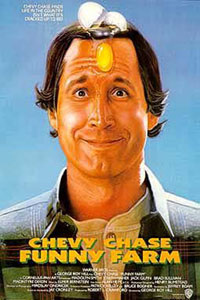
 Andy Farmer (Chevy Chase) is a New York sports writer who leaves the city and moves to the small town of Rosebud, Vermont so that he can work on his novel. He and his wife, Elizabeth (Madolyn Smith), struggle to adjust to living in a small town. The delivery of their furniture is delayed by the collapse of a covered bridge. When they try to make a phone call from inside their own house, the local operator tells them to deposit ten cents. They were expecting a Norman Rockwell-type town and instead, they find themselves having to pay for the funeral of a man who was buried on their property long before they moved in. When Elizabeth makes more progress writing a children’s book than Andy does with his heist novel, their marriage starts to feel the strain.
Chevy Chase is now so much better known for the stories of his unprofessional and diva-like behavior on film and television sets that it’s easy to forget that he was, at his peak, a very funny actor. Chase may be playing a variation of his put-upon everyman but, compared to the first two Vacation movies, most of the humor in Funny Farm is very mild. George Roy Hill was a classy director who had been making movies since the 50s and Funny Farm feels like a throwback to the type of family-friendly comedies that Disney would make in the 60s. That I laughed as much as I did was largely due to Chase’s performance. Whether he was tripping over a Dutch door, reacting to his wife’s dislike of the first few chapters of his new novel, or offering to pay the townspeople $50 to pretend to be nice for a weekend, Chase was consistently funny and even likable. I don’t know if this is the type of performance that Chevy Chase could give today. There’s a bitterness that’s now integral to screen persona and it’s made him into someone who audience want to laugh at instead of with. It’s too bad because Funny Farm is a reminder of the type of comedic actor that Chevy Chase used to be and who he probably still could be if not for the failed talk show and the infamous Friar’s Club roast.
As for Funny Farm, it’s an amusing and likable comedy and it still holds up well today. Chase is the key to the film’s success but he’s not the only reason that the film works. I liked the scene where Mike Starr and Glenn Plummer, as the two movers, watch as the bridge they tried to drive over collapses. I even liked the running joke about the two ducks who refused to leave the Farmers’s property. Funny Farm may not have been a hit when it was first released but it’s since built up a cult following. There will always be a place for a funny comedy that leaves you in a good mood.
 Through the Shattered Lens