Horror on TV: Friday the 13th: The Series 2.1 “Doorway to Hell” (dir by William Fruet)


Tonight, for our horror on the lens, we have the first episode of the 2nd season of Friday the 13th: The Series!

Guess what? Uncle Lewis is, once again, trying to reenter the world of the living! Can Micki and Ryan stop him!?

This episode originally aired on September 30th, 1988.

Horror on TV: Friday the 13th 1.15 “Vanity’s Mirror” (dir by Willam Fruet)


Tonight’s episode of Friday the 13th: The Series is considered by many to be one of the best episodes of the series.

In this episode, the antique is a gold compact.  It causes men to fall in love with whoever owns it.  Unfortunately, the men usually become so obsessive that the owner of the compact has no choice but to kill them.  Hey, it happens.

In Vanity’s Mirror, the compact has fallen into the hands of an awkward teenager named Helen, who is poignantly played by Ingrid Veninger.  As is often the case with the best horror stories, Helen is as much a victim as a villain.

This episode originally aired on March 5th, 1988.

Horror on TV: Friday the 13th The Series 1.11 “Scarecrow” (dir by William Fruet)


Tonight’s episode of Friday the 13th The Series finds Micki and Ryan tracking down a cursed scarecrow. The scarecrow guarantees a good crop but only after three people have had their heads chopped off. AGCK!

Listen, folks, scarecrows are scary enough even when they aren’t chopping off people’s heads. I’ve lived around farms. Scarecrows are scary as Hell!

Enjoy!

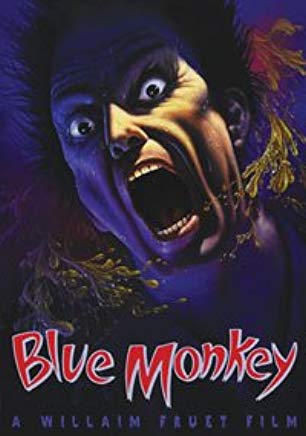
The TSL’s Grindhouse: Blue Monkey (dir by William Fruet)


1987 Blue Monkey

Last night, as I sat down to watch the 1987 Canadian film, Blue Monkey, I found myself singing a song in my head:

How does it feel
When you treat me like you do
And you’ve laid your hands upon me
And told me who you are?

I thought I was mistaken
And I thought I heard your words
Tell me, how do I feel?
Tell me now, how do I feel?

Unfortunately, it turned out that the only thing Blue Monkey had in common with the classic New Order song, Blue Monday, was an enigmatic title.  Just as the song never really mentions anything about Monday, Blue Monkey does not feature a single monkey.  One minor character does mention having a dream about a monkey but, otherwise, there are no monkeys in the film.  Speaking as someone who believes that almost any film can be improved the presence of a monkey, I was disappointed.

(Seriously, Nomadland would have been a hundred times better if Frances McDormand had a pet monkey.)

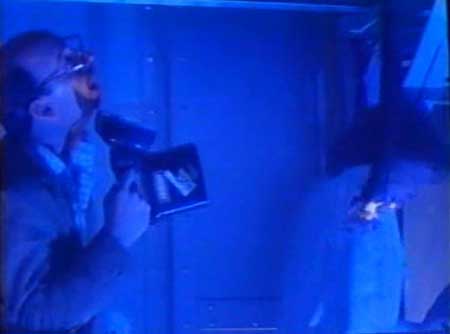
What Blue Monkey does have is a lot of blue.  The characters wear blue shirts and some wear blue uniforms.  Another wears a blue hat.  The film takes place in a hospital where almost all of the walls are painted blue.  Even worse, the majority of the film’s scenes are saturated with blue lighting.  

Here’s just two screenshots:

blue-monkey-1987-movie-image-7Blue-Monkey-1987-movie-William-Fruet-4

Seriously, some scenes were so blue that I was reminded of John Huston’s decision to suffuse Reflections in a Golden Eye with the color gold.  Personally, I think Huston made a mistake when he did that with Reflections but I can still understand the reasoning behind the decision and I can see what Huston was attempting to accomplish.  The blue in Blue Monkey feels like a distraction, as if someone realized, on the day before shooting, that the title didn’t make any damn sense.  “We’ll just make the whole movie blue!”

The problem, of course, is that the film goes so overboard with the blue lighting that it actually becomes difficult to look at the screen for more than a few minutes.  I had to keep looking away, specifically because all of those blue flashing lights were starting to make me nauseous and were on the verge of giving me a migraine.  At times, the image is so saturated in blue that you literally can’t make out what’s happening in the scene.  Of course, once you do figure out what’s happening, you realize that it doesn’t matter.

Blue Monkey takes place in a hospital.  A handyman has been having convulsions after pricking his finger on a plant that came from a mysterious island.  Perhaps that’s because a mutant larvae is now using his body for a host.  The larvae eventually develops into a giant grasshopper — NOT A MONKEY! — who stalks around the hospital and kills a few people.  The Canadian government is threatening to blow up the hospital unless something is done about the blue grasshopper.

It’s a Canadian exploitation film but Michael Ironside isn’t in it so it somehow feels incomplete.  That said, John Vernon plays a greedy hospital administrator and it’s fun to watch him get irritated with everyone.  A very young Sarah Polley has an early role as an annoying child.  There’s actually several children in this film and you’ll want to throw something at the screen whenever they show up, that’s just the type of film this is.  (Some of my fellow movie-watching friends were actually upset that the children survived that film.  I wouldn’t go that far but I still found myself hoping John Vernon would tell them all to shut up and let the adults handle things.)  Susan Anspach plays a doctor, showing that anyone can go from Five Easy Pieces to Canadian exploitation.  The film’s nominal star is Steve Railsback, playing a cop who comes to the hospital to check on his wounded partner and who ends up on grasshopper duty.  Steve Railsback has apparently said that he’s embarrassed to have appeared in this film.  Consider some of the other films that Steve Railsback has appeared in and then reread that sentence.  

In the end, Blue Monkey doesn’t add up too much.  There’s no Michael Ironside.  There’s no monkeys.  There’s just a lot of blue.

The TSL’s Horror Grindhouse: Killer Party (dir by William Fruet)


The 1986 film Killer Party is one of those late 80s slasher films that somehow has developed a cult following.  Up until recently, there was a fairly active fansite devoted to the history of Killer Party and Killer Party still regularly shows up on TCM Underground.

So, apparently, Killer Party has fans.

I’m just not sure why.

Some of it, I suppose, could have to do with the first ten minutes of the film, which are genuinely clever.  It starts out with a young woman being menaced at a drive-in theater and, just when you’ve gotten invested in her story and have started to wonder whether or not she’ll survive the entire movie, it is suddenly revealed that we’ve actually been watching a movie-within-a-movie.  And that movie-within-a-movie then turns out to be part of an incredibly silly music video, featuring a band that is so 80s that you find yourself expecting them to stop performing so they can do a line of coke and play the stock market.  At one point, the band even performs while standing on the drive-in’s concession stand.

It’s all marvelously silly and kind of clever.  The problem is that the rest of the film never lives up to those ten minutes.  In fact, you spend the rest of the movie wishing you were still watching that movie about the girl trapped at the drive-in.

I also suppose that some of the film’s cult reputation has to do with the fact that Paul Bartel has a small supporting role.  Bartel plays the same basic role that he played in almost every horror film in which he appeared.  He’s a pompous professor who says a few dismissive lines and is then promptly killed off.  Maybe it’s the Bartel factor that has led to this film developing a cult following.

Who knows?

Killer Party is essentially four movies in one.  The first movie is that part that I’ve already talked about.  The opening is clever but it only lasts for ten minutes.

After the opening, the film turns into a rather standard college comedy.  Three girls want to join the wildest sorority on campus but it won’t be easy!  Everyone on this campus is obsessed with playing pranks.  And by pranks, I mean stuff like locking a bunch of people outside while they’re naked in a hot tub and then dumping a bunch of bees on them.  Of course, that prank gets filmed and the footage is later shown at a meeting of stuffy old people.  That’ll teach those uptight members of the World War II generation!  You may have made the world safe for democracy but that was like a really, really long time ago!  So there!  It’s time for a new generation, one that will make the world safe for pranks!

During this part of the film, there are only a few hints that we’re watching a horror movie.  For instance, the sorority wants to have a party in an abandoned frat house.  Their housemother goes by the frat house and kneels in front of a grave.  She speaks to someone named Alan and tells him that it’s time to move on.  Then she promptly gets killed and no one ever seems to notice.

The comedy part of the movie segues into a remarkably bloodless slasher movie.  The cast assembles at the forbidden house.  They have a party.  Someone in a diving mask shows up and kills off the majority of the cast in 20 minutes.  Almost everyone dies off-screen so there’s really not even any suspense as far as that goes.

Then, during the last few minutes of the film, the slasher film suddenly turns into a demonic possession film and that seems like that should be brilliant turn of events but it just doesn’t work in Killer Party.  Usually, I love movies that are kind of messy but Killer Party is a rather bland and listless affair.  If you’re going to combine a campus comedy with a slasher film and a demonic possession film, you owe it to your audience to really go totally over the top and embrace the ludicrousness of it all.  Instead, Killer Party rolls out at a languid and rather dull pace.

I would not accept an invitation to Killer Party.