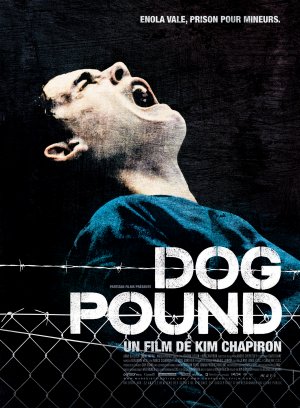
Back to School Part II #46: Dog Pound (dir by Kim Chapiron)


dog_pound

The 2010 film Dog Pound is a disturbing and rather sad film but that really shouldn’t be a surprise, since it deals with the American justice system.  Even more specifically, it deals with the juvenile justice system and portrays, in exacting detail, how a mere juvenile delinquent can be transformed into a hardened criminal.

The film opens with three teenagers being either sentenced or transferred to the (fictional) Enola Vale Juvenile Detention Center in Montana.  Enola Vale is the type of place where the walls are covered with inspiring but ultimately empty-headed slogans.  It’s the type of place that claims to teach young offenders the importance of self-respect and respecting authority but ultimately, all it does is teach them how to be better criminals.  The staff is largely portrayed as being well-meaning but ineffectual.  Not only are they incapable of controlling their prisoners but they also remain oblivious to much of what is going on inside the prison.  The real power is held by the prisoners who have managed to reach the rank of trustee.  If you stay out of trouble long enough, you can become a trustee.  And then, of course, you can do whatever you want to whomever you want…

The three newest prisoners are a mixed bunch.  One can take one look at 15 year-old Angel (Mateo Morales) and 16 year-old Davis (Shane Kippel, best known for playing Spinner Mason on Degrassi) and tell immediately that neither one of them is tough enough to survive inside.  Angel is a non-violent car thief.  Davis is a drug dealer and something of a momma’s boy.

And then there’s Butch (Adam Butcher).  Butch is 17 years-old and he’s been transferred to Enola Vale from another facility.  Butch attacked an officer at the previous facility, gouging out the man’s eyes.  The angry Butch may be dangerous but he’s also the best friend that Angel and Davis could hope for.  When the three of them find themselves being targeted by a sadistic trustee named Banks (Taylor Poulin), Butch is the one who eventually ends up beating Banks nearly to death.  With Butch now the most feared prisoner at Enola Vale, Davis and Angel are safe.

Or, at least, they are until Butch witnesses a frustrated guard kill a prisoner.  While the death is being investigated, Butch is put into solitary confinement, leaving his friends at the mercy of the other prisoners…

Dog Pound is a dark and harrowing look at the juvenile justice system, one that challenges the popular belief that incarceration is always the best (and only) solution.  In fact, Dog Pound makes the argument that maybe — just maybe — automatically tossing non-violent offenders in with violent offenders may not be the ideal way to deal with delinquency.  That may sound like simple common sense but this is America and we love the idea of “lockin’ people up and throwin’ away the key.”  If the film’s plot occasionally seems to wander without any clear direction, that’s because these are characters who literally have nowhere to go.  They may only be teenagers but their lives are pretty much over.  The film’s episodic nature captures the pitiless randomness of their own existence.  The few scenes in which they actually get to behave like regular teenagers are poignant precisely because they are so rare.

Dog Pound is a well-directed and acted film, featuring especially strong work from Adam Butcher and Shane Kippel.  Reportedly, many of the smaller roles were played by actual inmates and they add a disturbing and, at times, heart-breaking authenticity to this film.  Show Dog Pound to anyone who is fond of saying that “bad kids” need to be “scared straight” and taught to “respect authority.”  At a time when many people seem to be increasingly comfortable with the idea of a police state, Dog Pound is a film that needs to be seen.
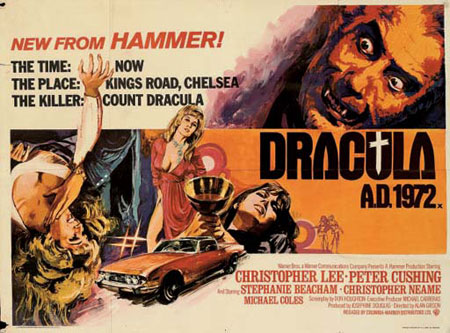
Horror Film Review: Dracula A.D. 1972 (dir by Alan Gibson)


(I originally wrote and posted this on February 5th, 2011.  Seeing as how we’ve been taking a look at the other Hammer Dracula films, I figured I might as well repost it for Halloween!)

Dracula A.D. 1972 opens in 1872 with a genuinely exciting fight on a runaway carriage that ends with the death of both Count Dracula (Christopher Lee) and his nemesis, Prof. Van Helsing (Peter Cushing).  However, as Van Helsing is buried, we see one of Dracula’s disciples (played by Christopher Neame, who had an appealingly off-kilter smile) burying Dracula’s ashes nearby.  The camera pans up to the clear Victorian sky and, in a sudden and genuinely effective jumpcut, we suddenly see an airplane screeching across the sky.

Well, it’s all pretty much downhill from there.  Suddenly, we discover that a hundred years have passed and we are now in “swinging” London.  The city is full of red tourist buses, hippies wearing love beads, and upright policemen who always appear to be on the verge of saying, “What’s all this, then?”  We are introduced to a group of hippies that are led by a creepy guy named Johnny Alculard (also played — quite well, actually — by Christopher Neame). One of those hippies (Stephanie Beacham) just happens to be the great-great-granddaughter of Prof. Van Helsing.  Apparently, she’s not really big on the family history because she doesn’t notice that Alculard spells Dracula backwards.  Then again, her father (played by Peter Cushing, of course) doesn’t either until he actually writes the name down a few times on a piece of a paper.

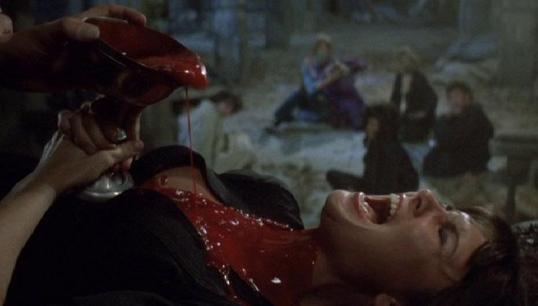
Anyway, the film meanders about a bit until finally, Alculard convinces all of his hippie friends to come take part in a black mass.  “Sure, why not?” everyone replies.  Well, I don’t have to tell you how things can sometimes get out-of-hand at black mass.  In this case, Dracula comes back to life, kills a young Caroline Munro, and eventually turns Johnny into a vampire before then setting his sights on the modern-day Van Helsings.

Poor Caroline Munro

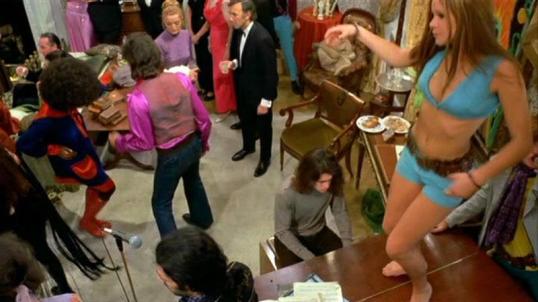
Dracula A.D. 1972 was Hammer’s attempt to breathe some new life into one of its oldest franchises and, as usually happens with a reboot, its critical and (especially) commercial failure ended up helping to end the series.  Among even the most devoted and forgiving of Hammer fans, Dracula A.D. 1972 has a terrible reputation.  Christopher Lee is on record as regarding it as his least favorite Dracula film.  And the film definitely has some serious flaws.  Once you get past the relatively exciting pre-credits sequence, the movie seriously drags.  There’s a hippie party sequence that, honest to God, seems to last for about 5 hours.  As for the hippies themselves, they are some of the least convincing middle-aged hippies in the history of fake hippies.  You find yourself eagerly awaiting their demise, especially the awkward-looking one who — for some reason — is always dressed like a monk.  (Those crazy hippies!)  But yet…nothing happens.  All the fake hippies simply vanish from the film.  Yet, they’re so annoying in just a limited amount of screen time that the viewer is left demanding blood.  Add to that, just how difficult is it to notice that Alculard is Dracula spelled backwards?  I mean, seriously…

To a large extent, the charm of the old school Hammer films comes from the fact that they’re essentially very naughty but never truly decadent.  At their heart, they were always very old-fashioned and actually quite conservative.  The Hammer films — erudite yet campy, risqué yet repressed — mirrors the view that many of my fellow Americans have of the English.  For some reason, however, that Hammer naughtiness only works when there’s the sound of hooves on cobblestone streets and when the screen is populated by actors in three-piece suits and actresses spilling out of corsets.  Dracula A.D. 1972 did away with the support of the corset and as a result, the film is revealed as a formless mess with all the flab revealed to the world.

The Party Scene

Still, the film isn’t quite as bad as you may have heard.  First off, the film — with its middle-aged hippies — has a lot of camp appeal.  It’s the type of film that, once its over, you’re convinced that the term “groovy” was uttered in every other scene even though it wasn’t.  As with even the worst Hammer films, the film features a handful of striking images and Christopher Neame is surprisingly charismatic as Alculard.

As with the majority of the Hammer Dracula films, the film is enjoyable if just to watch the chemistry between Christopher Lee and Peter Cushing.  Both of these actors — so very different in image but also so very stereotypically English — obviously loved acting opposite of each other and whenever you see them on-screen together, it’s difficult not to enjoy watching as each one tried to top the other with a smoldering glare or a melodramatic line reading.  As actors, they brought out the best in each other, even when they were doing it in a film like Dracula A.D. 1972.  In this film, Cushing is like the father you always you wished you had — the stern but loving one who protected you from all the world’s monsters (both real and cinematic).

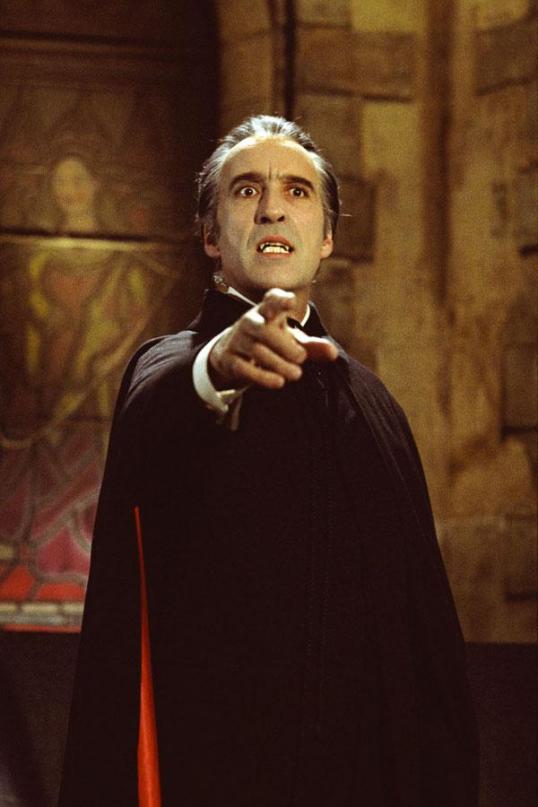
Christopher Lee as Dracula

As for Lee, he’s only in six or seven scenes and he has even fewer lines but, since you spend the entire film wondering where he is, he actually dominates the entire movie.  Lee apparently was quite contemptuous of the later Hammer Dracula films and, oddly enough, that obvious contempt is probably why, of all the Draculas there have been over the years, Lee’s version is the only one who was and is actually scary.  F0rget all of that tortured soul and reluctant bloodsucker crap.  Christopher Lee’s Dracula is obviously pissed off from the minute he first appears on-screen, the embodiment of pure destructive evil.  And, for whatever odd reason, the purity of his evil brings a sexual jolt to his interpretation of Dracula that those littleTwilight vampires can only dream about.  Even in a lesser films like Dracula A.D. 1972, Christopher Lee kicks some serious ass.

So, in conclusion, I really can’t call Dracula A.D. 1972 a good film nor can I really suggest that you should go out of your way to see it..  I mean, I love this stuff and I still frequently found my mind wandering whenever Cushing or Lee wasn’t on-screen.  However, it’s not a terrible movie to watch if you happen to find yourself trapped in the house with 90 minutes to kill.

Dracula A.D. 1972