Shattered Politics #34: The Parallax View (dir by Alan J. Pakula)


Parallax_View_movie_poster

Judging from the films that the decade produced, the 1970s were truly a paranoid time.  (Of course, 2015 is a paranoid time as well, which is probably why so many of the classic films of the 70s still feel incredibly relevant.)  Some weekend, you should watch a marathon of 1970s films and I guarantee that, by the time Monday rolls around, you will be looking for lurkers in every shadow and automatically distrusting any and all authority figures.  The 1970s were a good time to be paranoid.

And it’s really not surprising at all.  The previous decade was a time of turmoil and upheavel, a time when some people feared protestors and some people feared the establishment but, ultimately, everyone was afraid of someone.  When you think of the 1960s, you think about all the leaders who were violently assassinated — John F. Kennedy, Malcolm X, Martin Luther King, Robert F. Kennedy, and more.  (And that’s just in America!)  And then the 70s came along, with Watergate and the revelations about the CIA partnering up with the Mafia to try to kill Fidel Castro.

The 70s were a good time to be paranoid and the films of the 70s reflected that fact.

Take for instance, 1974’s The Parallax View.  The Parallax View opens and ends with assassination.  In both cases, the victims are U.S. politicians who are running for President and whose ambitions have caused concern for the shadowy and rarely seen leaders of the established order.  In both cases, the official story is that the assassin was a lone gunman, a nut with a gun and absolutely no political or religious motivations.  Of course, both accused assassins were apparently involved with the shadowy Parallax Corporation and, over the course of the film, anyone who knows anything about Parallax ends up dying.  Reporter Joe Frady (Warren Beatty) goes undercover to investigate the group but, as he does so, he grows increasingly paranoid and unstable, until finally  it’s easy to mistake him for any other paranoid madman, ranting in the street and, in many ways, indistinguishable from the accused assassins that he’s been investigating.  In many ways, Joe becomes like a character in a H.P. Lovecraft short story who, upon laying eyes on Cthulhu, is driven mad as punishment.

It’s a good film, one that’s enhanced by Gordon Willis’s trademark shadowy cinematography and the convincing desperation of Warren Beatty’s performance.  In the film’s best scene, Frady applies for a job with the Parallax Corporation.  As a part of his job interview, he’s taken a dark room and he’s told to watch a short film.  His reactions will help to determine what role he could possibly play at Parallax.

Needless to say, The Parallax View feels just as relevant today as it did when it was first released.  We still live in paranoid times and hints of conspiracy are still everywhere to be seen.  Perhaps the only thing that has changed is that, back in 1974, conspiracies could still take people be surprise.

Now, we just take them for granted.
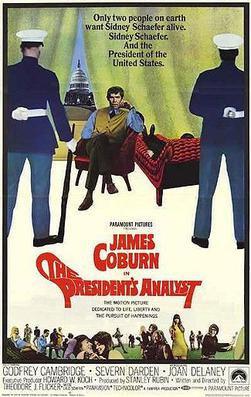
Shattered Politics #25: The President’s Analyst (dir by Theodore J. Flicker)


Presidents_movieposter “If I was a psychiatrist, which I am, I would say that I was turning into some sort of paranoid personality, which I am!” — Dr. Sidney Schaefer (James Coburn) in The President’s Analyst (1967)

Let’s just be absolutely honest about something.  Judging from what they regularly get caught saying and from some of the policies that they support, a good deal of politicians could probably use some sort of professional help.  That’s probably especially true of the men who sit in the Oval Office.  It can’t be easy to have to hide so many secrets, tell so many lies, and be constantly aware of how close the government is to actually collapsing.  We’ve had 44 Presidents and I imagine all of them probably could have used someone to talk to.

But here’s the thing.  We spend so much time worrying about the well-being of the President that we often don’t stop to think about the people who have to listen to them speak on a daily basis.  I imagine that being the President’s therapist must be a thankless job.  Not only do you have to spend hours listening to someone who you may not have voted for but, at the same time, you can’t share any of the information that you’ve learned.

That would certainly seem to be what’s happening with Dr. Sidney Schaefer (James Coburn), the title character of the wonderfully psychedelic 1967 satire, The President’s Analyst.  At the start of the film, Sidney is a supremely confident psychiatrist.  He can calmly and rationally deal with all of his patients problems and, in order to keep from getting overwhelmed, he has his own analyst (Will Geer).

One of his patients is Don Masters (Godfrey Cambridge), an agent for the Central Enquiries Agency (CEA) who is first seen casually murdering a man on the streets of New York.  (When Sidney discovers that Don is an assassin, he’s thrilled and impressed to discover that Don has managed to channel all of his hostility into his job.)  What Sidney doesn’t realize is that Don is testing him to see if he’s up to the job of serving as the President’s analyst.

At first, Sidney is thrilled with his new position but he soon discovers that being the closest confidante of the leader of the free world has its downside.  For one thing, Sidney is viewed by suspicion by Henry Lux (Walter Burke), the head of the Federal Bureau of Regulation (which, in this film, is exclusively staffed by people who are less than 5 feet tall).  Even beyond being targeted by the FBR, Sidney struggles with not being able to see his own therapist and discuss what he’s been told by the President.  Soon, Sidney is becoming paranoid and is even convinced that his girlfriend is a spy.

(And, of course, she is.)

So, Walter does what any sensible and paranoid person would do.  He makes a run for it.  Pursued by the FBR, the CEA, and a Russian assassin (a funny performance from Severn Darden, who also played Kolp, the sadistic torturer in Conquest of the Planet of the Apes), Sidney hides out with everyone from a group of hippies to a family of heavily armed, karate-trained, middle class “militant liberals.”

(The father of the militant liberal family is played by William Daniels, who decades later would play Mr. Feeney in Boy Meets World.)

Of course, there’s an even bigger conspiracy at work than even Sidney realizes.  The real threat is the TPC and I’m not going to tell you what that stands for.  You need to see the movie.

And really, The President’s Analyst is a film that you really should see.  What makes this film truly special — beyond the clever dialogue and the excellent performances and the great direction — is that it’s both a product of when it was made and a timeless portrait of power and paranoia.  It’s a time capsule that still feels incredibly relevant.


What Lisa Watched Last Night #52: Boy Meets World S5E17 “And Then There Was Shawn” (dir by Jeff McCracken)


Last night, my BFF Evelyn and I watched the infamous “And Then There Was Shawn” episode of the old ABC sitcom Boy Meets World.

Why Were We Watching It?

We were watching it because it’s October and we both had Halloween on the mind.  Of course, according to the Boy Meets World wikia — and yes, I am as shocked as you to discover that such a thing exists — this episode actually originally aired on February 27th, 1998 so, technically, it was more of a belated Valentine’s Day episode than a Halloween episode.  But anyone who has ever sat through And Then There Was Shawn knows that this was so totally a Halloween episode, even if it did air in February.

What Was It About?

And Then There Was Shawn pretty much starts out the exact same way as every single episode of Boy Meets World: Obsessive-stalker Cory (Ben Savage) and frigid, self-righteous Topanga (Danielle Fishel) are having issues and the entire world is just so concerned about whether or not they’ll be able to get back together so that they can eventually get married at the age of 18.  Cory’s friend Shawn (played by the very adorable Rider Strong) manages to stop talking about living in the trailer park long enough to disrupt Mr. Feeney’s history class.  Rather then questioning why his entire life seems to revolve around a bunch of 16 year-olds, Mr. Feeney (William Daniels) responds by giving everyone detention.

So, Topanga, Cory, and Shawn are all in Mr. Feeney’s after-school detention, along with Shawn’s boring girlfriend Angela and a random student named Kenny.  (It took me a while to recognize that Kenny was being played by Richard Lee Jackson, who I remembered from Saved By The Bell: The New Class.)  Since this is Boy Meets World, everyone is using their time in detention to discuss Cory and Topanga’s creepy relationship when suddenly “No one gets out of here alive” appears on the chalkboard, written in blood.

And from that moment on, it goes from being a standard episode of Boy Meets World to transforming into being perhaps one of the weirdest episodes ever to show up in a family sitcom.

Soon, Kenny’s dead as the result of someone jamming a pencil into his head, Mr. Feeney’s dead with a pair of scissors in his back, there’s a creepy janitor stalking the hallways, and Cory’s cute older brother Eric (Will Friedle) shows up, along with Jennifer Love Hewitt.  By the end of the episode, almost the entire cast has been killed and, of course, it turns out that it’s all because the entire world revolves around Cory and Topanga…

What Worked?

Over the course of the episode, just about every character on the show is killed off.  Considering just how annoying most of the characters on Boy Meets World could be, it’s hard not to appreciate this episode’s determination to kill all of them off.

The episode, itself, is actually pretty well-written and clever.  Unlike a lot of sitcom Halloween episodes, And Then There Was Shawn actually feels like a legitimate (and respectful) homage to the great horror films of the past.

What Did Not Work?

I’ve often wondered if the audiences in the 20th Century found the character of Cory Matthews to be as creepy as I find him to be in the 21st.  Seriously, whenever I see Boy Meets World, I’m struck by the fact that Cory basically spends every episode telling everyone that 1) they’ll never love anyone as much as he loves Topanga, 2) that Topanga’s belonged to him her entire life, and 3) that everyone in the world has an obligation to think about him and Topanga before they do or say anything.  In addition to that, you have to consider his oddly co-dependent relationship with Shawn, the fact that he looks nothing like anyone else in his family, and the fact that whenever he and Topanga have a fight, he yells, “NO!  We’re not supposed to ever disagree because I love you Topanga and … YOU LOVE ME!”  Seriously, what a creep!  Fortunately, Corey is less of a jerk than usual in this episode but, all things considered, it’s still hard to root for that little psycho.

Finally, what was up with the Boy Meets World theme song?  I mean, it’s awful but it certainly does get stuck in your head.

“OMG!  Just like me!” Moments

To be honest, I find almost all of the regular characters on Boy Meets World to be so annoying that I’m almost tempted to say that there wasn’t a single “Just like me!” moment in this episode.  However, I do have to admit that — much like Jennifer Love Hewitt in this episode — I probably would have found time to make out with Eric as well.  Seriously, he was soooooooooo cute!

Lessons Learned

Sitcom love = creepy love.