Bob Randall (John Wayne) is a coast guard boatswain, headquartered in Alaska where he and the members of his crew battle evil seal poachers like oily Phil Morgan (Russell Hicks). When Randall returns to port after his latest patrol, he has to deal with two disappointments. First off, he is passed over for a promotion to commanding officer, even though everyone knows that he deserves it. Instead, the promotion goes Lt. Commander Mays (William Blakewell), the son of a commander (George Irving). Mays doesn’t even want the job. He’s scared of the water and he’d rather fly airplane as a part of the Coast Guard’s aviation force. Bob is disappointed but he’s a professional and he’s going to support Mays. Secondly, Bob’s girlfriend (Nan Grey) witnesses a murder and is kidnapped by Phil Morgan. Bob and his sidekick (dependable western mainstay Fuzzy Knight) go undercover as fisherman to try to find her.
The Sea Spoilers was the first of six B-movies that John Wayne did for Universal. Wayne, who had been stuck in the B’s for a while, was trying to prove that he was more than just a singing cowboy so, in this one, he plays a tough and ready sailor. Wayne is convincing in the role, even if the movie is really just a western set in what was then modern day Alaska. Though only 30, Wayne shows the no-nonsense professionalism that would become his trademark once he became one of the world’s biggest movie stars. Unlike some of Wayne’s early films, it’s possible to see the icon that John Wayne would eventually become while watching him here. The Sea Spoilers is only 66 minutes long but fans of the Duke should enjoy it.
Finally, The Sea Spoilers was written by George Waggner. Waggner would later go on to direct the original Wolf Man.
I have to admit that the 1942 film, The Loves of Edgar Allan Poe, turned out to be far different from what I was expecting.
Just based on the title, I was expecting it would be a highly fictionalized, borderline silly film about Edgar Allan Poe defeating his romantic rivals and winning the hand of the woman he loved while still finding time to write The Raven. I figured that there would be at least a few gentlemanly fisticuffs, with Poe portrayed as a combination of Rhett Butler and Cary Grant. Looking at the title, it was easy for me to imagine the film closing with Poe kissing his future wife and then looking straight at the camera. “Quoth the Raven!” he would say and wink while romantic music swelled in the background…
But no. The Loves of Edgar Allan Poe is actually a very conventional biopic. With a running time of only 67 minutes, the movie often feels rather rushed but it still manages to include most of the better known details of Edgar Allan Poe’s short but eventful life. (An ever-present narrator is always ready to fill us in on every thing that happens off-screen.) The film doesn’t spend much time on what initially inspired Poe’s macabre imagination. There’s a scene of Poe, as a child, standing on a desolate hill and looking at a raven perched in a dead tree. With the exception of an extended section that deals with Annabel Lee, that’s about as deep as the movie is willing to get as far as Poe’s art is concerned.
When Poe grows up, he’s played by actor Sheppard Strudwick, who has a good mustache but never exactly comes across as being the type of tortured genius who would eventually end up both revolutionizing literature and drinking himself to death. The majority of the film deals with Poe’s advocacy for copyright reform, which is an important issue but not exactly the most cinematic of concerns. Poe survives college. Poe tries to sell The Raven for $25. Eventually, Poe marries Virginia Clemm (Linda Darnell) and her subsequent sickness and death leads to not only Poe’s greatest work but also his own tragic end.
Along the way, Poe meets both Thomas Jefferson and Charles Dickens. Jefferson shows up long enough to tell a young Poe that he’s a good writer and that he needs to stop gambling. Dickens meets Poe and encourages him to continue to advocate for better copyright laws.
It is known that Poe and Dickens actually did meet but did Poe also meet Thomas Jefferson? Legend says that he did but no one knows for sure. Here’s what we do know:
Poe attended the University of Virginia in 1826. The University’s founder, former President Thomas Jefferson, was still alive in 1826 and would often invite promising students to Monticello. Whether Jefferson was still doing that when Poe enrolled at the University of Virginia is questionable. Jefferson died five months after Poe started his studies.
As for Dickens, Charles Dickens and Edgar Allan Poe admired each other’s writing and they met in Philadelphia during Dickens’s 1842 tour of North America. No record has been kept of what they discussed, though some think that Dickens told Poe about his pet raven and perhaps inspired Poe’s best-remembered poem. In the movie, they discuss copyright laws, which is nowhere near as much fun.
(When it comes to Poe’s meetings with both Jefferson and Dickens, it is perhaps best to remember the lesson of The Man Who Shot Liberty Valance and print the legend.)
The Loves of Edgar Allan Poe is a very short film and an obviously low-budget one as well. When the presence of that somewhat pedantic narrator, The Loves of Edgar Allan Poe feels more like an educational special than a real movie. It’s an okay introduction to Poe’s life but, ultimately, the best way to get to know Edgar Allan Poe is to sit down and start reading.
“When it comes to dying for your country, it’s better not to die at all!”
— Paul Baumer (Lew Ayres) in All Quiet On The Western Front (1930)
Tonight, I watched the third film to ever win the Oscar for Best Picture, the 1930 anti-war epic, All Quiet On The Western Front.
All Quiet On The Western Front opens in a German classroom during World War I. Quotes from Homer and Virgil, all exalting heroism, are written on the blackboard. The professor, a man named Kantorek (Arnold Lacy), tells his all-male class that “the fatherland” needs them. (It’s all very patriarchal, needless to say.) This, he tells them, is a time of war. This is a time for heroes. This is a time to fight and maybe die for your country. He beseeches his students to enlist in the army. The first to stand and say that he will fight is Paul Baumer (Lew Ayres). Soon, almost every other student is standing with Paul and cheering the war. Only one student remains seated. Paul and the others quickly turn on that seated student, pressuring him to join them in the army. That seated student finally agrees to enlist, even though he doesn’t want to. Such is the power of peer pressure.
A year later, a visibly hardened Paul returns to his old school. He’s on furlough. He’s been serving in a combat zone, spending his days and nights in a trench and trying not to die. He’s been wounded but he hasn’t been killed. He can still walk. He can still speak. He hasn’t gone insane. He is one of the few members of his class to still be alive. (That student who didn’t want to enlist? Long dead.) When Kantorek asks Paul to speak to his new class, Paul looks at the fresh-faced students — all of whom have just listened to Kantorek describe the glories of war — and Paul tells them that serving in the army has not been an adventure. It has not made him a hero. The only glory of war is surviving. “When it comes to dying for one’s country, it’s better not to die at all!” Kantorek is horrified by Paul’s words but he needn’t have worried. The students refuse to listen to Paul, shouting him down and accusing him of cowardice and treason.
(This scene is even more disturbing today, considering that we live in a time when accusations of treason and calls for vengeance are rather cavalierly tossed around by almost everyone with a twitter account.)
What happened between those two days in the classroom is that Paul saw combat. He spent nights underground while shells exploded over his head. He watched as all of his friends died, one by one. One harrowing night, spent in a trench with a French soldier who was slowly dying because of Paul stabbing him, nearly drove Paul insane. In the end, not even his friend and mentor, Kat (Louis Wolheim), would survive. From the first sound of bombs exploding to the film’s haunting final scene, the shadow of death hangs over every minute of All Quiet On The Western Front. By the end of it all, all that Paul has learned is that men like Kantorek and the buffoonish Corporal Himmelstoss (John Wray) have no idea what real combat is actually like.
All Quiet On The Western Front may be 87 years old but it’s still an incredibly powerful film. There are certain scenes in this pre-code film that, after you watch them, you have to remind yourself that this film was made in 1929. I’m not just talking about a swimming scene that contains a split second of nudity or a few lines of dialogue that probably wouldn’t have made it past the censors once the production code started to be enforced. Instead, I’m talking about scenes like the one where a bomb goes off just as a soldier attempts to climb through some barbed wire. When the smoke clear, only his hands remains. And then there’s the sequence where the camera rapidly pans by soldier after soldier falling dead as they rush the trenches. Or the scene where Paul literally watches as one of his friends, delirious and out-of-his-mind, suddenly dies. Or the montage where a pair of fancy boots is traded from one doomed soldier to another, with each soldier smiling at his new boots before, seconds later, laying dead in the mud. Or the harrowing scene where Paul tries to keep a French soldier from dying.
All Quiet On The Western Front remains a powerful film. It’s perhaps not a surprise that, when it briefly played in Germany, the Nazis released live mice in the theaters to try to keep away audiences. (Both the film and the book on which it was based were later banned by the Nazi government.) Sadly, we’ll never get to see All Quiet On The Western Front the way that it was originally meant to be seen. A huge hit in 1930, All Quiet On The Western Front was rereleased several times but, with each rerelease, the film was often edited to appease whatever the current political climate may have been. Over the years, much footage was lost. The original version of All Quiet On The Western Front was 156 minutes long. The version that is available today is 131 minutes long. But even so, it remains a harrowing and powerful antiwar statement.
With all due respect to both Wingsand Broadway Melody, All Quiet On The Western Front was the first truly great film to win the Oscar for Best Picture. Sadly, it remains just as relevant today as when it was first released.
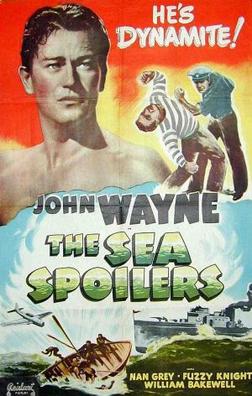 Bob Randall (John Wayne) is a coast guard boatswain, headquartered in Alaska where he and the members of his crew battle evil seal poachers like oily Phil Morgan (Russell Hicks). When Randall returns to port after his latest patrol, he has to deal with two disappointments. First off, he is passed over for a promotion to commanding officer, even though everyone knows that he deserves it. Instead, the promotion goes Lt. Commander Mays (William Blakewell), the son of a commander (George Irving). Mays doesn’t even want the job. He’s scared of the water and he’d rather fly airplane as a part of the Coast Guard’s aviation force. Bob is disappointed but he’s a professional and he’s going to support Mays. Secondly, Bob’s girlfriend (Nan Grey) witnesses a murder and is kidnapped by Phil Morgan. Bob and his sidekick (dependable western mainstay Fuzzy Knight) go undercover as fisherman to try to find her.


 Through the Shattered Lens