October True Crime: Murder in Coweta County (dir by Gary Nelson)


In 1948, one of the richest men in Georgia committed a murder.

John Wallace was a landowner, back when that title actually meant something.  He was known as the boss of Meriweather County.  Everyone in the county seemed to work for Wallace in one way or another.  He controlled the county officials.  The sheriff enforced the law only as far as John Wallace would allow him.  The bootleggers had to pay Wallace for protection.  When one bootlegger, a sharecropper named Wilson Turner, failed to do so, he was fired and kicked off of Wallace’s land.

Turner retaliated by stealing two of Wallace’s cows.

Wallace responded by murdering Turner.

Because Turner attempted to flee and Wallace chased after him, Wallace committed the murder not in Meriweather County but in neighboring Coweta County.  What Wallace didn’t realize was that this meant the investigation didn’t fall under the jurisdiction of his hand-picked sheriff.  Instead, Sheriff Lamar Potts of Coweta County headed up the investigation.  John Wallace was eventually arrested by Sheriff Potts and he was eventually convicted of murdering Wilson Turner.  At the time, the case drew a lot of attention both because of Wallace’s wealth but also because two of the main witnesses for the prosecution were the two black men who Wallace forced to help him dispose of Wallace’s body.

It’s an interesting story, largely because the history of America is full of men like John Wallace, people who set up their own little dictatorships.  It’s often portrayed as being a Southern phenomena but John Wallace really wasn’t that much different from the crude political bosses who, for decades, dominated politics in city like New York and Chicago, the type who held onto power through a combination of intimidation and patronage.  In my home state of Texas, George Berham Parr inherited the political machine that controlled Duval and Jim Wells County.  Parr committed numerous crimes during his time as the “Duke of Duval” but he had important friends.  He was the one who “found” the votes necessary for Lyndon Johnson to win a senate seat in 1948.  (In return, Johnson got Harry Truman to pardon Parr for failing to pay his taxes.)  Parr is also suspected of having been involved in at least one murder but it wasn’t until LBJ himself retired from politics that anyone truly investigated Parr’s activities.  In 1974, he was again convicted of failing to pay his taxes and Parr was later found dead at his ranch.  Suicide was the official police ruling.

As for the story of John Wallace, it was turned into a made-for-TV movie in 1983.  Murder in Coweta County stars Andy Griffith as John Wallace and Johnny Cash as Sheriff Potts.  Griffith, playing a soulless villain, is chilling as John Wallace.  Wallace is all-smiles and good ol’ boy charisma whenever there’s a crowd around but, once it’s just him and his cronies, a different side comes out.  Wallace thinks that he can get away with murder because he’s been able to get away with everything else.  Sheriff Potts is determined to see that justice is done.  Murder in Coweta County is an atmospheric Southern crime story, one that is so full of atmosphere that you can feel the humidity.  While Johnny Cash was definitely a better singer than an actor, Andy Griffith’s villainous turn makes the film worth watching.
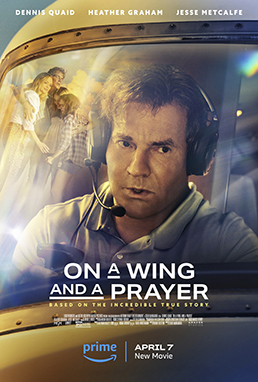
Film Review: On a Wing and a Prayer (dir by Sean McNamara)


Having just attended the funeral of his brother, Doug White (Dennis Quaid) and his family — wife Terri (Heather Graham) and daughters Bailey (Abigail Rhine) and Maggie (Jessi Case) — are flying back to their home in Louisiana.  Unfortunately, shortly after takeoff, their pilot suffers a heart attack and dies.  Now Doug, who’s had only one flight lesson in his entire life, has to not only fly the plane but also land safely.

Doug has people on the ground, trying to talk him through the landing even though they don’t know what is actually happening in the cockpit.  Hard-drinking Dan Favio (Rocky Myers) calls his friend, Kari Sorenson (Jesse Metcalfe).  Kari has never gotten over the death of his family in a similar plane crash so, for him, helping Doug land is about more than just saving Doug and his family.  It’s also about achieving his own personal redemption and hopefully finding the strength to forgive himself.

While this is going on, two kids — Donna (Raina Grey) and Buggy (Trayce Malachi) — follow the flight online and then head down to the airport so that they can watch it try to land.  To be honest, I’m really not sure why either one of them is in the movie.  When Donna first showed up, talking about how she wanted to be a pilot because “Mr. Jones” told her that girls can’t fly planes, I found myself dreading the inevitable moment when the kids would take it upon themselves to help Doug land the plane.  I dreaded Donna calling the cockpit and Doug going, “Wait a minute …. you’re just a kid!”  Fortunately, that moment didn’t happen but I was still left wondering why Donna and Buggy were in the film to begin with.

It feels almost churlish to be overly critical of a film like On a Wing and a Prayer because it is based on a true story.  Doug White really did have to land an airplane after the pilot died mid-flight and he really was instructed on what to do by a group of air traffic controllers and Kari Sorenson.  It’s a good story and the film ends with some undeniably touching shots of the real people involved in the landing.  That said, this is ultimately a film that many filmgoers will want to like more than they actually do.  Thanks to some dodgy special effects, the viewer never forgets that Dennis Quaid and his family aren’t really tapped up in the sky.  Instead, one is always aware that they’re just watching a movie and a rather cheap-looking one at that.  As well, the script is full of awkward dialogue and heavy-handed moments.  As soon as I saw that one of the daughters wouldn’t stop looking at her phone, I knew that she would be the one who would be forced to grow up in a hurry.  As soon as the other daughter ate something with nuts in it, I knew that there was going to be a desperate search for an epi-pen.

On the plus side, Dennis Quaid was as likable as ever and Heather Graham managed to wring some genuine feeling out of even the most sentimental of dialogue.  On A Wing and a Prayer was directed by Sean McNamara, who also directed one of my favorite films of 2011, Soul Surfer.  (Later this year, McNamara and Quaid have another project that is scheduled to be released, a biopic of President Ronald Reagan.)  On A Wing and A Prayer doesn’t really work as a film but, as a story, it at least reminds us of what people are capable of doing when they all work together.

Embracing The Melodrama Part II #121: No Good Deed (dir by Sam Miller)


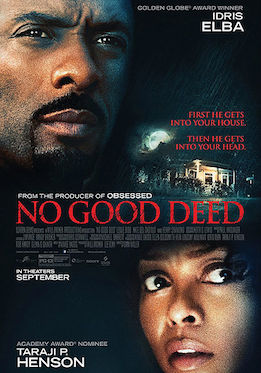
No_Good_Deed_2014_movie_posterSo, this weekend, my BFF Evelyn and I were watching the critically reviled 2014 film No Good Deed.  As we watched Idris Elba (playing the role of Colin) viciously and violently choke to death a character played by Kate del Castillo, Evelyn said, “He can strangle me any time that he wants.”  My first instinct was to reprimand my friend and remind her that it’s not empowering to allow a man to murder you, regardless of how unbelievably sexy that man may be.  But then, by the time that Idris was murdering Leslie Bibb, I found myself agreeing.  Seriously, Idris Elba can do anything he wants to me….

Idris is pretty much the only reason to see No Good Deed.  No Good Deed is one of those crappy suspense films where every plot point hinges on someone acting like a total idiot.  Colin escapes from prison.  Colin murders his ex-fiancee after he discovers that she’s been cheating on him.  Later, Colin crashes his truck outside of the house of Terri Granger (Taraji P. Henson).  Terri’s husband is out-of-town and when Colin shows up at her doorstop and asks to use the phone to call for a tow truck, Terri invites him inside.  Terri’s friend Meg (Leslie Bibb) shows up.  Mayhem follows.  Of course, there’s a big twist at the end.

This is where I’d usually say something like, “DON’T REVEAL THE SURPRISE ENDING OF NO GOOD DEED!” but, honestly, you’ll figure it out within the first few minutes of the film.  It’s pretty obvious and it’s pretty stupid.  I won’t reveal it but if you see the film, feel free to tell all your friends about the big twist.  Some films were meant to be spoiled.

As I watched No Good Deed and found myself hissing at the terrible dialogue and the total stupidity of all of the characters and wondering if any of the filmmakers had ever actually met any real human beings, I found myself wondering how this film could be so incredibly bad.  I hopped onto the imdb and discovered that the film was written by Aimee Lagos.

If you don’t recognize that name, Lagos also wrote and directed the absolutely terrible movie, 96 Minutes.  And I will say this: No Good Deed is slightly better than 96 Minutes.

That’s the power of Idris Elba.

(Incidentally, it bothers me that nobody in this film is actually named Deed.  If Colin’s full name had been Colin Deed … well, that would have been pretty stupid but it would have at least been kinda fun and entertaining.)

(Also, for those keeping track, that’s 121 reviews down and 5 to go.)

Film Review: Devil’s Knot (dir by Atom Egoyan)


After having spent close to a year hearing only negative things about it, I finally watched Atom Egoyan’s Devil’s Knot last night.  On the basis of what a lot of critics had said about the film, I have to admit that I was mostly watching it to see if I needed to include it on my upcoming list of the 16 worst films of 2014.

But you know what?

Devil’s Knot really isn’t a bad film.  It’s just an extremely unnecessary one.

Devil’s Knot opens with a title card that reads, “Based on a true story.”  Honestly, the title card could have just as easily read, “Based on a true story and if you doubt it, there’s four other movies you can watch.”  The trial, conviction, and subsequent imprisonment of the West Memphis Three is perhaps the most famous miscarriage of justice in recent history precisely because so many documentaries have been made about it.  Paradise Lost and Paradise Lost Part Three are two of the most disturbing true crime documentaries ever made.

(As for Paradise Last Part Two, it displays a stunning lack of self-awareness as it attempts to prove the guilt of John Mark Byers by using many of the same techniques that were used to convict the West Memphis Three.  The less said about it, the better.)

The story is so well-known that I almost feel like retelling it would be like taking the time to inform you that George Washington was our first president.  But here goes — in 1993, 3 eight year-old boys were murdered in the small town of West Memphis, Arkansas.  Three teenagers were arrested for the crime and, on the flimsiest of evidence, were convicted.  As is seen in the documentaries, their conviction had more to do with community hysteria and paranoia than anything else.  The supposed leader of the West Memphis Three, Damien Echols, was accused of being a Satanist.  Why?  Mostly because he wore black clothing.

Eventually — and largely as a result of the documentaries made about the case — the West Memphis Three would be freed from prison.  (However, their convictions would still legally stand, meaning that their exoneration would be limited to the court of public opinion.)  Devil’s Knot, however, doesn’t deal with any of that, beyond a lengthy scroll of “this is what happened after the movie” information that rolls up the screen after the final scene.  Instead, Devil’s Knot deals with the first trial of the West Memphis Three and the small town atmosphere of fear and hysteria that led to them being convicted in the first place.

And — though the film is surprisingly conventional when you consider the reputation of director Atom Egoyan — it’s all fairly well-done.  As a former resident of and frequent visitor to Arkansas, I was happy to see that Egoyan didn’t indulge in as many stereotypes as I feared he would.  (One need only watch the self-important Northern activists in Paradise Lost Two to see the attitude that I feared Egoyan would bring to the project.)  Reese Witherspoon is perfectly cast as the mother of one of the murdered boys.  Kevin Durand is properly intimidating at John Mark Byers.  Even Colin Firth manages to make for a convincing Arkansan.

But, ultimately, Devil’s Knot just feels so unnecessary.  It doesn’t bring anything new to the story and there’s ultimately nothing here that you couldn’t have learned from the original Paradise Lost.

Probably the best thing that I can say about Devil’s Knot is that it’s better than Paradise Lost Part Two.