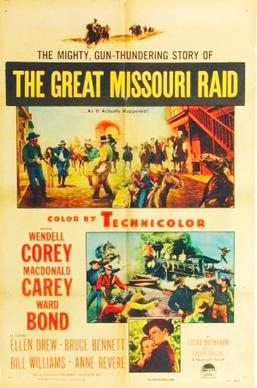
 During the Civil War, brothers Frank (Wendell Corey) and Jesse James (Macdonald Carey) leave the family farm and fight as Confederate guerillas under the leadership of the infamous William Quantrill. When the war ends with the Confederacy’s defeat, Frank, Jesse, and their friend Cole Younger (Bruce Bennett) return home to Missouri and discover that their town is being ruled over the tyrannical Major Towbridge (Ward Bond). With their farms in ruin and having little opportunity to make honest money, the James Brothers and the Younger Brothers soon resort to robbing banks and trains. It’s their revenge against not only the soldier occupying their land but also the bankers and land barons who have been taking advantage of their friends and family members. The James-Younger Gang become heroes to economically oppressed people everywhere.
From the minute that they arrive home, Towbridge is determined to imprison the James brothers. Not only does he distrust them because of their past with Quantrill but he also blames them for the death of his own brother. Towbridge becomes so obsessed that he even leaves the army so that he can pursue Frank and Jesse as a private detective. Even as it appears that Jesse might be on the verge of settling down and abandoning his criminal life, he still has to deal with unexpected visitors like the Ford brothers.
The story of Frank and Jesse James inspired several films, some of which were better than others. Directed with a good eye for detail by Gordon Douglas, The Great Missouri Raid tells the familiar story with enough skill to be watchable but it never reaches the classic status of Walter Hill’s The Long Riders.
The main problem is that both Wendell Corey and Macdonald Carey come across as being almost too civilized as the James brothers. The film is obviously sympathetic to the James brothers and, as westerns tended to do in the 50s, it ignores some of the less heroic details of their lives of outlaws. (The film, for instance, doesn’t mention that the James brothers were probably already outlaws before the Civil War started and it’s doubtful that a modern film would be as sympathetic to two men who left home to fight for the Confederacy.) Usually, though, even the most sympathetic film portrayals of the James brothers still portray them as being the type of people who you wouldn’t necessarily want to meet while riding the trail. Wendell Corey and Macdonald Carey play Frank and Jesse as being so nice that it’s hard to believe that they could have even rode with Quantrill, let along the Younger brothers. They’re the most reasonable outlaws this side of the Mississippi. Bruce Bennett and Bill Williams are more believable as the rough and tough Cole and Jim Younger.
Not surprisingly, the film is stolen by Ward Bond. Bond usually played reasonable authority figures for John Ford and Frank Capra. As Major Towbridge, though, he’s cast as a martinet who allows his obsession with James brothers to turn him into a fanatic. For those who are used to only seeing Bond cast as a fair cop or a tough-but-fair military officer, his performance in The Great Missouri Raid is a revelation.
The Long Riders is the best movie about the James Gang but, for western fans, The Great Missouri Raid should be entertaining if not definitive.


 Through the Shattered Lens