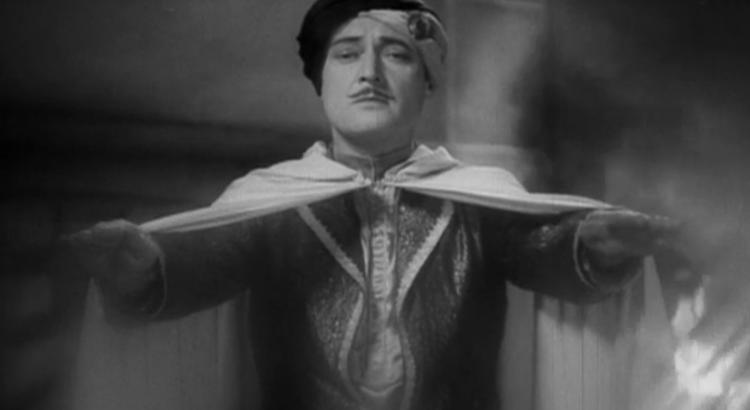
Film Review: Speed (dir by Edwin L. Marin)


1936’s Speed takes place in Detroit, at the home of Emery Motors.

When Joan Mitchell (Wendy Barrie) shows up to start her new job in the PR department, one of the first things she sees is a car being driven around a race track at a high speed until eventually it crashes.  Automotive engineer Frank Lawson (Weldon Heybourn) explains that it’s all a part of making sure the car is safe.  At Emery Motors, they crash cars on a daily basis to make sure that both the car and the driver will survive.

Terry Martin (James Stewart), the driver of the crashed car, proceeds to give Joan a tour of the factory.  There’s an obvious attraction between the two of them but Joan also seems to have feelings for Frank.  Terry and Frank are rivals.  Terry may not have Frank’s education but he has instincts and he has common sense.  He and his friend, Gadget Haggerty (Ted Healy), have an instinctive understanding of cars.  They know how to drive them.  They know how to fix them.  They know how to make them go really fast.

In fact, Terry is working on a new carburetor, one that he says will increase the speed of Emery’s cars.  Frank is skeptical but Terry knows that, if he can enter his car into the Indianapolis 500, he’ll be able to prove that he knows what he’s talking about.  Joan comes to believe in Terry and his carburetor.  And, fortunately, Joan has a secret of her own that will be very helpful to Terry’s ambitions.

Speed was not Jimmy Stewart’s first feature role but it was his first starring role.  28 years old when he starred in Speed, Stewart is tall, a little bit gawky, and unbelievably adorable.  From the minute that Terry climbs out of that wrecked car and introduces himself to Joan, Stewart’s a true movie star.  He and Wendy Barrie have a lot of chemistry and are a truly cute couple but Stewart is the one who dominates the film with his straight-forward charisma.  Terry may not be the best educated engineer at Emery Motors but he is determined to prove himself and Stewart does a great job of portraying that determination.

As for the film itself, it’s low-budget and it’s short.  Automotive enthusiasts might enjoy seeing all of the old cars and getting a chance to see what a car race was about in the days when cars themselves were still a relatively new invention.  The film itself starts out as almost a documentary, with Stewart (as Terry) explaining how each car is manufactured on the assembly line.  He points out all the machinery that goes into making the car in an almost-awed tone of voice.  If the information is a bit dry, it doesn’t matter because it’s impossible not to enjoy listening to Jimmy Stewart speak.  In his pre-WWII films, Stewart was the voice of American optimism and that’s certainly the case with Speed.

Speed was not a huge box office success but, in just two years, Stewart would be working with Frank Capra on You Can’t Take It With You, the first Stewart film to be nominated for (and to win) the Oscar for Best Picture of the year.

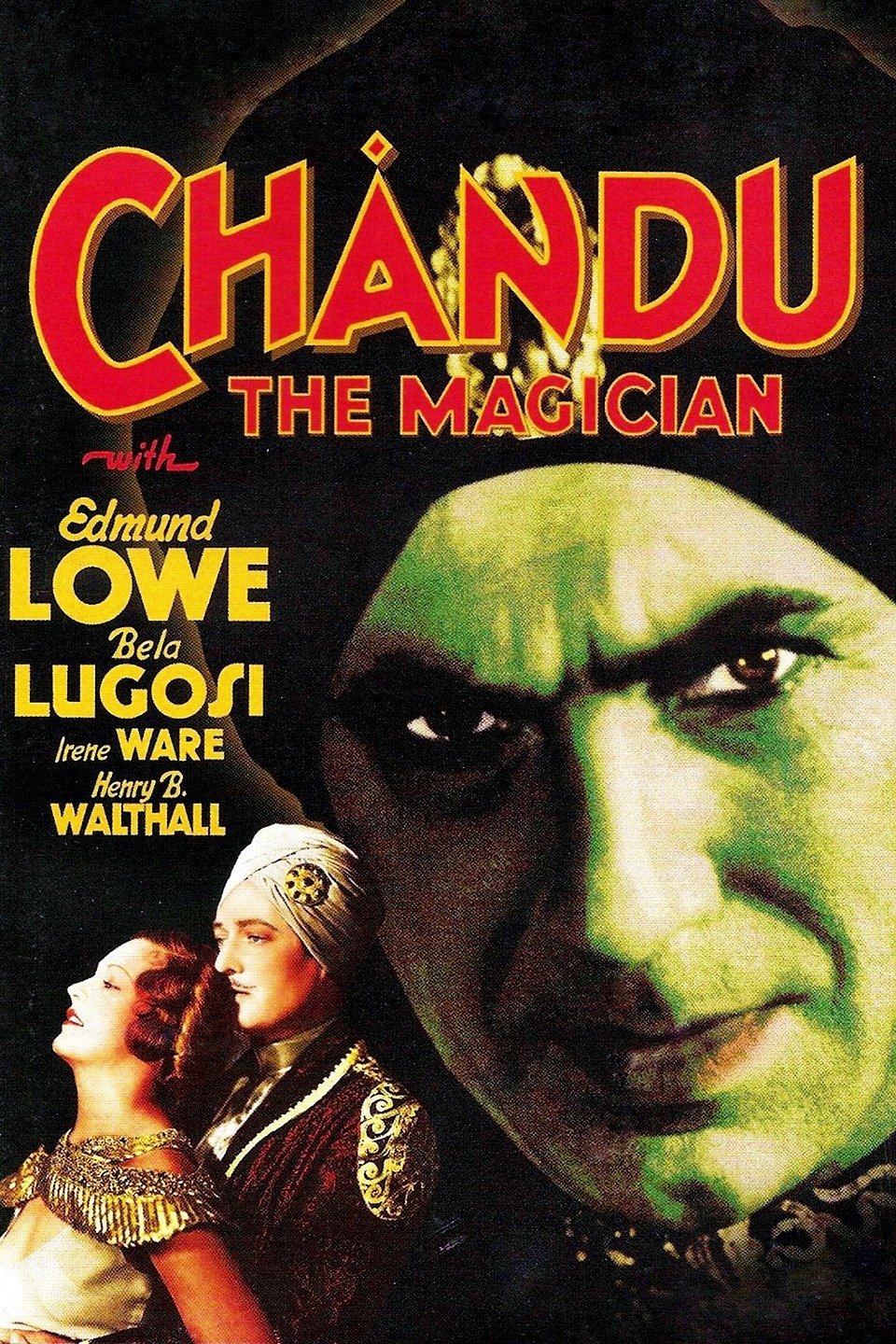
Halloween Havoc!: Bela Lugosi in CHANDU THE MAGICIAN (Fox 1932)


gary loggins's avatarcracked rear viewer

chandu1

Thrills! Chills! Romance! Action! CHANDU THE MAGICIAN plays like a Saturday matinée serial aimed directly at the kiddie crowd. Based on a popular radio series, the film is pretty antiquated seen today, its saving graces being the special effects wizardry of co-director William Cameron Menzies and the deliciously evil Bela Lugosi as the megalomaniacal villain Roxor.

chandu2

The movie kicks off with the banging of a gong and an offscreen narrator ominously intoning “Chan-du the Magician”. A hand is used to wipe the screen credits, the first of Menzies’ many filmic tricks. We’re taken inside a temple where Frank Chandler, aka Chandu, has spent three years learning the ancient secrets of the mystic arts (move over, Dr. Strange!). He’s a yogi now, master of the hypnotic eye and astral projection, and demonstrates his prowess by performing the old Indian rope trick and walking through fire. His mentor bids him to “go…

View original post 682 more words

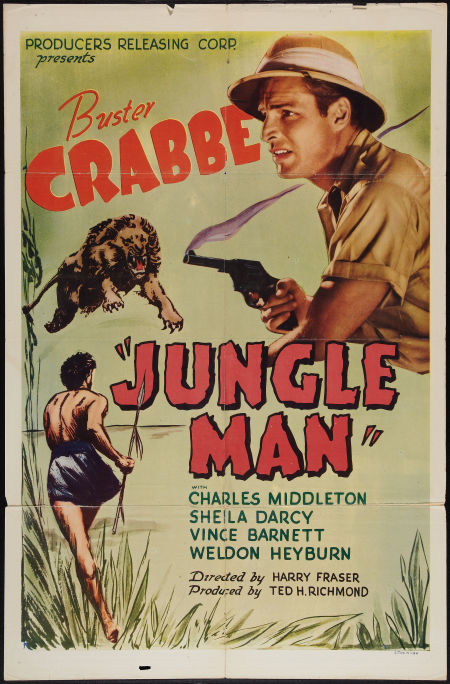
The Fabulous Forties #25: Jungle Man (dir by Harry L. Fraser)


40s

About a month ago, for reasons that I’m sure made sense at the time, I decided it would be fun to watch and review all 50 of the films included in Mill Creek’s Fabulous Forties box set.  If you know anything Mill Creek box sets, then you won’t be surprised to learn that the majority of these 50 films are public domain B-movies.  A few of them have been good, a few of them have been bad, and a few of them have been forgettable.

I have to admit that, as much as I love watching old movies, there’s a part of me that’s more than ready to move onto the next Mill Creek box set, the Nifty Fifties.  But, before I do that, I have to finish up the Forties.  Fortunately, I just watched the 25th film included in the Fabulous Forties and I am happy to say that I am now halfway done with this project!  Yay!

As for the film itself, it’s a 63-minute film from 1941.  Though it was later retitled Drums of Africa, it was originally called Jungle Man.

Jungle Man

As for what Jungle Man is about … well, it’s mostly about stock footage.

There is kind of a plot.  Wealthy Bruce (Weldon Heyburn) and his friend Alex (Robert Carson) want to go to Africa so that they can see the legendary City of the Dead.  Bruce’s fiancée, Betty (Sheila Darcy), decides to accompany them because she wants to visit her brother (Charles Middleton), a missionary.  Once they get to Africa, they also meet a doctor (Buster Crabbe) who is trying to find a cure for a fever that is wiping out the native population.

But really, the plot is mostly just an excuse for stock footage.  We watch as our explorers walk down a jungle trail.  Someone says, “Look up in that tree!”  We cut to grainy footage of a monkey in a tree.  Cut back to everyone looking upward.  Cut back to that monkey in the tree.  Suddenly, we hear a roar on the soundtrack.  Cut to slightly less grainy footage of a tiger running through a field.  Cut back to the explorers saying, “Look out, tiger!”  Cut back to the monkey climbing up higher in the tree.

(Of course, tigers don’t live in Africa but that’s just the type of film this is!)

Even when our heroes finally reach the City of the Dead, we don’t actually see them walking around the city.  Instead, we see them staring into the distance and then immediately cut to some still shots of what Wikipedia identifies as being Cambodia’s Angkor Wat.  Of course, no attempt is really made to match any of the shots.  If Jungle Man was made today, they could just CGI the Hell out of it.  But since it was made in 1941, audiences had to suspend their disbelief and accept shots that didn’t particularly match up with any other shots and a storyline that was pretty much determined by whatever stock footage the producers had available.

On the plus side, it’s only 60 minutes long and some of the stock footage is fun, particularly if you like cute monkeys or fierce tigers.  For the most part, it’s silly but inoffensive.

And you can watch it below!

http://www.youtube.com/watch?v=IUz4Vvay7so

(I should admit that, as I watched it, I kept thinking about those GEICO commercials where Jane and Tarzan are lost in the jungle and Tarzan refuses to ask for directions.  “Tarzan know where Tarzan go.”  “No, Tarzan does not know where Tarzan go.  Excuse me, do you know where the waterfall is?  The waterfall?”)