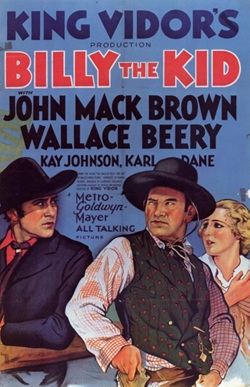
Billy The Kid (1930, directed by King Vidor)


In a frontier town, land baron William P. Donavon (James A. Marcus) finds his control challenged by the arrival of a English cattleman named John W. Tunston (Wyndham Standing).  Donavon orders his henchmen to gun down Tunston on the same day that Tunston was to marry the lovely Claire (Kay Johnson).  Tunston’s employee, an earnest young man named Billy The Kid (Johnny Mack Brown), sets out to avenge Tunston’s murder.  When Billy starts killing Donavon’s henchmen, it falls to Deputy Sheriff Pat Garrett (Wallace Beery) to arrest him.  When Billy escape from jail and rides off to be with Claire, Garrett pursues him.  Garrett is a friend of Billy’s and he knows that Billy’s killings were justified.  But he’s also a man of the law.  Will he be able to arrest or, if he has to be, even kill Billy?  Or will Garrett let his friend escape?

There were two silent biopics made about Billy the Kid but neither of them are around anymore.  This sound movie, directed by King Vidor, appears to the earliest surviving Billy the Kid film.  It’s a loose retelling of Billy’s life and his friendship with Pat Garrett and it doesn’t bother with sticking close to the established facts but that’s to be expected.  It’s an early sound film and, seen today, the action and some of the acting feels creaky.  Wallace Beery was miscast as Pat Garrett but I did like Johnny Mack Brown’s performance as the callow Billy.  The movie goes out of its way to justify Billy’s murders and it helps that Billy is played by the fresh-faced Brown.  King Vidor shows a good eye for western landscapes, a skill that would come in handy when he directed Duel In The Sun seventeen years later.

There are better westerns but, for fans of the genre, this film is important as the earliest surviving film  about one of the most iconic outlaws not named Jesse James.  It’s interesting to see Brown, usually cast as the clean-cut hero, playing a killer here.  The film’s ending is pure fantasy but I bet audiences loved it.
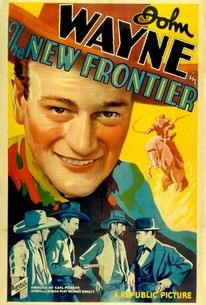
The New Frontier (1935, directed by Carl Pierson)


In 1889, wagon master Milt Dawson (Sam Flint) rides into a western town. He is planning on meeting his son John, who is also a wagon master. However, when a friend of Milt’s is killed by gambler Ace Holmes (Warner Richardson), Milt announces that he’s going to clean up the town and Ace is the first piece of trash that Milt is going to toss out. Ace responds by having his henchmen shoot Milt in the back.

After Milt’s death, his son finally arrives in town and you know that Ace is going to be in trouble because John Dawson is played by John Wayne! Seeking to avenge his father’s death, John teams up with an outlaw named Kit (Al Bridge) and declares war on Ace and his gang.

This is a typical western programmer, one that would probably be forgotten if not for the presence of John Wayne in an early starring role. This was before Stagecoach so the budget is low and the plot is simple. Even in his early 20s, John Wayne has the natural authority that would later make him a star but it’s still strange for me to see him in any film where he’s playing a young man who still has parents. There are some actors who you can’t picture as ever having been anything less than middle-aged and John Wayne is one of them. While most of the other actors are stiff and awkward, Wayne seems right at home in the dusty streets of The New Frontier. Interestingly, given Wayne’s identification with law-and-order, he plays a character here who has no problem working with outlaws and who understands that sometimes, the law can be unfair.  Ace is the most powerful man in town and John has no choice but team up with those on the outs of what was then considered to be respectability.  Another memorable scene juxtaposes a gun battle with the town’s citizens praying in church, a reminder that innocent people were often caught in the middle of the old west’s grudge matches.  These are interesting themes, though they’re not very deeply explored.  

Though the gunfights are nicely choreographed and shot, the chance to see a pre-stardom John Wayne clean up the old west is the main reason to watch The New Frontier.

Embracing the Melodrama Part II #11: Child Bride (dir by Harry Revier)


Child_Bride“Child marriage must go!”

— Miss Carol (Diana Durrell) in Child Bride (1938)

Oh my God!

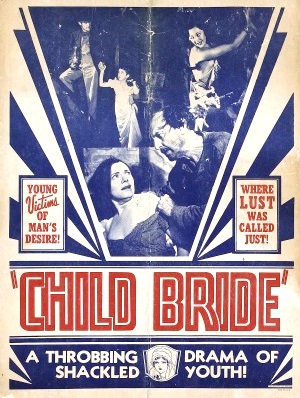
Listen, I have never made a secret about the fact that I love low-budget exploitation films but watching the 1938 film Child Bride was seriously one of the ickiest experiences of my life.  This is one of those films that, after you watch it, you have to take a long shower to try to wash it off of you.  This is the type of film that will inspire you to lock your door and sit in a corner with a long kitchen knife for protection.  The film’s poster describes it as being a “throbbing drama of shackled youth” but I would be scared of anyone who came out of Child Bride throbbing.

Child Bride claims to take place in Ozarks but, from the minute you see all of the Eucalyptus trees and hear all the bad accents, you know that this film is about as Californian as a film can be.  Miss Carol (Diana Durrell) grew up in the backwoods and now she’s returned so she can serve as the teacher in a tiny, one-room schoolhouse.  Upon her arrival, Miss Carol is viewed by suspicion by the townspeople.  They distrust her refined ways and, even worse, she keeps saying how she’s going to get the state to pass a law banning underage marriage.  There won’t be any more child brides!

So, of course, the townspeople decide to tar and feather her.  Fortunately, Miss Carol is saved by moonshiner Ira (George Humphreys) and his partner in crime, Angelo the Dwarf (Angelo Rossitto).  However, one of the townspeople — the demonic Jake Bolby (Warner Richmond) — has decided that he wants to marry Ira’s 12 year-old daughter, Jennie (Shirley Mills) and he’s not above committing murder to get what he wants.

What makes the film so icky is that Jennie was played by an actual 12 year-old and there’s a length scene where Jennie goes skinny dipping while Jake watches from the bushes.  As you watch, you find yourself wondering whether Child Bride was actually made to appeal to the Jake Bolbys of the world.

(It doesn’t help that Richmond, one of the few professional actors to appear in this film, gives a totally convincing performance.  Kevin Bacon in The Woodsman has got nothing on Warner Richmond…)

That said, as icky as it is, Child Bride is still definitely watchable.  It’s hard not to laugh at the film’s extreme version of the Ozarks.  I’ve never seen so many shacks, overalls, and toothless grins in my life.  Since I have family that lives in that part of the country, it was hard for me not to be amused by the film’s version of country living.  (If you want to know about life in the so-called “backwoods,” see Winter’s Bone.)

Ultimately, Child Bride is so weird that it’s understandable if you want to see it once but just make sure to take a shower afterward.