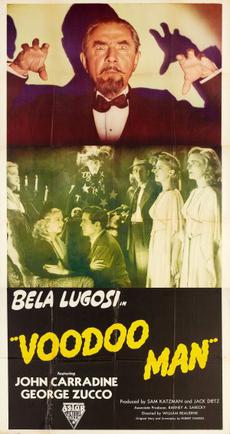
In 1944’s Voodoo Man, Michael Ames stars as Ralph, a screenwriter who has been asked to write a treatment based on the real case of several “girl motorists” who have disappeared in the surrounding area. Ralph turns down the assignment because he’s busy planning his wedding to Betty (Wanda McKay). However, when Betty’s maid of honor, Stella (Louise Currie), vanishes, Ralph and Betty set out to investigate. As Ralph puts it, he’s become a part of the story that he earlier rejected.
What has happened to Stella and all of the other women? They’ve been abducted by Toby (John Carradine) and Grego (Pat McKee), two lunkheads who work for Dr. Marlowe (Bela Lugosi). Dr. Marlowe lives in an isolated mansion where he is cared for by his loyal housekeeper (Mici Goty). Twenty-two years ago, Dr. Marlowe’s wife, Evelyn (Ellen Hall), died but Marlowe has been able to keep her body in a sort of suspended animation ever since. Marlowe is kidnapping women because, through the use of voodoo and mad science, he hopes to take their “will to live” and transfers it into Evelyn. Helping Marlowe out is a voodoo priest named Nicholas (George Zucco).
Lugosi, Carradine, and Zucco! Obviously, the main appeal of Voodoo Man is that it brings together three great names in horror. Even if the story doesn’t really make much sense (and it doesn’t), the film gets a lot of mileage out of the combination of Lugosi, Carradine, and Zucco. While Lugosi does seem to be a bit bored with his role, Carradine and Zucco really throw themselves into their characters. John Carradine, in particular, seems to be having the time of his life as he shuffles around the mansion and replies, “Yes, master,” to every command from Dr. Marlowe. It’s the type of entertaining performance that could only be delivered by a trained Shakespearean slumming in a low-budget, B-grade horror film. As for Zucco, he plays Nicholas with a certain amount of ruthless erudition. Zucco is playing the Boris Karloff role here and he definitely seems to understand what that means.
As for the film itself, it has its moments. Legend has it that director William Beaudine’s nickname was “One Shot” because he was usually only willing to do one take of each scene. As a result, he filmed quickly and he didn’t spend a lot of money and that was probably a good thing for a production like Voodoo Man. It also meant that if someone flubbed a line or bumped into a piece of furniture, that take would still be the one that showed up in the film. My favorite moment of Voodoo Man was when the local sheriff (Henry Hall) referred to Dr. Marlowe as being “Dr. Martin,” and Bela Lugosi, who appeared to be struggling not to laugh, quickly said, “It’s Marlowe.” The sheriff corrected himself. That’s the type of fun you don’t get in movies made by people who do more than one take.
Voodoo Man has a quick 61-minute running time. To enjoy it, it probably helps to already be a fan of low-budget, B-horror films from the 40s. Lugosi, Carradine, and Zucco are combination that deserves to be seen.

 Through the Shattered Lens