October True Crime: Into Thin Air (dir by Roger Young)


Originally broadcast in 1985, Into Thin Air is a made-for-TV movie that is based on a true story.  It’s film that brings to life the horror of every family’s nightmare.  Brian Walker (Tate Donavon) is an intelligent, soft-spoken, and somewhat naive college student in Ottawa.  He’s been accepted into a summer writing program in Colorado.  As he gets in the van that he will be driving to Colorado, he promises his mother, Joan (Ellen Burstyn), that he’ll call her when he reaches Nebraska and again when he reaches Colorado.

Brian drives away and that’s the last time that Joan ever sees her son.  Brian calls from Nebraska and talks to his brother, Stephen (Sam Robards).  Joan arrives home just as Stephen is saying goodbye.  Brian never calls from Colorado.  He has vanished, seemingly into thin air.

Joan, Stephen, and Joan’s ex-husband, Larry (played the great character actor Nicholas Pryor) travel to America to search for him.  At one point, Stephen thinks that he’s spotted Brian’s van on the road and chase after it, just to discover that it’s a different van.  Joan talks to cops in Nebraska and Colorado and discovers that different jurisdictions don’t work together or share information.  As the days pass, Joan keeps hoping that Brian is somehow still alive….

I was about ten minutes into this film when I started sobbing.  I pretty much cried through the entire film.  Some of that was because I knew that they were never going to see Brian again.  Some of that was because of the powerful, heartfelt performances of Ellen Burstyn, Nicholas Pryor, and Sam Robards.  Most of it was because this film did such a good job of capturing the feeling of hopelessness and the dread that comes with not knowing what has happened to someone who you love.  I found myself crying for Brian’s lost potential.  He was a writer and he was engaging in a time-honored writing tradition.  He was taking a road trip and he was discovering the world.  He deserved better than whatever happened to him.  He deserved see his novel sitting in a bookstore.  Instead, he ran into the wrong people.

It’s the little details that really got to me.  Stephen flies into a rage when he sees his younger brother wearing one of Brain’s sweaters.  Joan momentarily gets her hopes up when she discovers that Brian reported some lost traveler’s checks, just to have that hope shot down when she’s told that the bank can’t reveal where Brian called them from unless Brian himself gives permission.  When the van eventually turn up in Maine, it’s been totally trashed by whoever took it from Brian.

Eventually, Joan hires a private detective and Robert Prosky is well-cast as Jim Conway, a seemingly cynical ex-cop who dedicates himself to trying to provide closure for the Walkers.  The scene where he finally discovers what happened to Brian is one of the strongest in the film and one of the most upsetting.  So many people could have saved Brian if they only had the courage to speak up.

Into Thin Air is a powerful film.  No one should ever be forgotten.
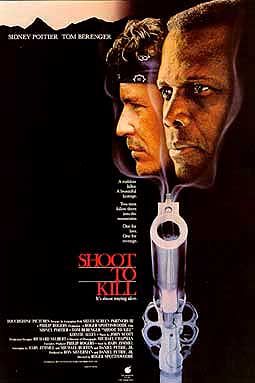
Film Review: Shoot to Kill (dir by Roger Spottiswoode)


I am not one for camping.

I’m actually kind of alone amongst my family as far as that’s concerned.  All three of my sisters enjoy spending the night outdoors, listening to sounds of nature and looking up at the stars.  They know how to set up tents and make campfires and they enjoy hiking and rafting and exploring the great outdoors.  Myself, I do enjoy occasionally spending the weekend up at Lake Texoma and I like the fact that, even though we live in the city, we still occasionally get to see wildlife running around.  I think possums are cute.  A few days ago, I squealed with delight when I saw that there was a raccoon hanging out in one of our backyard trees.  (“Don’t go near that thing, Lisa Marie!” Erin snapped as I reached for the den door.)  Growing up, I spent time in both the country and the city.  While I love living in the city, there’s still a part of me that’s still a country girl.  That said, I definitely prefer sleeping inside to outside.  The inside is safe.  The inside is comfortable.  The inside is free of creepy bugs that crawl on the ground.

Watching 1988’s Shoot to Kill definitely did not do much to change my opinion about camping.  In this thriller from director Roger Spottiswoode, Sidney Poitier plays Warren Stantin, an FBI agent who is obsessed with capturing a sadistic criminal who blackmails people into doing his work for him.  At the start of the film, the extortionist has forced a jeweler to break into his own jewelry store by taking the jeweler’s wife hostage.  Stantin’s attempt to capture the extortionist leads to the jeweler’s wife taking a bullet in the eye.  (AGCK!  Seriously, this guy is mean!)  Stantin traces the man to Washington State, where he discovers that the extortionist has committed another murder and stolen the victim’s identity.  The extortionist is now a member of a five-man fishing party that is being led by a local guide, Sarah Renell (Kirstie Alley).  Stantin teams up with Sarah’s partner, Jonathan Knox (Tom Berenger), and the two of them attempts to track down the group before the murderer among them makes his move.

The action cuts back-and-forth, between Sarah’s party and Knox and Stantin.  Most viewers will probably be able to quickly figure out which member of Sarah’s party is the killer but director Spottiswoode still creates a little suspense by casting actors like Richard Masur, Andrew Robinson, and Clancy Brown as the suspects.  All three of the actors have played their share of sinister characters.  (Andrew Robinson was the Scorpio Killer, for God’s sake!)  While Sarah leads the murderer though the wilderness, Knox teaches Stantin how to survive in the great outdoors.  As is typical with films like this, Knox and Stantin go from disliking each other to depending on each other.  Have you ever wanted to see Sidney Poitier get into a verbal altercation with a bear?  This is the film for you!

Shoot to Kill is a superior genre film.  The story’s predictable but it’s told so well that it doesn’t matter.  Kirstie Alley, Tom Berenger, and Sidney Poitier all give good performances as sympathetic characters.  As for the actor who turns out to be the killer, he gives a performance that is, at times, absolutely terrifying.  Shoot to Kill is an entertaining thriller.  Just don’t watch it if you’re going camping the next day.

Love On The Lens: The Amy Fisher Story (dir by Andy Tennant)


Poor Mary Jo Buttafuoco!

As seen in the 1993 made-for-tv movie, The Amy Fisher Story, Mary Jo (Laurie Paton) was just a normal Long Island housewife.  She was married to an auto mechanic named Joey (Anthony John Denison).  She had a family and a nice house and a seemingly perfect life.  But, one day, a teenage girl named Amy Fisher (played by a young Drew Barrymoe) showed up at her front door and claimed that her younger sister was having an affair with Joey.  When Mary Jo accused Amy of lying and then said she was going to call her husband, Amy pulled a gun and shot Mary Jo in the head.  That Mary Jo survived, albeit with partial facial paralysis, was a miracle.

The Amy Fisher Story was the third of the movies to be based on the true story of Amy Fisher and her affair with Joey Buttafuoco.  If Casualties of Love portrayed Amy as being an obsessed stalker who targeted a saintly man and if Amy Fisher: My Story portrayed Amy as a vulnerable teen who was groomed by a sleazy older man, The Amy Fisher Story suggests that perhaps the truth was somewhere in between.  As played by Drew Barrymore, Amy Fisher is immature, unstable, and self-destructive even before she meets Joey Buttafuoco.  As played by Anthony John Denison, Joey is a cocky and arrogant womanizer who grooms a teenage girl and leads her to believe that the only thing keeping them from being truly together is the fact that he has a wife.  (If Casualties portrayed Joey as being a dumb, salt-of-the-Earth type of guy and Amy Fisher: My Story portrayed him as being coldly manipulative and cruel, The Amy Fisher Story portrays him as being a self-centered idiot who did whatever he felt like doing without thinking about any possible consequences.)  Of all the performers who played Amy and Joey, Drew Barrymore and Anthony John Denison are the most convincing.  On the one hand, that lends a credibility to this film’s version of the events that led to the shooting of Mary Jo.  On the other hand, it also means that neither of the main characters is particularly likable.

The film instead tries to make a hero out of a reporter named Amy Pagnozzi (Harley Jane Kozak), who finds herself assigned to follow the Amy Fisher story when she would much rather be reporting on the upcoming presidential election.  Pagnozzi pops up throughout the story, commenting on the media feeding frenzy and generally acting annoyed by the whole thing.  The problem with this approach is that, for all of Pagnozzi’s condemnation of the country’s tabloid mentality, she’s still a part of the monster.  It’s hard to have sympathy for someone complaining about how a story is covered when they’re the one doing the covering.

Interestingly, for a film that condemns that way the story was covered, The Amy Fisher Story is probably the most tabloid-y of the three films.  Every sordid detail — from Amy and Joey’s motel meetings to Amy’s work as an escort to her subsequent dalliance with a gym owner — is provided in artfully filmed detail.  The result is a film that can feel a bit over-the-top but that’s exactly the right approach to take when it comes to a story like this.  When you’re making a movie about a suburban teenage escort who shoots her boyfriend’s wife, there’s really not much need or room for subtlety.  The Amy Fisher Story works because it fully embraces the melodrama and it features a performance from Drew Barrymore that remind us that, back before she became a permanently cheerful talk show host, Drew was a force of pure chaos.

When it comes to the story of the Fishers and the Buttafuocos, this is the film to see.

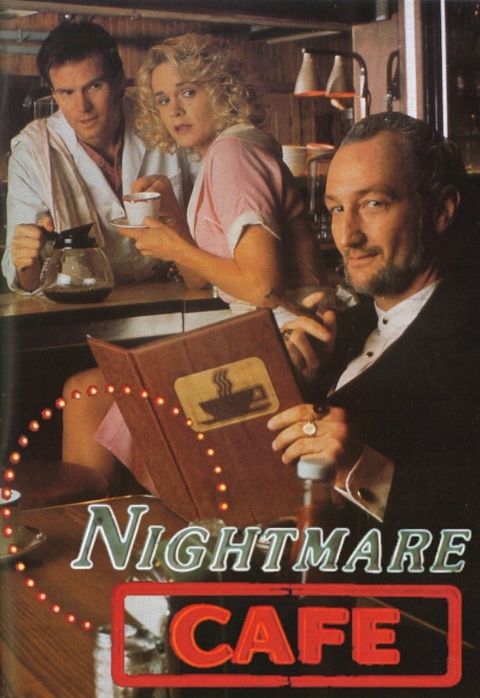
Late Night Retro Television Reviews: Nightmare Café 1.5 “Sanctuary For A Child”


Welcome to Late Night Retro Television Reviews, a feature where we review some of our favorite and least favorite shows of the past!  On Mondays, I will be reviewing Nightmare Café, which ran on NBC from January to April of 1992.  The entire show is currently streaming on YouTube!

This week, the café goes country!

Episode 1.5 “Sanctuary For A Child”

(Dir by Armand Mastroianni, originally aired on March 27th, 1992)

On tonight’s episode of Nightmare Café, we learn a few things about the café.  Apparently, the café is not just located in Los Angeles.  It can materialize anywhere on the planet but it apparently does so on its own.  Though Blackie (played by Robert Englund) claims to be the proprietor of the café, this episode suggests that he actually has no control over it.  While Blackie apparently does know why the Nightmare Café does the things that it does, it would appear that the café still has a mind of its own.  It decides where it is going and it decides when it is time to leave.

This episode, for instance, begins with the Nightmare Café materializing on a street in a small, country town.  Soon after it materializes, both Frank and Fay also materialize inside the café.  I’ve often wondered where Frank and Fay go whenever the café is closed for business.  Frank and Fay, after all, are essentially ghosts.  Do they need to eat or sleep?  This episode suggests that they do, as Fay complains about having to get up early because “the café” has decided to open up the crack of dawn.

Soon enough, a young boy named Luke Wall (Brandon Quintin Adams) comes walking into the café.  He and Frank immediately bond, with Frank realizing that Luke is trying to run away from home.  What Frank discovers upon following Luke out of the café is that Luke’s home is in a hospital.  Luke is in a coma and has been for quite some time.  Frank also discovers that the café has materialized in his home town, the place that he left when he joined the Navy and to which he thought he would never return.  Luke is the son of Frank’s former best friend, Tom (Vondie Curtis-Hall), and his ex-girlfriend, Evelyn (Angela Bassett).  Frank explains to Fay that Evelyn was the love of his life but his racist father demanded that they break up.  That was one of the main reasons why Frank left town and has never returned.

So, the Nightmare Cafe wants two things to happen.  It wants Tom and Evelyn to make peace with Luke’s impending death and also with each other.  And it wants Frank to deal with his past and his feelings towards his late father.

And that’s exactly what happens.  It’s a sweet episode, even if it’s a bit predictable and heavy-handed enough to end with “The Living Years” playing on the soundtrack.  In many ways, this felt more like an episode of Highway to Heaven than an episode of Nightmare Café but, as was so often the case with this show, the strong performances of the cast carried the narrative over any rough spots.  In the end, Frank made his peace with the past, Luke moved on to the afterlife, and the Nightmare Café moved on to a new town.

Next week: the final episode of Nightmare Café!