It’s hard to keep track in The Human Duplicators. Dr. Kolos (Richard Kiel) is an alien who is sent down to Earth. He thinks that he’s not an android but how can he be sure? He goes to the laboratory of Dr. Vaughan Dornheimer (George Macready) and tells Donheimer that they will be working together to create androids that are perfect duplicates for humans and that Kolos will be the “master.” But then an android is built of Dornheimer himself and android Dornhiemer declares that he is the master. Kolos is distracted because he’s fallen in love with Dornhiemer’s daughter, a blind pianist named Lisa (Dolores Faith).
Glenn Martin (George Nader) of the National Intelligence Agency is assigned to figure out what is happening at the Dornhiemer mansion and, wouldn’t you know it, there’s already an android version of Glenn. Glenn’s girlfriend is played the brassy Barbara Nichols, a comedic actress who was briefly groomed to be the next Marilyn Monroe and who comes on like the star of a burlesque show. Glenn’s boss is Austin Wells and he’s played by Hugh Beaumont, which makes this film feel like a weird episode of Leave It To Beaver where Wally has to save the world. I don’t think the bad guys ever duplicate Hugh Beaumont and that’s good because real trouble could be created by an evil version of Ward Cleaver.
The presence of Richard Kiel and Hugh Beaumont is really the only thing that The Human Duplicators have going for it. There are plenty of fights between Glenn and the androids but it turns out that the androids are easy to beat into oblivion so there’s not much suspense or excitement to be found. At times, it feels as if it’s trying to be an episode of The Avengers just without the wit of Patrick Macnee or the charm of Diana Rigg. The Human Duplicators seems to take itself very seriously and I’m not sure why.
After The Human Duplicators, Richard Kiel later went on to play Jaws in The Spy Who Loved Me and Moonraker. Hugh Beaumont retired from the movies.
Filmed in 1972 and subsequently released in 1974, Silent Night Bloody Night is a real treat, an atmospheric thriller that has a wonderfully complicated plot that will keep you guessing.
Silent Night Bloody Night opens with attorney John Carter (Patrick O’Neal) arriving in a small town on Christmas Eve. He’s traveling with his assistant and mistress, Ingrid (Astrid Heeren). He’s been hired by Jeff Butler (James Patterson) to oversee the sell of his grandfather’s home. When Carter arrives, he finds that the town is run by a group of elderly eccentrics, including the mute Charlie Towman (John Carradine). Charlie communicates by ringing a bell and he’s the editor of the town newspaper. Carter convinces the town council to buy the Butler mansion. Then, Carter and Ingrid go to the mansion, make love, and are promptly brutally hacked to death by an unseen assailant with an axe. It’s a shocking moment because, up until their death scene, Carter and Ingrid seemed to be our main characters. Much as with Marion Crane’s shower in Psycho, their murder leaves an absence at the heart of the film.
That night, our new hero, Jeff Butler (James Patterson) comes to the isolated town to check on how the sale is going. He finds the mansion locked up and no one willing to talk about John Carter. With the help of local girl Diane (Mary Woronov), Jeff investigates his grandfather’s death and discovers that the town is full of secrets and people who are willing to kill to maintain them. As we discover through some wonderfully dream-like flashbacks, Jeff’s grandfather died nearly 40 years ago when he was set on fire in his own home. Those aren’t the only flashbacks to the film. In an extended sepia-toned flashback, we learn about the previous inhabitants of the house. They are all played by former Warhol superstars, including Candy Darling, Ondine, Tally Brown, Charlotte Fairchild, Lewis Love, Harvey Cohen, George Trakas, Susan Rothenberg, and Jack Smith. (Mary Woronov was, herself, a former member of Warhol’s entourage.)
Silent Night Bloody Night has a terrible reputation. Mary Woronov, who was married to director Theodore Gershuny at the time she made the film, later described it as being “lousy.” Personally, I think the film’s reputation has more to do with all of the grainy, bad copies of the film that have turned up in various Mill Creek box sets over the years than the quality of the film itself. (Silent Night BloodyNight is in public domain.) The film itself is atmospheric, memorably bloody, and — for those who have the patience to deal with the occasional slow spot — effectively creepy. Mary Woronov is a likable lead and the Warhol superstars definitely make an impression. The film plays out at its own deliberate pace and, at its best, it duplicates the feeling of a particularly macabre holiday dream.
Director Theodore Gershuny uses the low budget to his advantage and the sepia-toned flashbacks are truly disturbing and haunting. Ultimately, Silent Night BloodyNight feels like a dream itself and the mystery’s solution is less important than the journey taken to reach it.
The 1974 film Silent Night, Bloody Night is an oddity.
On the one hand, it’s pretty much a standard slasher film, complete with a menacing mansion, a horrible secret, a twist ending, and John Carradine playing a mute newspaper editor.
On the other hand, director Ted Gershuny directs like he’s making an underground art film and several of the supporting roles are played by actors who were best known for their association with Andy Warhol.
Personally, I like Silent Night, Bloody Night. It has a terrible reputation and the film’s star, Mary Woronov, has gone on record calling it a “terrible movie” but I like the surreal touches the Gershuny brought to the material and the sepia-toned flashbacks have a nightmarish intensity to them. The film makes no logical sense, which actually makes it all the more appealing to me. As the saying goes, your mileage may vary.
The 1974 film Silent Night, Bloody Night is an oddity.
On the one hand, it’s pretty much a standard slasher film, complete with a menacing mansion, a horrible secret, a twist ending, and John Carradine playing a mute newspaper editor.
On the other hand, director Ted Gershuny directs like he’s making an underground art film and several of the supporting roles are played by actors who were best known for their association with Andy Warhol.
Personally, I like Silent Night, Bloody Night. It has a terrible reputation and the film’s star, Mary Woronov, has gone on record calling it a “terrible movie” but I like the surreal touches the Gershuny brought to the material and the sepia-toned flashbacks have a nightmarish intensity to them. The film makes no logical sense, which actually makes it all the more appealing to me. As the saying goes, your mileage may vary.
The 1974 film Silent Night, Bloody Night is an oddity.
On the one hand, it’s pretty much a standard slasher film, complete with a menacing mansion, a horrible secret, a twist ending, and John Carradine playing a mute newspaper editor.
On the other hand, director Ted Gershuny directs like he’s making an underground art film and several of the supporting roles are played by actors who were best known for their association with Andy Warhol.
Personally, I like Silent Night, Bloody Night. It has a terrible reputation and the film’s star, Mary Woronov, has gone on record calling it a “terrible movie” but I like the surreal touches the Gershuny brought to the material and the sepia-toned flashbacks have a nightmarish intensity to them. The film makes no logical sense, which actually makes it all the more appealing to me. As the saying goes, your mileage may vary.
(With the Oscars scheduled to be awarded on March 4th, I have decided to review at least one Oscar-nominated film a day. These films could be nominees or they could be winners. They could be from this year’s Oscars or they could be a previous year’s nominee! We’ll see how things play out. Today, I take a look at the 1941 best picture nominee, Hold Back the Dawn!)
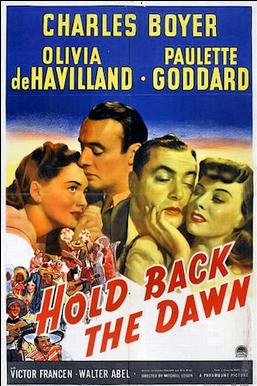
Hold Back The Dawn is a historically important film for many reasons.
First off, this was the last film to be written by Billy Wilder before he launched his own legendary directorial career and, with its mix of sharp comedy and tearful melodrama, Hold Back The Dawn definitely feels like a Wilder film. Wilder, himself, claimed that he was never happy with the way his script was adapted. For instance, Wilder wrote a scene in which Charles Boyer, playing a Romanian who is stranded in a Mexican border town, was meant to deliver a monologue to a cockroach. Boyer felt that the scene was ridiculous and the film’s director, Mitchell Leisen, never filmed it. Wilder was so incensed that he declared that he would never again allow any of his scripts to be filmed by anyone other than himself.
Hold Back The Dawn also played a part in one of the most legendary feuds in Hollywood history, though there are some who claim that it was more the product of an overzealous pr agent’s imagination than anything else. For her role as the shy school teacher with whom Boyer falls in love, Olivia de Havilland was nominated for Best Actress and was considered to be one of the front-runners for the reward. (If nothing else, it was felt that giving her the Oscar would make up for not giving it to her when she was nominated for Gone With The Wind.) However, that same year, Joan Fontaine was nominated for her role in Hitchock’s Suspicion and many felt that, after losing the previous year for her performance in Rebecca, Fontaine was owed an Oscar as well. An Oscar night, Joan Fontaine beat Olivia de Havilland. What complicated matters it that, beyond issues of professional jealousy, de Havilland and Fontaine were sisters. For years, there were stories that de Havilland had never gotten over losing her Oscar to Fontaine and that, as a result, the two sisters had little to do with each other. (The truth, as is always the case with siblings, appears to have been a lot more complicated. de Havilland herself said it was less about the Oscars and more about just not having much in common with her sister.)
Beyond all that, however, Hold Back The Dawn is a charming dramedy that holds up remarkably well. Boyer is Georges Iscoveu, a Romanian gigolo who has spent eight years living in a Mexican hotel, waiting to be allowed to enter the U.S. Olivia de Havilland is Emmy Brown, an unmarried teacher who has nearly given up on ever finding love. At first, Georges just wants to trick Emmy into marrying him so that he can legally enter the United States. However, he soon finds himself truly falling in love with her. Unfortunately, his partner-in-crime — Anita (Paulette Goddard) — is also in love with Georges and is not at all prepared to lose him to Emmy. I know it all sounds very melodramatic but Wilder frames his story with a meeting between Georges and a Hollywood producer, a move the assures us that Hold Back The Dawn is content to be pure entertainment and we really should just sit back, not get too caught up on the specifics of the plot, and enjoy ourselves. Charles Boyer is all befuddled charm as Georges while de Havilland is both poignantly likable as Emmy. For me, as good as they are, the best performance came from Paulette Goddard, who is sharp-tongued and wonderfully cynical as Anita. All three performers are helped by a wonderful script. Even if Boyer never does talk to a cockroach, Wilder’s dialogue is still sharp and witty. This is a film that is as much fun to listen to as it is to look at.
 Who’s an android and who’s not!?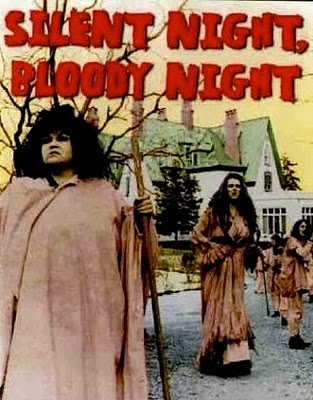
 Through the Shattered Lens