News that the sequel to Eastern Promises was one of the few pieces of news that really bummed me out when it made the rounds late 2012. The first film was one of my top ten for 2007 and consider it one of the better films about organized crime in the 21st century. A sequel to this film wasn’t needed, but most fans of the film wanted one just to see a furthering of the storyline between Viggo Mortensen’s character and that of Vincent Cassel’s character.
While the sequel may not be happening there’s still hope that it will get resuscitated in the future. Until that happens let’s take a look at what has to be one of the most realistic fight scenes on film. It’s the infamous (or famous depending on how you feel about the scene) Russian bath house scene near the end of the film. The scene sees Viggo Mortensen’s character of Nikolai Luzhin set upon by a couple of Chechen hitmen in the bath house where he proceeds to fight for his life in the most vulnerable fashion anyone can ever find themselves in.
Cronenberg has always been one of my favorite filmmakers and I continue to believe that his work body of work throughout his career puts him in the upper echelon, if not the elite level, of filmmakers living and working today. This fight scene has nothing glamorous about it. The cool factor that some attribute to the scene just emphasizes Cronenberg’s recent observation about the hypocrisy of those who denounce violence yet look at the violence he creates on film and call it art.
I consider this a scene I love just for the base simplicity of the scene itself. It’s primal and almost Darwinian in the lengths a person will go through to keep themselves alive for one second more. The scene also reminds me why Viggo Mortensen remains one of this era’s most underrated and greatest actors. Yes, it’s just a fight scene, but he gives so much into making it authentic that one could almost believe that his life was in danger and he did the fight for real (in fact Mortensen did injure himself so much during the several takes of the scene that his bruises afterwards became a problem for the make-up department who had to apply his vory v zakone tattoos every day).
2007’s Eastern Promises was a film well-received by both critics and the public alike. People loved it because it was David Cronenberg dipping his artistic toe into the pulp crime genre of mob films. Some loved it because it had Viggo Mortensen in what could be his best role to date. For some the film ended just when it really got interesting. The scene in the end with Mortensen’s Nikolai Luzhin sitting alone finally reaching his ultimate goal and an unanswered question of where his loyalties truly lie now.
It’s has now been reported by Deadline Hollywood that producer Paul Webster has lined up both David Cronenberg and Viggo Mortensen for a sequel with Mortensen reprising his Russian mobster Nikolai Luzhin. Plans to have the film to start filming later this winter using a screenplay by Steven Knight (also wrote the first film) may hinge on whether Cronenberg and Mortensen can finish their current project together. This current project, their third together as a creative team, is the Sigmund Freud film The Taking Cure.
No matter how this project develops in the coming months one of the questions fans of the first film will be asking is whether Vincent Cassel will return as well to reprise his role from the first film. Not to mention Naomi Watts and Armin Mueller-Stahl. There’s also the question of how Cronenberg will top the original film’s now famous Turkish Bath House fight scene that’s now considered one of the best, if not THE BEST, fight sequence ever put on film. Or will he even try.
In the end, this is just great news. From all the talk The Taking Cure looks to continue the success the Cronenberg-Mortensen duo have had and this sequel to Eastern Promises may just keep that success going.
“You can’t always be in control.” — Nikolai Luzhin
In 2005 Canadian filmmaker David Cronenberg brought to the silver screen a film that was both a taut, smart crime-thriller and also a well-done film treatise on the nature of violence and how it changes not just witness’ perception of an individual but about themselves as well. The film also introduced what might be the newest creative pairing that could be on par as other pairings like Scorsese-DeNiro and Burton-Depp. The pairing I speak of is that of Cronenberg and his growing repertoire with actor Viggo Mortensen. They scored a critical hit with A History of Violence and in 2007 they collaborate in another crime-drama that more than lives up to their initial collaboration. Eastern Promises is a taut and meticulous drama which brings new eyes and a different approach to the mob film genre made famous by Coppola and Scorsese.
The film begins innocently enough with a very pregnant teenage Russian girl named Tatiana entering a neighborhood store. While Cronenberg chose to open up A History of Violence nary any musical cues and backgrounds to create a sense of naturalism and plant a seed of unease in the audience of what’s to come, he does the opposite with Eastern Promises by allowing long-time collaborator Howard Shore to score this opening scene with a haunting violin solo. Even right from the start Cronenberg’s propensity to use a sudden image of violence to shock the audience works well to set the tone for the film. It is not the usual filmgoing experience to see a young girl, looking lost and afraid of her surroundings, suddenly and bloodily starts to give birth in the middle of a store. It is from the diary entries of this young girl where we get glimpses of the true meaning of the film’s title and sets up the clues and tidbits that Cronenberg gradually fills in as the film progresses and the main characters investigate the girl’s death and the full contents of her diary.
We’re quickly introduced to Anna Khitrova (played with touching compassion and a certain naivete by Naomi Watts), midwife at the London hospital where Tatiana dies from bloodloss due to childbirth. Having had experienced her own personal tragedy regarding a past pregnancy Anna takes it upon herself to find the next of kin or, at the very least, close friends who might know Tatiana and thus claim the child and care for her. It was finding Tatiana’s diary and the business card tucked within amongst the young girl’s meager possessions which gives Anna a starting point for her investigation and search.
It is during this search into Tatiana’s life that Anna encounters Nikolai Luzhin (Viggo Mortensen at his most chameleonic), the personal driver of one Semyon (as played by Armin Mueller-Stahl). Semyon charms Anna with his old world grandfatherly persona yet both the audience and Anna feels something off, even sinister beneath the charm and twinkling eyes. Semyon is not just the owner of the Trans-Siberian, a Russian restaurant, but a boss in the vory v zakone also known as the Russian Mafia. It is through Nikolai that we see the underbelly of Tatiana’s life before her death.
It is during the second half of the film that the film takes a clear turn into Cronenberg territory. With all the players in play Eastern Promises starts to peel the layers on all the characters. Just like in A History of Violence every character in this unofficial follow-up to that film go on through the film living dual-lives. Even Anna’s seeming naivete, in regards to the danger she faces in Semyon and his unstable son Kirill, shows a modicum of world-weariness born out of personal tragedy and those she sees on a daily basis when working as a midwife in the hospital.
Cronenberg doesn’t just try to tell a crime drama about the mob and the subculture they live and die in but he adds his own personal stylistic and metaphorical touches on the mob film conventions. While in the past he has taken on the immutability of the body and the physical nature of man in his later years he has moved on to the amorphous nature of man’s very nature as both a civilized and reasoned animal to the primal being which lurks within each. Eastern Promises delves into this metaphysical topic by showing the natures of both Nikolai and Semyon. Both of whom, at first glance, inhabiting a particular stereotype but soon showing the opposite as the audience gets to know them. Even the twists in the story in the middle section and close to the end doesn’t seem like cheap plot tricks but a logical and almost mathematical conclusion to the very themes Cronenberg has been exploring right from the beginning.
The performances by the cast was top-notch from top to bottom. David Cronenberg’s always has had a reputation for being an actor’s director. His willingness to allow his actors to not just play the part but find ways to become their characters makes his films some of the more well-acted one’s of the last quarter-century. From Watts’ own touching performance as the moral center of the film in Anna to Cassel’s unstable and coward of a bully in Kirill the work put on by the actors adds a level of gravitas to a story that has it’s roots in pulp crime stories and not the high-brow tales prestige films like Eastern Promises has been compared to. But the two stand-out work comes from Viggo Mortensen as the enigmatic Nikolai and Armin Mueller-Stahl as Russian mob boss Semyon. Where Watt’s performance was subtle and Cassel’s literally scene-chewing both Mortensen and Mueller-Stahl bring forth nuanced performances full of life and complexities that makes both characters stand out above a cast already doing great work.
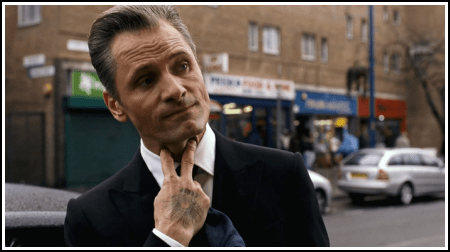
Mortensen’s work as Nikolai actually surpasses his previous Cronenberg-directed role in Tom Stalls of A History of Violence. Viggo has always been quite the Method actor and really loses himself in every role he takes on, but it took him being paired up with Cronenberg for critics and cineastes to finally realize how great an actor he really has become in the last decade. His Nikolai oozes a charisma from the moment he enters the film. He makes Nikolai not just a thug with a brain and a semblance of compassion beneath the rough surface. Mortensen literally becomes Nikolai right down to the very tattoos which tells his character’s criminal past in ink. One could not help but be mesmerized by Mortensen’s work in this film that it was easy to forget that he was playing a part and not actually living that life. To say that Mortensen may have found his creative soulmate in Cronenberg would be quite the understatement and with more projects in the future linking the two together it wouldn’t be a surprise if the two in conjuction finally get the critical awards that has eluded both.
While A History of Violence showed that Cronenberg could work beyond the genre and esoteric genres of his part works, it is with Eastern Promises that we see him move towards a more mainstream type of work. Yet despite a work more accessible than before he still was able to add his own style of storytelling and explore themes usually not seen in crime dramas and mob films. It is this ability to marry the violent pulp with the intellectual high-brow which makes Eastern Promises a delight for both the general filmgoer and the arthouse cineaste. Time will only tell if the successful streak by the duo of Cronenberg-Mortensen continues as the two continue to work together in the years to come.


 Through the Shattered Lens