Film Review: The Shoes of The Fisherman (dir by Michael Anderson)


The 1968 film, The Shoes of The Fisherman, opens in a snowy Siberian labor camp.  For the past twenty years, this camp has been the home of Kiril Pavlovich Lakota (Anthony Quinn), the Ukrainian archbishop of Liviv.  Kiril is unexpectedly released by Russia’s new leader, Piotr Ilyich Kamenev (a very British Laurence Olivier).  After explaining to Kiril that Russia and China are on the verge of nuclear war due to a famine that has been instigated by U.S. sanctions, Kamenev tells Kiril that he is being released on the condition that he tell no one about the conditions at the Russian labor camp.  Kiril starts to protest just for Father Telemond (Oskar Werner), the Vatican’s representative, to say that the conditions have already been agreed to.

In Rome, Kiril meets the Pope (John Gielgud), who makes the humble Kiril a cardinal, over Kiril’s objections that he just a “simple man.”  Later, when the aged Pope suddenly dies, Kiril is unexpectedly elected, as a compromise candidate, to succeed him.  Still humble and considering himself to be a simple man with a simple mission, Kiril suddenly finds himself as one of the most revered and powerful men on the planet.  With Father Telemond as his secretary, Kiril tries to make the Vatican responsive to the needs of the people and sets out to bring peace between the Russians and the Chinese. That turns out to be easier said than done, especially when Telemond himself is eventually accused of heresy for his progressive views.

(And yes, Telemond is a Jesuit….)

The Shoes of the Fisherman is a type of film that should be familiar to anyone who has any knowledge of the Hollywood studios in the 60s.  It’s the type of big and self-serious film that was meant to tell audiences, “You won’t find anything this opulent and important on television!”  The cast is designed to appeal to everyone.  Anthony Quinn and Laurence Olivier are there for the older viewers (especially the older viewers who made up the majority of the Oscar voters in 1968) while, for the younger voters, there’s handsome Oskar Werner as a Jesuit who interpretation of the Gospels is so radical that even Pope Francis would probably tell him to step back a little.  For the older, anti-communist viewers, there are scenes that portray the harsh conditions at a Siberian labor camp.  The commies put Kiril in prison so he must be one of the good guys.  And for the younger, more liberal viewers, there was the suggestion that the threat of World War III was largely due to the actions of the American government.  And, just in case there was still anyone who thought that television was preferable to a prestige picture, TV star David Janssen shows up as a cynical reporter whose wife (played by Barbara Jefford) is a doctor who Kiril helps to get some medicine for one of her dying patients.  Director Michael Anderson includes enough sudden zoom shots to let younger viewers know that he’s with them while still directing in a stately enough manner to appeal to the older viewers.

The end result is a film that is big and grand but also rather slow.  The film gets bogged down in subplots that don’t really add much to the overall story.  We spend way too much time with the reporter and his wife.  Anthony Quinn does a good enough job as Kiril, giving a rather subdued performance by Quinn standards.  (A scene where Kiril recites a Jewish prayer for a dying man is wonderfully acted by Quinn, who seems to truly be emotionally invested in the film’s message of togetherness.)  Laurence Olivier is not at all convincing as a Russian but still, he has the stately bearing of a man used to being in power.  Like many of the studio productions of the late 60s, The Shoes of The Fisherman tries a bit too hard to strike a balance between old school Hollywood and the counterculture and the film ultimately feels rather wishy-washy as a result.  It’s a noble film with good intentions but it’s not particularly memorable.
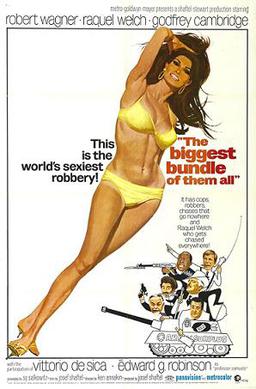
The Biggest Bundle Of Them All (1968, directed by Ken Annakin)


Harry Price (Robert Wagner) is a small-time tough guy with big plans.  He and his gang of accomplices fly over to Italy and plot to kidnap Cesare Celli (Vittorio De Sica), a retired mafia don who is reputed to be worth millions.  However, after snatching Celli from a wedding, Harry discovers that Celli is actually flat broke.  Trying to be helpful, Celli suggests that Harry call up the local gangsters and demand that they pay a ransom for Celli’s release.  When everyone refuses to pay, Celli comes up with another plan.  Celli takes over Harry’s gang and, with the help of Celli’s old friend, Prof. Samuels (Edward G. Robinson), plots to steal $5,000,000 worth of platinum ingots from a train.

Complicating matters is that Harry and his gang are not exactly master criminals.  Benny (Godfrey Cambridge) is a violinist who has moral objections to carrying a gun and who also refuses to cross a picket line, even in the course of a robbery.  (“I’m a union man!”)  Tozzi (Francesco Mule) is more interested in having a good dinner than pulling off the perfect heist.  Davey (Davy Kaye) is short, which is apparently a problem for some reason.  Finally, Harry’s girlfriend, Juliana (Raquel Welch), is more interested in dancing than in committing crimes.  Still, Celli is determined to use them to pull off the heist of the century and, even more importantly, to help prove that this old criminal has still got what it takes.

The Biggest Bundle of Them All was an attempt at a wacky heist film.  Unfortunately, at the time that the film was made, Robert Wagner and “wacky” didn’t belong anywhere near each other.  Wagner stiffly delivers lines like, “I’ve had it, baby.  Can you dig it?” and looks thoroughly out-of-place.  Godfrey Cambridge and Edward G. Robinson have a few funny scenes but both Kaye and Mule are wasted in one-note role while De Sica looks like he’s trying to figure out how he went from Bicycle Thieves to this.  Everyone in the movie just goes through the motions.  Even while they’re robbing the train, the cast seems to be indifferent.

It almost doesn’t matter, though, because this is a Raquel Welch film.  Welch doesn’t have much of a character to play but she looks amazing while doing it and that really is the appeal of any film that Welch made in the late 60s and early 70s.  Welch spends a good deal of the film in a bikini and is undeniably sexy, particularly in the scene where Wagner sends her to seduce De Sica.  She also gets to share a dance with Edward G. Robinson, which is such a goofy and fun scene that it’s almost worth the price of admission.  (Regardless of what fun they may have been having on-screen, Robert Wagner later wrote in his autobiography that, off-screen, Robinson grew so annoyed with Welch’s chronic lateness on the set that he yelled at her until she was in tears.)

Even Raquel Welch in a bikini can only carry a film so far and The Biggest Bundle of Them All is ultimately too disjointed to work.  Director Ken Annakin tries to recreate the same sort of frantic comedy that was at the heart of his previous film, Those Magnificent Men in Their Flying Machines, but the end result falls flatter than 5 million dollars worth of platinum ingots sliding out of an airplane.

The TSL’s Horror Grindhouse: Blood for Dracula (dir by Paul Morrissey)


Count Dracula (played by Udo Kier) has a problem.  In order to stay strong and healthy, he needs a constant supply of virgin blood.  (Or, as Kier puts in, “weergen blood.”)  Unfortunately, he lives in 1920s Romania and apparently, there just aren’t many virgins left in Eastern Europe.

However, Dracula’s assistant, Anton (Arno Juerging) has a solution.  Dracula just needs to move to Italy!  After all, Italy is the home of the Vatican and it’s just been taken over by Mussolini and the fascists.  Surely, no one in Italy is having sex!  Dracula should be able to find all the virgins that he needs in Italy!

So, Dracula climbs into his coffin and Anton drives him to Italy.  Once they arrive, they meet an Italian land owner,  Il Marchese di Fiore (played by Italian neorealist director Vittorio De Sica).  The Marchese is convinced that Dracula is a wealthy nobleman and he says that Dracula can marry any of his four daughters.  He assures Dracula that they’re all virgins but Dracula soon discovers that two of them are not.  It turns out that, thanks to the estate’s Marxist handyman, Mario (Joe Dallesandro), it’s getting as difficult to find a virgin in Italy as it was in Romania!

After completing work on Flesh For Frankenstein, director Paul Morrissey and actors Udo Kier, Joe Dallesandro, and Arno Juerging immediately started work on Blood for Dracula.  Though Blood for Dracula never quite matches the excesses of Flesh for Frankenstein, it still taps into the same satiric vein that provided the lifeblood that gave life to Flesh for Frankenstein.  Once again, the sets and costumes are ornate.  Once again, the frequently ludicrous dialogue is delivered with the straightest of faces.  Once again, Udo Kier goes over-the-top as a famous monster.  And, once again, Joe Dallesandro plays his role with a thick and anachronistic New York accent and he looks damn good doing it.

Ironically, one of the differences between Flesh for Frankenstein and Blood for Dracula is that there’s quite a bit less blood in the Dracula film.  Then again, that’s also kind of the point.  Dracula literally can’t find any blood to drink and, as a result, he’s become weak and anemic.  Udo Kier is perhaps the sickliest-looking Dracula in the history of Dracula movies.  By the time that he meets the Marchese’s four daughters, he’s so sick that he literally seems like he might fade away at any second.  As ludicrous as the film sometimes is, you can’t help but sympathize with Dracula.  All he wants is some virgin blood and the communists aren’t even willing to let him have that.  Blood for Dracula is, in its own twisted way, a much more melancholy film than Flesh For Frankenstein.  Or, at least it is until the finale, at which point one character gets violently dismembered but still continues to rant and rave even after losing the majority of their limbs.

When Blood for Dracula was released in 1974, it was originally called Andy Warhol’s Dracula, though Warhol had little to do with the movie beyond allowing his name to be used.  As with Flesh for Frankenstein, Antonio Margheriti was credited in some prints as a co-director, largely so the film could receive financial support from the Italian government.

Sadly, there would be no Andy Warhol’s The Mummy or Andy Warhol’s Wolfman.  One can only imagine what wonders Kier, Dallesandro, and Morrissey could have worked with those.