Tom and Fred Denton (Preston Foster and Jim Davis) are two frontier lawmen who are frustrated with their jobs. They are both owed backpay. When they shoot an outlaw, they are expected to pay the $80 burial fee. Neither Tom nor Fred feels that they are appreciated by banks and the railroads that expect them to risk their lives on a daily basis.
When Tom and Fred are informed that their younger brother, Matt (Kim Spalding), has been convicted of murder and sentenced to hang in another town, they ride off to save him.
Even though Tom and Fred can both provide an alibi for Matt and it is obvious that Matt has been framed by a corrupt railroad agent, the town is still determined to hang him. Tom and Fred manage to rescue him from the gallows but, in the process, a deputy is killed. Now wanted by the authorities, the Denton brothers are forced to team up with the same outlaws that they used to hunt. Soon, the Dentons are robbing banks and trains and their old friend, Pete Coleman (Monte Blue), has been ordered to captured them, dead or alive.
One of the many low budget westerns to be produced by the Lippert Company, Three Desperate Men is a cut above the usual B-western. None of the Dentons want to be outlaws but they are forced into it by circumstances out of their control. The real villains of the film are the bankers and the railroad tycoons who hoard the land and the money and who try to cheat men like Tom and Fred out of their rightfully earned wages. The Denton brothers ultimately decide that their number one loyalty is to each other and that leads to the movie’s fatalistic conclusion, which is surprisingly violent for a 1951 western. Preston Foster, Jim Davis, and Monte Blue head a cast that is full of tough and authentic western veterans and the action scenes are imaginatively staged by director Sam Newfield. Three Desperate Men is a B-western that can be enjoyed even by those who don’t like westerns.
Rondo Hatton (1894-1946) was dubbed by “The Ugliest Man in Hollywood” by Universal for his repulsive visage. Originally a Tampa-based sportswriter, Hatton began developing the disease acromegaly as a young adult, a form of gigantism which distorts the facial features and bone structure (wrestler Andre the Giant suffered from this). Rondo moved to Hollywood and got work as a film extra and some bit parts (he can be spotted in SAFE IN HELL , IN OLD CHICAGO, THE HUNCHBACK OF NOTRE DAME (’39 version), and THE OX BOW INCIDENT, among others).
1944’s “The Pearl of Death”
Hatton played “The Hoxton Creeper” in the 1944 Sherlock Holmes entry THE PEARL OF DEATH (with Universal Scream Queen Evelyn Ankers as a villainess, for a change), then proceeded to scare the daylights out of audiences in JUNGLE CAPTIVE and THE SPIDER WOMAN STRIKES BACK. While not a trained actor, his unique looks made…
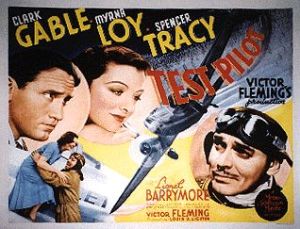
(With the Oscars scheduled to be awarded on March 4th, I have decided to review at least one Oscar-nominated film a day. These films could be nominees or they could be winners. They could be from this year’s Oscars or or they could be a previous year’s nominee! We’ll see how things play out. Today, I take a look at the 1938 best picture nominee, Test Pilot!)
Test Pilot is all about charisma.
It tells a fairly simple story. I imagine that the plot seemed just as familiar in 1938 as it does in 2018. Jim Lane (Clark Gable) is a test pilot. In the early days of aviation, long before people took the idea of flight for granted, Jim Lane is a hero and celebrity. Whenever a new aviation technique is developed, Jim is the one who tests it. He’s the one who makes sure that it’s safe. Every day, when Jim goes to work for Mr. Drake (Lionel Barrymore), there’s a chance that he might not make it home. Not surprisingly, he’s cocky, reckless, and not prone to commitment. He’s also handsome, charming, manly, and quick with a quip. In short, he’s Clark Gable.
When the movie starts, Jim has only one real friend. Gunner (Spencer Tracy) is his mechanic. Gunner is a by-the-book, no-nonsense professional. He might enjoy a drink every now and then but Gunner knows his job and he knows his planes and, even more importantly, he knows Jim. Gunner’s a man of unimpeachable integrity, the type who will always call things as he sees them. In short, he’s Spencer Tracy.
One day, while on a test flight, Jim is forced to make an emergency landing on a farm in Kansas. That’s where he meets Ann Barton (Myrna Loy). Ann is beautiful and outspoken. She quickly proves that she can keep up with Jim, quip-for-quip. In short, she’s Myrna Loy and, before you know it, she and Jim are in love. Just as quickly, Jim and Ann are married.
The movie starts out as a bit of domestic comedy. Jim may know how to fly a plane but it quickly becomes obvious that he doesn’t know much about commitment or being a husband. When Jim attempts to buy his wife a nightgown, he doesn’t even know how to pronounce the word lingerie. (He asks a store clerk for help in finding the “lonjur department.”) However, Jim soon starts to find that married life agrees with him.
Of course, that’s a problem when your job requires you to defy death on a daily basis. Ann worries that Jim is going to go to work and never come home, fears that are intensified after a race with another airplane ends in a terrible and (for the other pilot) fatal crash. Gunner, meanwhile, starts to fear that there’s only so many times that Jim can cheat fate. Both Ann and Gunner promise that they will never leave Jim’s side.
Well, you can probably already guess everything that’s going to happen. Test Pilot is not exactly the most narratively adventurous movie ever made but, when you’ve got Gable, Tracy, Loy, and Barrymore all in the same film, you don’t really need to break any new ground, storywise. Test Pilot is an example of the power of pure movie star charisma. It’s watchable because the performances are just as entertaining today as they were in 1938. The film features Gable doing what he did best and Tracy doing what he did best and Loy and Barrymore all doing what they did best. In this case, that’s more than enough.
When it comes to the film’s numerous flight sequences, it’s perhaps best to try to put yourself in the shoes of someone seeing the film in 1938. Today, of course, we’ve been spoiled by CGI. We tend to assume that literally anything can happen in a movie. In the 30s, however, people couldn’t take special effects for granted. When they watched the flight footage in Test Pilot, they did it with the knowledge that it was filmed by people who actually were putting their lives at risk to get it. At a time when commercial aviation was considered to be a luxury, Test Pilot provided audiences with a view of the world in the sky and of the world below, a view that they probably wouldn’t have gotten a chance to see otherwise.
A huge box office success, Test Pilot was nominated for best picture but lost to another film featuring Lionel Barrymore, Frank Capra’s You Can’t Take It With You.
Tonight I’ll be watching the Major League Baseball All-Star Game, but for those of you non-baseball fans, here’s a look at five funny films from the 1930’s & 40’s:
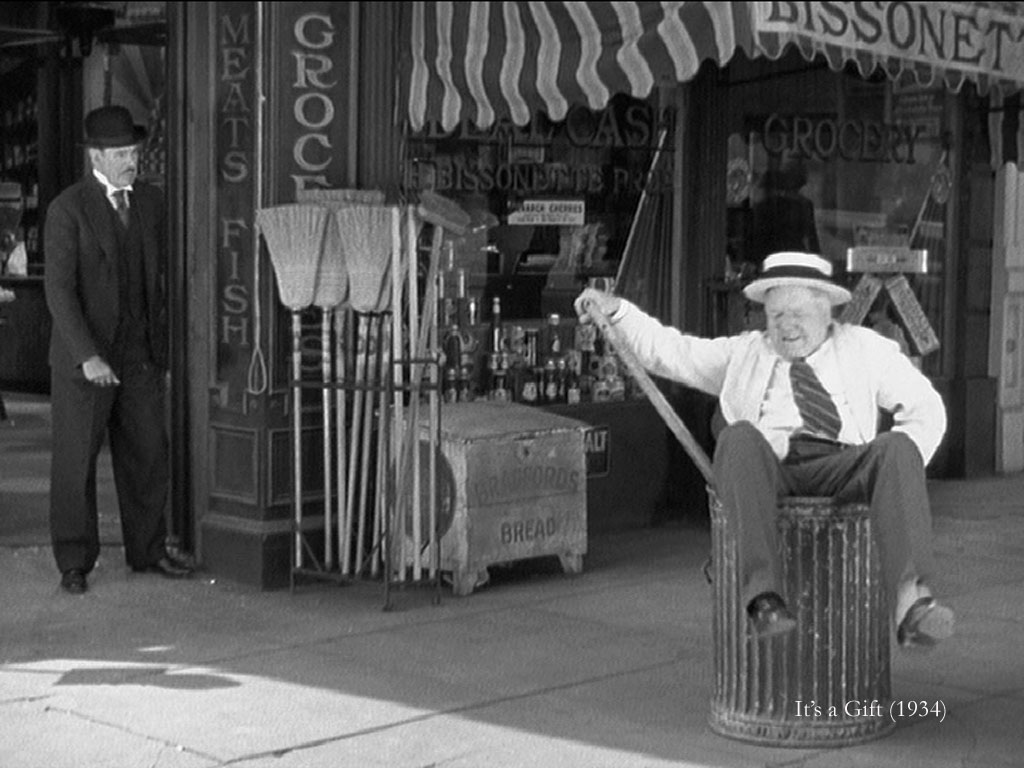
IT’S A GIFT (Paramount 1934, D: Norman Z. McLeod) The Great Man himself, W.C. Fields , works his magic in this delightfully demented domestic comedy about hen pecked grocer Harold Bissonette, who dreams of owning an orange grove in California. His wife (Kathleen Howard) is a domineering battle-axe, his kid (Tommy Bupp) an obnoxious, roller skating brat, and daughter Mildred (Jean Rouveral) doesn’t want to leave her “true love”. This sets the stage for some of Fields’ funniest surrealistic scenes, including his grocery store being demolished by blind Mr. Mickle and perennial nemesis Baby Leroy; poor W.C. trying to get some sleep on the porch while being constantly disturbed by noisy neighbors, a wayward coconut, a man looking for “Carl LeFong”, and…
The third Netflix Noir that I watched was 1957’s Crime of Passion.
In Crime of Passion, Barbara Stanwyck plays Kathy Ferguson, a San Francisco-based advice columnist. She is approached by two homicide detectives who request her help tracking down a fugitive who they think might read her column. Charlie (Royal Dano) is aggressive and outspoken. When he first meets Kathy, he tells her, “You’re work should be raising a family and having dinner ready when your husband comes home from work.” His far more passive partner is Detective Bill Doyle (Sterling Hayden).
Kathy writes a column that convinces the fugitive to turn herself in. (The power of Kathy’s column is shown in an amusing montage where woman after woman is seen reading the column aloud. Significantly, no men are seen to ever read anything that Kathy has written.) The resulting fame leads to Kathy getting a job offer in New York.
However, before Kathy can leave, she gets a phone call from Bill. He asks her out on a date and, one scene later, they’re getting married in the shabby office of a justice of the peace. Kathy sacrifices her career to be a suburban housewife.
From the minute that Kathy first looks at the small and anonymous house and the boring neighborhood that she’ll be sharing with Bill, it’s obvious that things are not going to work out well. Even though Kathy even tells Bill, “I hope all your socks have holes in them and I can sit for hours darning them,” the life of domestic servitude is not for her.
Every day, she stays home while Bill goes to work. At night, she reluctantly plays hostess to the constant gatherings of Bill’s colleagues and their wives. The women stay in one room while the man gather in another. Kathy is quickly bored with the inane chattering of the other wives but whenever she tries to go into the other room, she finds herself treated like an unwanted intruder.
And worst of all is the fact that Bill has absolutely no ambition of his own. He’s got his house. He’s got his wife. He’s got his friends. And he doesn’t feel that he needs anything else.
Kathy takes it into her own hands to advance Bill’s career, first by having an affair with Bill’s boss (Raymond Burr) and finally by trying to find a spectacular crime that Bill can solve. And, as the suburbs continue to drive her mad, Kathy is not above creating a few crimes on her own…
In many ways, Crime of Passion reminds of another 50s film, Nicholas Ray’s Bigger Than Life.Both films use the conventions of melodrama to present a surprisingly subversive look at the horrors of suburban conformity. Unfortunately, Crime of Passion never quite reaches the heights of Bigger Than Life, largely because Sterling Hayden gives such a dull performance as Bill that you never believe that Kathy would have married him in the first place. (The film would have been far more impressive if Bill had started out as an apparently dynamic character whose dullness was then revealed after Kathy married him.) However, Barbara Stanwyck is well-cast as Kathy and Raymond Burr plays up his character’s ambiguous morality. If nothing else, Crime of Passion is one of those film to show anyone who is convinced that nothing subversive was produced in the 1950s.
 Tom and Fred Denton (Preston Foster and Jim Davis) are two frontier lawmen who are frustrated with their jobs. They are both owed backpay. When they shoot an outlaw, they are expected to pay the $80 burial fee. Neither Tom nor Fred feels that they are appreciated by banks and the railroads that expect them to risk their lives on a daily basis.




 Through the Shattered Lens