Film Review: Berlin Correspondent (dir by Eugene Forde)


In the 1942 film, Berlin Correspondent, Dana Andrews plays Bill Roberts.

Bill is an American journalist, working out of Berlin.  Because the film takes place before America’s entry into World War II, Bill pretends to report only what the Germans want him to report.  Even while there are bombs exploding outside of the studio, Bill and his fellow correspondents report that everyone in Berlin is happy and that the German government is doing a great job.

However, Bill fills his reporting with code words, which are then interpreted by listeners in the American Intelligence service.  They understand that when Bill says that the people are happy, that means that they’re actually miserable.  When Bill says that the weather in Berlin is cloudy, that means that there is dissent brewing in the government.

Still, Captain Von Rau (Martin Kosleck) comes to suspect that Bill might be sending out secret messages and he decides to send someone to not only compromise Bill but to also discover who is feeding Bill information.  Von Rau sends his own fiancée, Karen Hauen (Virginia Gilmore), to seduce Bill.  Little does Von Rau suspect that Bill’s source of information is Karen’s own father (Erwin Kalser) and that Karen herself is going to end up falling in love with Bill.

Berlin Correspondent is typical of the films that were made to try to build support for the American war effort during the Second World War.  The hero is a tough and cynical American who pretends to not care about what is happening in the rest of the world but who eventually reveals himself to be an idealist with a strong sense of right and wrong.  Bill may say that he’s only in Berlin to report the news but, when Karen’s father is sent to a concentration camp, Bill proves himself to be willing to risk his own life to help the older man make it to Switzerland.  Karen’s father stands in for the members of the German resistance who worked from the inside to bring down the Nazis.  Bill and Karen’s love serves as a reminder that the world can come back together but only after Hitler has been defeated.

The two main Nazi villains are played by Martin Kosleck and Sig Ruman, two German actors who immigrated to the United States to escape the real-life Nazis.  Kosleck and Ruman play their characters as being buffoonish bullies who are easily outsmarted by street smart Americans like Bill.  It’s the film’s way of saying to the audience, “Are you really going to let these idiots think that they can defeat America?”  Still, a scene is included in which a crippled girl is described as being someone who should be put to death.  It’s a necessary reminder that the Nazis may be idiots but they’re also a legitimate threat.

Berlin Correspondent clocks in at a brisk 70 minutes and it features a typically strong leading performance from Dana Andrews.  If you needed someone to fight for America, 40s-era Dana Andrews would definitely be a good pick to go with.  It’s a joy to watch him outsmart the Nazis.
18 Days of Paranoia #17: Walk East On Beacon! (dir by Alfred L. Werker)


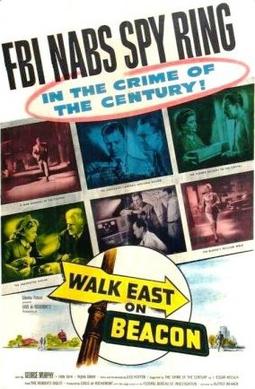
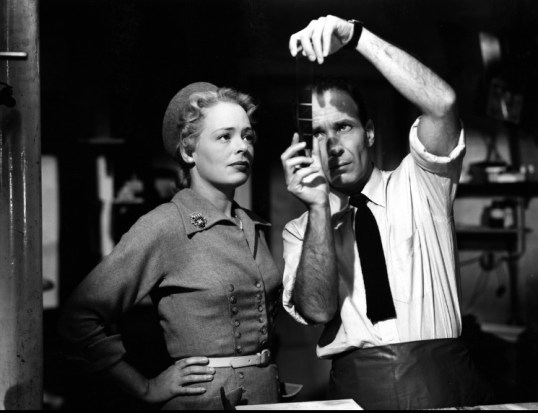
From 1952 comes Walk East On Beacon, a mix of spy thriller and film noir that highlights the efforts of the FBI to expose and take down a communist sleeper cell working right in the United States of America!  (Cue the dramatic music.)

One need only check out the opening credits to see what type of film Walk East On Beacon is going to be.  We’re told early on that the film was “suggested” by a Reader’s Digest article that was written by none other than the director of the FBI, J. Edgar Hoover. The title of that article was “The Crime of the Century: The Case of A-Bomb Spies” and it dealt with the FBI investigation that led to the arrest, conviction, and controversial execution of two Russian spies, Julius and Ethel Rosenberg.  I haven’t read the article but judging by the fact that it was written by Hoover and published in Reader’s Digest, I think it’s fairly safe to guess that it wasn’t particularly concerned with things like protecting the First Amendment, civil rights, or the freedom to hold any ideological belief regardless of how unpopular it may be with the general public.  (Of course, I would be remiss if I didn’t also point out that most historians now agree that, despite what many on the Left claimed over the decades, the Rosenbergs were indeed guilty of being spies and they played a very central role in the Russians discovering the secret to making atomic bombs.)

In the film, George Murphy plays an FBI agent named Jim Belden.  According to J. Hoberman’s book, An Army of Phantoms, the FBI specifically requested that Murphy be cast in the lead role because Murphy was an outspoken anti-communist.  (Murphy would also later be elected to the U.S. Senate.)  Project Falcon, a super-secret U.S. program, has been infiltrated by spies and Belden has been assigned to track down and capture their ringleader.  He does this by using a number of techniques that were probably considered pretty high tech back in 1952, stuff like hidden cameras and secret microphones.  He even brings in a group of lip readers to watch silent footage of two possible spies speaking so that they can tell him what the spies are talking about.  You don’t have to worry about a thing with Jim Belden on the case!

As for the members of the spy ring, they’re a mixed bunch.  Some of them are just bad people who have betrayed their country just because it’s the evil thing to do.  Others are people who idealistically joined the Communist Party years ago because they wanted to help their fellow man and, instead, they’ve now found themselves forced to spy against their country.  Prof. Albert Kafer (Finlay Currie) doesn’t want to betray America but he’s been told that his son will be executed if he doesn’t cooperate.  Kafer goes to the FBI.

As you can probably guess, this is not a particularly subtle film.  The communists are all evil and the FBI is doing its best to protect the loyal citizens of America and, if you’re going to question the legality or the ethics of their methods …. well, why don’t you just move to Russia and tell Stalin about it, okay!?  Interestingly enough, the film is shot like a film noir, with an emphasis on shadows and dark streets and desperate men trying to escape their fate.  But it has none of the moral ambiguity that one usually expects to find in a film noir.  Instead, it presents a thoroughly black-and-white view of the world.  All of the communists are either neurotic or cruelly evil while the FBI is professional, bland, and rather humorless.  There’s really only one moment — where a blackmailed spy admits to his wife that he’s been trapped into betraying his country — where the film seems to come to life.  Otherwise, this is a rather dry film, one that even comes with officious voice over narration.

While the film may not work as a thriller, it is somewhat fascinating as a historical document.  The film was shot on location in Boston and, while I realize this may just be the history nerd in me talking, it’s still somewhat interesting to see what an major American city looked like in 1952.  (It looks remarkably clean.)  As well, the film really delves into the minutia of stuff that today seems mundane but which probably took audiences by surprise in 1952, stuff like wiretapping, drop points, and how even a condolence card could be used to send a secret message.  If nothing else, the film’s portrait of a world where anyone — from a cab driver to an atomic scientist — could be a spy certainly provides a interesting snapshot of 1950s paranoia.

Other Entries In The 18 Days Of Paranoia:

  1. The Flight That Disappeared
  2. The Humanity Bureau
  3. The Private Files of J. Edgar Hoover
  4. The Falcon and the Snowman
  5. New World Order
  6. Scandal Sheet
  7. Cuban Rebel Girls
  8. The French Connection II
  9. Blunt: The Fourth Man 
  10. The Quiller Memorandum
  11. Betrayed
  12. Best Seller
  13. They Call Me Mister Tibbs
  14. The Organization
  15. Marie: A True Story
  16. Lost Girls

Film Review: The Loves of Edgar Allan Poe (dir by Harry Lachman)


I have to admit that the 1942 film, The Loves of Edgar Allan Poe, turned out to be far different from what I was expecting.

Just based on the title, I was expecting it would be a highly fictionalized, borderline silly film about Edgar Allan Poe defeating his romantic rivals and winning the hand of the woman he loved while still finding time to write The Raven.  I figured that there would be at least a few gentlemanly fisticuffs, with Poe portrayed as a combination of Rhett Butler and Cary Grant.  Looking at the title, it was easy for me to imagine the film closing with Poe kissing his future wife and then looking straight at the camera.  “Quoth the Raven!” he would say and wink while romantic music swelled in the background…

But no.  The Loves of Edgar Allan Poe is actually a very conventional biopic.  With a running time of only 67 minutes, the movie often feels rather rushed but it still manages to include most of the better known details of Edgar Allan Poe’s short but eventful life.  (An ever-present narrator is always ready to fill us in on every thing that happens off-screen.)  The film doesn’t spend much time on what initially inspired Poe’s macabre imagination.  There’s a scene of Poe, as a child, standing on a desolate hill and looking at a raven perched in a dead tree.  With the exception of an extended section that deals with Annabel Lee, that’s about as deep as the movie is willing to get as far as Poe’s art is concerned.

When Poe grows up, he’s played by actor Sheppard Strudwick, who has a good mustache but never exactly comes across as being the type of tortured genius who would eventually end up both revolutionizing literature and drinking himself to death.  The majority of the film deals with Poe’s advocacy for copyright reform, which is an important issue but not exactly the most cinematic of concerns.  Poe survives college.  Poe tries to sell The Raven for $25.  Eventually, Poe marries Virginia Clemm (Linda Darnell) and her subsequent sickness and death leads to not only Poe’s greatest work but also his own tragic end.

Along the way, Poe meets both Thomas Jefferson and Charles Dickens.  Jefferson shows up long enough to tell a young Poe that he’s a good writer and that he needs to stop gambling.  Dickens meets Poe and encourages him to continue to advocate for better copyright laws.

It is known that Poe and Dickens actually did meet but did Poe also meet Thomas Jefferson?  Legend says that he did but no one knows for sure.   Here’s what we do know:

Poe attended the University of Virginia in 1826.  The University’s founder, former President Thomas Jefferson, was still alive in 1826 and would often invite promising students to Monticello.  Whether Jefferson was still doing that when Poe enrolled at the University of Virginia is questionable.  Jefferson died five months after Poe started his studies.

As for Dickens, Charles Dickens and Edgar Allan Poe admired each other’s writing and they met in Philadelphia during Dickens’s 1842 tour of North America.  No record has been kept of what they discussed, though some think that Dickens told Poe about his pet raven and perhaps inspired Poe’s best-remembered poem.  In the movie, they discuss copyright laws, which is nowhere near as much fun.

(When it comes to Poe’s meetings with both Jefferson and Dickens, it is perhaps best to remember the lesson of The Man Who Shot Liberty Valance and print the legend.)

The Loves of Edgar Allan Poe is a very short film and an obviously low-budget one as well.  When the presence of that somewhat pedantic narrator, The Loves of Edgar Allan Poe feels more like an educational special than a real movie.  It’s an okay introduction to Poe’s life but, ultimately, the best way to get to know Edgar Allan Poe is to sit down and start reading.

Lisa Reviews An Oscar Nominee: The Pride of the Yankees (dir by Sam Wood)


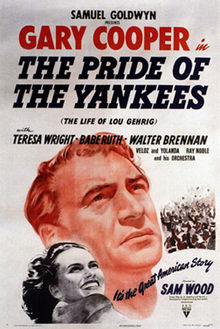
220px-The_Pride_Of_The_Yankees_1942

“People all say that I’ve had a bad break. But today … today, I consider myself the luckiest man on the face of the Earth.”

— Lou Gehrig (Gary Cooper) at the end of The Pride of the Yankees (1943)

After airing Foreign Correspondent earlier tonight, TCM followed up by showing the 1943 best picture nominee, The Pride of the Yankees.  Knowing that Pride of the Yankees was going to be a baseball film and that I know next to nothing about baseball, I recruited my sister, the Dazzling Erin, to watch the movie with me.  Erin loves baseball and I knew that she would be able to explain anything that went over my head.

Well, I absolutely loved watching this movie with my sister but it turns out that The Pride of the Yankees isn’t really much of a baseball movie.  True, it’s about a real life baseball player.  Several actual players appeared as themselves.  About 85% of the film’s dialogue deals with baseball and probably about 70% of the film features characters playing some form of the game.  But the film never goes into any great detail about baseball or how it’s played.  There’s no talk of strategy or rules or deeper meaning or anything else.  Going into the film, I knew that baseball was a game that involved throwing, swinging bats, and running.  And it turns out that was all that I needed to know.

The Pride of the Yankees is less about baseball and more about celebrity.  It’s a biopic of Lou Gehrig, who today is best known for his battle with ALS, a disease that is also known as Lou Gehrig’s disease.  Lou Gehrig died on June 2, 1941 and The Pride of the Yankees was released just a year later.  Watching the film, it’s obvious that Gehrig was a beloved figure, the type of celebrity who, if he were alive today, would probably be the center of stories like, “Lou Gehrig Did Something This Weekend And It Was Perfect.”  Watching the film, it easy to imagine how traumatic it must have been for the nation when a beloved athlete like Lou Gehrig died at the age of 37.

As a result, The Pride of the Yankees is less a biopic and more a case for canonization.  From the minute that the film’s Lou Gehrig appears on-screen, he is presented as being the type of saintly athlete who, by promising to hit two home runs in one game, inspires a crippled child to walk.  Lou is modest, kind, unpretentious, and never gets angry.  Over the course of the film, he takes care of his mother, displays a worthy work ethic, and marries Eleanor.  He and Eleanor have a perfect marriage without a single argument or a hint of trouble, except for the fact that Lou sometimes gets so busy playing baseball with the local children that he’s late coming home.  There’s not a hint of sadness in their life, until Lou suddenly gets sick.

And really, it should not work.  If ever there’s ever been a film that should be painfully out-of-place in our more cynical times, it would be The Pride of the Yankees.  However, the film still works because Lou is played by Gary Cooper and Eleanor is played by Teresa Wright.  These two excellent performers bring their considerable talents to making overly sentimental scenes feel credible.  Gary Cooper was 40 years old when he made The Pride of the Yankees and there’s a few scenes — especially the ones where Lou is supposed to be a student at Columbia University — where Cooper is clearly too old for the role.  But, for the most part, Gary Cooper did a great job as Lou Gehrig.  Cooper is especially memorable when Lou first starts to show signs of being ill.  Watching Lou struggle to swing a bat, I was reminded of a horse struggling to stand on an injured leg.  It was almost painfully poignant.

The Pride of the Yankees was nominated for 11 Academy Awards, including best picture.  However, it lost to another sentimental film that featured Teresa Wright, Mrs. Miniver.