Retro Television Review: Miami Vice 5.8 “Hard Knocks”


Welcome to Retro Television Reviews, a feature where we review some of our favorite and least favorite shows of the past!  On Mondays, I will be reviewing Miami Vice, which ran on NBC from 1984 to 1989.  The entire show can be purchased on Prime!

This week, Switek takes center stage!

Episode 5.8 “Hard Knocks”

(Dir by Vern Gillum, originally aired on January 20th, 1989)

Stan Switek has a gambling problem!

That’s right.  The lovable Stan Switek, played by Michael Talbott, finally gets to be the center of another episode and it’s a pretty dark one.  It’s not as dark as the one where Stan discovered that his partner and best friend had been given a heroin overdose but it’s still pretty depressing.

There are a lot of things that lead to Switek becoming both an alcoholic and a gambling addict.  The death of Larry Zito still haunts him.  The job haunts him.  The fact that he’s continually stuck in “the black box,” and doing surveillance on terrible people haunts him.  At the start of the episode, he learns that he’s been turned down for a promotion and it will be another two years before he can apply again.  Castillo says it’s about money.  The Miami PD doesn’t have the money to pay Switek a sergeant’s salary.  “You’re the best at what you do,” Castillo tells Switek.  That’s of little help.

Switek is best friends with Mac Mulhern (Jordan Clarke), the father of a hotshot college quarterback named Kevin Mulhern (Richard Joseph Paul).  When Switek’s former bookie (Ismael “East” Carlo) is murdered by Goodman (Richard Jenkins, who apparently always looked like he was in his late 50s, even 40 years ago), Goodman orders Switek to tell Kevin to throw his upcoming game.  In order to make sure that it happens, Goodman kidnaps Mac and threatens to kill him.

Switek snaps.  Switek sets out to get his own justice against Goodman and to rescue Mac.  Fortunately, Crockett and Tubbs realize what’s happening and they show up in time to help Switek out.  Once Goodman is dead and Mac is free, Kevin is able to win the game.

Later, Crockett confronts Switek.  He says that Switek’s name is all over Goodman’s books.  What’s Crockett going to do?  Given that Crockett spent months as Miami’s biggest drug lord, I’m not sure that Crockett is in a position to judge anyone.  Fortunately, Crockett seems to understand that as well.  Crockett hands the evidence over to Switek and promises to keep quiet.  Switek — who has spent almost the entire series as comedic relief — breaks down and starts to cry.

That’s one dark episode!  It’s also a very well-done episode.  Michael Talbott gave an excellent performance as Switek, revealing the character’s dark side while still remaining true to who Switek has been since the series began.  Don Johnson and Philip Michael Thomas didn’t do much in this episode but the final scene between Switek and Crockett was wonderfully acted by both Talbott and Johnson.

This was a good episode but I’m worried about Switek now.  I hope everything works out because there’s only a few episodes left!

Speaking of which, Retro Television Review will be going on break for the holidays at the end of this week. Miami Vice will return on January 5th!
I Watched The Bridges of Madison County (1995, Dir. by Clint Eastwood)


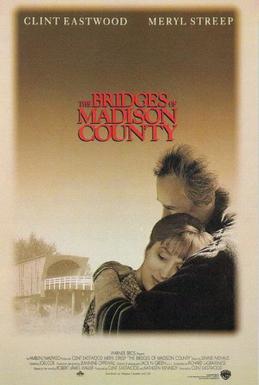
The Bridges of Madison County starts with a mystery.  A sister and her brother try to find out why their mother requested that she be cremated and her ashes scattered from a bridge rather than be buried next to her late husband.  Going through their mother’s things, they learn about four-day affair that she had with a photographer who was just passing through town and taking pictures of covered bridges.

Meryl Streep plays their mother, an Italian war bride named Francesca.  Clint Eastwood plays the photographer, Robert Kincaid.  The movie shows how Francesca, trapped in a loveless marriage, rediscovered her passion for life and love during her four-day affair with Robert.  Robert rediscovered his love for photography.  (I like to take pictures so I was happy for him.)  With her family due home after a trip to the Iowa State Fair, Francesca had to decide whether to abandon them to pursue her affair with Robert.  Since this is the first that her children have ever heard about the affair, it’s easy to guess what she decided to do.

My aunt loved this film and I like it too.  It’s the most tasteful film about a woman being tempted to abandon her family that I’ve ever seen.  It’s a film about adultery that the entire family can enjoy!  The film looks beautiful and Meryl and Clint … wow!  Let’s just say that they seemed to be really into each other.  The two leads give such heartfelt performances that every moment felt authentic and by the end of the movie, I very much wanted to see Francesca’s ashes dumped over the side of that bridge.  Whenever anyone says that Clint Eastwood could only play cops and cowboys, tell them to watch Bridges of Madison County.

Film Review: Worth (dir by Sara Colangelo)


How much is one life worth?

That’s the question that is asked in a film that’s appropriately titled Worth.

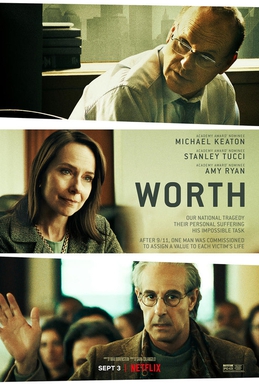
Based on a true story, Worth centers around Kenneth D. Feinberg.  Played by Michael Keaton, Fienberg was the Washington lawyer who, in the days after 9/11, was appointed the Special Master of the September 11th Victims Compensation Fund.  In that role, Feinberg was in charge of determining how much money should be given to the families who lost someone in the 9/11 attacks.  At first, Feinberg tries to reduce his job to just numbers.  He resists the efforts of his law partner, Camille Biros (Amy Ryan), to convince him to meet with any of the families one-on-one.  Instead, he tries to make it all about how much the victims would have earned if they had lived.  When Camille tries to get him to listen to a recording of the final phone call of a man trapped in the Pentagon, Feinberg refuses to do it.

Not surprisingly, Feinberg gets a reputation for being insensitive and many of the families signal that, rather than accepting the government’s compensation, they would rather sue the airlines and the city of New York, a move that we’re told could crash the U.S. economy or bankrupt the families or both.  It’s only after the workaholic Feinberg makes the mistake of staying in the office after everyone else has left that he actually meets one of the families.  With the help of activist Charles Wolf (Stanley Tucci), Feinberg finally starts to care about the people behind the numbers.

Worth is a bit of an old-fashioned film, a throw-back to the type of well-meaning, competently produced films that used to come out every December so that they could compete for the Academy Awards.  Even the film’s rather stolid, middle-of-the road liberalism feels like an artifact of another age.  (I had to laugh a little when the film assured us that, despite sometimes coming across like a jackass, Feinberg was a good guy because he had been a senior aide to Ted Kennedy, the senator who left a woman to drown in a car while he went back to his hotel and got some sleep.)  At a time when Adam McKay is being treated as a serious thought leader and Aaron Sorkin has somehow been recast as a sensible moderate, Worth’s fairly even-handed and nonjudgmental approach feels like almost an act of rebellion.  That said, Worth’s approach works for the story that it’s telling.  9/11 was such a huge tragedy that it doesn’t need to be talked to death, as it would be in a Sorkin film.  Nor do we need the heavy hand of Adam McKay to tell us that there’s something inherently disturbing about reducing the value of someone’s life to a mere number.  Unlike the films of McKay, Sorkin, or Jay Roach (Hell, why not throw him in there, too?), Worth trusts the audience to be able to figure out certain truths on its own.  After a decade of heavy-handed political agitprop, Worth’s nonshowy approach is actually a bit refreshing.

As a character, Kenneth Feinberg is not always easy to like.  That’s especially true during the first half of the film, when Feinberg seems to be more interested in the challenge of running the compensation fund as opposed to the people that he’s supposed to be helping.  When the film begins, Feinberg is the epitome of the technocrat who can figure out the numbers but who has no idea how to actually deal with human beings.  Fortunately, Feinberg is also played by Michael Keaton, who is one of the few actors to be capable of projecting the natural authority necessary to make Feinberg compelling without also resorting to begging us to like the character.  Keaton does a good job portraying both Feinberg’s quick mind but also his social awkwardness.  When we first meet him, he’s someone who has been an insider for so long that he can’t even imagine that an outside exists.  Keaton plays him as a man who does not mean to be callous but who is so work-obsessed that he doesn’t understand how his job comes across to other people.  Even more importantly, though, Keaton does a good job of portraying Feinberg’s transformation from being a detached bureaucrat to being someone who actually cares about the people who will effected by his decisions.  A lesser actor would have overplayed these scenes and the film would have felt mawkish.  Keaton underplays and it saves the film.

As I said before, Worth is an old-fashioned film.  Visually, it sometimes resembles the type of movie that HBO used to win Emmys with in the mid-aughts.  Keaton so dominates the film that, only afterwards, do you realize that the talented supporting cast was often underused.  Worth is not a perfect film but it is a good film and a thought-provoking one.  It’s currently showing on Netflix.

Embracing the Melodrama Part II #126: Veronika Decides To Die (dir by Emily Young)


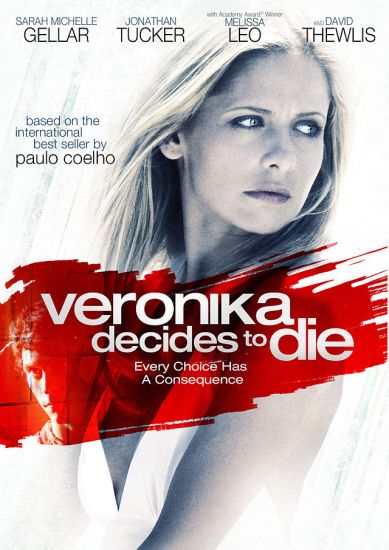
VeronikaDecidesToDie_USPosterWell, here we are!

It’s been 9 weeks since we originally embarked on this journey that I called Embracing The Melodrama Part II.  At that time, my plan was to do 126 reviews in just three weeks.  It didn’t quite work out that way, did it?  But still, I had fun doing this series of reviews and I hope that you’ve had at least a little fun reading them.  If I’ve inspired you take a chance on any of the films that I’ve reviewed — whether it be Sunrise or An American Hippie In Israel or Cocaine: One Man’s Seduction or Calvary — then this has all been worth it!

So, for my final review in this series, I want to take a quick look at one of the most melodramatic films to be released this year so far, Veronika Decides To Die.

Veronika Decides To Die finally got an American release in 2015, six years after it initially premiered on the festival circuit.  Years before it was available here in the States, Veronika played in Europe.  Not surprisingly, the American release felt much like an afterthought, one final attempt to make a little money off the film before moving on.  It’s spent about a week in theaters and two months later, it is now showing up on cable and Netflix.  And while Veronika didn’t get many reviews, the few that it did get were rather dismissive.

But you know what?

I like Veronika Decides To Die.

Don’t get me wrong.  It’s not a great film.  In many ways, it’s a very silly film.  The entire plot hinges on a character doing something that makes no sense.  Frustrated with her life as an anonymous and lonely office worker, Veronika (Sarah Michelle Gellar) attempts to commit suicide.  She survives the suicide attempt and, upon waking in a mental hospital, she’s told by a mysterious psychologist (David Thewlis) that, as a result of her attempt, she now has a heart condition that will kill her in a matter of weeks.  And what does Veronika decide to do after learning that she’s going to die?  She voluntarily remains in the mental hospital and goes to sessions of group therapy!

And you never really believe that Veronika would do that.  But, if you can bring yourself to accept that one implausibility — well, you’ll soon be confronted by a lot of other implausibilities.  You’ll meet Veronika’s glassy-eyed roommate (Erika Christensen) and a mysterious older patient (Melissa Leo).  You’ll also meet Edward (Jonathan Tuker), who is mute but has such a sexy stare that he really doesn’t need to speak.  And as Veronika gets to know her fellow patients, she starts to come to terms with her own issues of anger and regret and she realize that importance of embracing life and doing what you love.

Of course, that’s a little hard to do when you’re in a mental hospital.  Luckily, there’s a piano that Veronika can play while Edward silently watches her.  If you’re guessing that this eventually leads to Veronika sitting naked at the piano and masturbating in front of Edward, well, you’re right…

Listen, Veronika Decides To Die is one of those films that takes itself way too seriously and it ends with a plot twist that you’ll see coming from a thousand miles away.  I can understand why the film’s release was delayed because the film’s tone is all over the place.

But, dammit, I liked Veronika Decides To Die!

When taken on its own defiantly melodramatic terms, it works.  That’s largely because Sarah Michelle Gellar really commits herself to the role.  You forget that you’re watching Buffy.  Instead, Gellar truly becomes Veronika, this tragically sad and lonely young woman who finds inner peace by masturbating at a piano.  Veronika Decides To Die is a movie that really shouldn’t work but Sarah Michelle Gellar saves it.  When the film starts, she beautifully captures Veronika’s lonely desperation, her feelings of isolation and worthlessness.  (I don’t care who you are, we’ve all felt like Veronika at some point in our life.)   As the film progresses, she portrays both Veronika’s anger and her growing appreciation of life.  She has a nice chemistry with Jonathan Tucker and, in the end, Sarah Michelle Gellar probably gives a better performance than the material really deserves.

Of course, another reason that Veronika Decides To Die works is because it is so silly and melodramatic.  This is one of those films that goes so far over-the-top that it creates an almost heightened sense of reality.  It becomes, almost despite itself, compulsively watchable.

It’s also the perfect film with which to complete Embracing the Melodrama Part II.  I hope y’all have enjoyed reading these 126 reviews because I’ve certainly enjoyed writing them!  To everyone who has read these reviews and clicked on the “like” button and occasionally left a comment or two, thank you so much!  Love you!   However much effort or work it may take, all of you make it worth it.

And now I’m going to go pass out for a little while…