Today’s horror scene that I love comes from Lucio Fulci’s 1981 masterpiece, The Beyond.
In this memorably gruesome scene, Joe the Plumber (Tonino Pulci) comes back to life. Having previously lost an eye in the basement of the film’s haunted hotel, he proceeds to claim an eye for himself. I’ll tell you right now that if I ever stepped into a house or a hotel or anywhere that had a sink that looked like that, I would quickly leave and never come back.
First noted by the author Stendhal, Stendhal Syndrome is something that happens when one is confronted by a sight that they never expected to see in person. Usually, it’s a work of great art that triggers the condition and the viewer becomes so overwhelmed by the sight of it that they’re left disorientated and even dizzy. People have reported it happening while visiting museums or historical cities. Recently, a few teenagers made the news when they claimed to have felt the syndrome’s symptoms while at a Taylor Swift concert.
I know that it’s a real thing because I’ve actually experienced Stendhal Syndrome. I was in Florence, the summer after I graduated from high school. One minute, I was fine and even feeling a little bratty, as one does when they’re 18 and they have their entire future ahead of them. But then I looked up at the sky and I saw the skyline of Florence, with its mix of the ancient and the modern and I suddenly became aware that I was in one of the oldest cities in the world and that I was standing on a street that had existed for centuries and I was looking at buildings and statues and paintings that most people would never get a chance to see in person and suddenly, the entire world seemed to be spinning around me. I had to actually sit down for a few minutes to catch my breath because I was so overwhelmed with emotion. My sisters assumed I was having an asthma attack but, even then, I understood that I was feeling something far different. At that moment, history become very real for me and I understood that I existed in the same universe as every great artist and writer. We were all a part of the same existence.
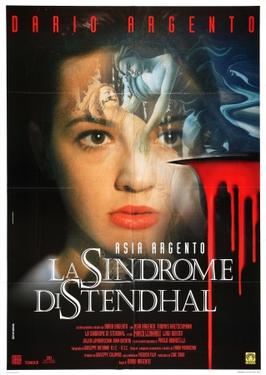
Dario Argento’s 1996 film, The Stendhal Syndrome, also takes place in Florence and features Asia Argento as Anna Mani, a police detective who is sent to the city to capture a serial killer. When Anna visits a museum, she is overwhelmed by what she sees. When she looks at Botticelli’s The Birth of Venus, she hears the wind that blows Venus’s hair. When she views Bruegel’s Landscapes With The Fall Of Icarus she, perhaps significantly, becomes Icarus and flies through the air before crashing into the water below, where she shares a passionate kiss with a fish. In the museum, Anna faints. She drops her purse, giving Alfredo Grossi (Thomas Kretschmann) time to not only steal her gun but also the key to her hotel room.
Dazed and not even sure of who she is, Anna returns to her hotel. A copy of Rembrandt’s The Night Watch turns into a doorway, which she steps through. Finding herself on a rainy city street, Anna is reminded that she’s a detective and that she’s in Florence to catch a vicious killer. When Anna steps back into her room, she discovers that she’s not alone. Alfredo grabs her, rapes her, and abducts her. Anna manages to escape and runs through the streets of Florence while a naked and blood-covered Alfredo screams in the night, which is one of the most disturbing scenes that Dario Argento has ever given us. Alfredo continues to stalk Anna while Anna goes through some changes herself, buying a blonde wig and pursuing a relationship with a French art student (Julien Lambroschini).
The Stendhal Syndrome was the first of Argento’s film to feature CGI, not just in the scenes in which Anna enters the paintings but also in scenes where were literally follow the pills that she’s taken down her throat and where a bullet is seen to enter the face of one of Alfredo’s victims. (Alfredo looks through the resulting bullet holes and winks at Anna on the other other side.) Sometimes, the CGI is effective and sometimes it’s a bit too cartoonish for its own good. At its most effective, the CGI inspires us to wonder if Anna is seeing reality or if she’s still trapped in her Stendhal Syndrome-inspired fantasy world. The scene where disturbing graffiti comes to life may not exactly look real but it’s still undeniably effective. At other times, the special effects just come across as being a bit self-indulgent on Argento’s part.
The film is at its best when it concentrates on the cat-and-mouse game between Anna and Alfredo. As played by Thomas Kretschmann, Alfredo is one of the most terrifying characters to ever appear in an Argento film, a handsome and seemingly charming man who is actually fueled by pure evil and hate. Alfredo is a villain who takes a definite pride in his ability to hide his true nature from the rest of the world. At first, Anna seems almost too physically frail and emotionally open to be believable as a police detective but she soon proves herself to be far tougher than anyone realizes. Anna, it turns out, has secrets of her own. Shot roughly around the same time that Asia Argento was being victimized by Harvey Weinstein, the scenes where Alfredo attacks Anna are difficult to watch, as they should be. Dario Argento took a lot of criticism (particularly from his former partner, Daria Nicolodi) for casting his daughter in a role where she is assaulted but the film itself is fully on Anna’s side.
The second half of the film loses its way a bit, though I can’t go into too much details without spoiling the plot. Several of the first half’s intriguing ideas are abandoned. Asia Argento gives a strong performance during the second half of the film, one that features some of her bravest and most revealing work. That said, despite the strength of Asia’s performance, many of Anna’s actions still don’t make sense no matter how much the film tries to convince us that they do. That said, the final scenes still carries an impact.
In the end, the film uses Stendhal Syndrome as a gimmick. If you want to see a realistic film about Stendhal Syndrome, you’re probably out of luck because it’s not a condition that’s easy to capture cinematically. But, as a thriller, The Stendhal Syndrome holds up well. This is an uneven film but ultimately, what does work outweighs what doesn’t.
David Lynch reportedly once described Eraserhead as being a “dream of dark and disturbing things” and the same description can easily be applied to Lucio Fulci’s 1981 masterpiece, The Beyond.
The second part of Fulci’s Beyond trilogy, The Beyond sits between City of the Living Dead and The House By The Cemetery. With its portrayal of naive humans getting an unwanted look at the inexplicable reality that hides just a little beyond ours, it’s a film that very much calls to the mind the work of H.P. Lovecraft. While insanity was often the punishment for gaining knowledge of Cthulhu and the Great Old Ones, the punishment for discovering the Beyond often seems to be blindness.
(Ocular damage was one of Fulci’s trademarks. Starting withZombi 2, almost every Fulci film seemed to feature someone losing an eye. In The Beyond, a plumber played by Giovanni De Nova loses an eye while wandering about a flooded basement and, over the course of the narrative, several character are rendered blind, making them incapable of seeing the true horror of what they’re experiencing. Fulci struggled with diabetes and the threat of blindness runs through almost all of his horror films.)
The Beyond starts with a striking, sepia-toned sequence that’s set in the year 1927. While a young woman named Emily (played Cinzia Monreale) reads from a book, a mob attacks a painter named Schweik. They believe Schweik to be a warlock and they view his grotesque paintings as being proof. (In many ways, the mob is comparable to the critics who insisted on judging Fulci solely based on the subject matter of his films while ignoring the skill with which Fulci directed them.) Schweik is tortured and left crucified in the basement of the Seven Doors Hotel in New Orleans, Louisiana.
Jump forward 54 years. A woman named Liza (Catriona MacColl, who appeared in different roles in all three of the Beyond films) has inherited the long-closed Seven Doors Hotel and she’s moved down to New Orleans to reopen it. Unfortunately, her efforts to renovate the place aren’t going smoothly. It’s been one disaster after another, almost as if someone or something is trying to keep her from reopening the place. The latest was the flooded basement and the plumber who lost both his eye and his life. Of course, Liza would probably be even more concerned if she knew just what exactly it was that attacked the plumber in the first place.
While driving down one of Louisiana’s many bridges to nowhere, Liza is forced to come to a stop when she sees a blind woman and her guide dog standing in front of her car. The woman is Emily, who doesn’t appear to have aged at all since we last saw her. Emily is now blind. She tells Liza that her hotel was once home to an evil warlock and she warns her to stay out Room 36.
Meanwhile, the plumber’s wife and his daughter visit the plumber’s corpse in the morgue. This not only leads to the plumber and several other dead people coming to life but it also leads to an accident with a beaker of acid that was, for some reason, sitting on a desk. Soon, the daughter is blind herself. On the plus side, all of the drama at the hospital does give Liza a chance to meet Dr. John McCabe (played by the always welcome David Warbeck).
Fulci never got much credit for his work with actors. (Some of that, of course, is due to the fact that most of Fulci’s film were atrociously dubbed for overseas release.) However, The Beyond is definitely one of the best-acted of all of his films. In fact, one reason why we stick with the film even when things start to get really, really weird is because we genuinely like Liza and John. Warbeck and MacColl had a lot of chemistry and, in the midst of all the mayhem, they created two very real characters. Cinzia Monreale is also impressive in the role of Emily. Fulci made good use of her other-worldly beauty and Monreale keeps us wondering whether Emily is trying to help of Liza or if she has a secret agenda of her own.
(Towards the end of the film, during a zombie siege, there’s a scene where John and Liza get in an elevator and, as the doors close, Warbeck tries to reload a gun by forcing a bullet down the gun’s barrel. MacColl sees what he’s doing and breaks character, laughing as the doors close. The Italian crew apparently did not realize that Warbeck was playing a joke because this was the take that they used in the film. Needless to say, it temporarily takes you out of the film and yet it’s such a charming moment that you can’t help but love it. It’s nice to see that with all the grotesque insanity going on around them, Warbeck and MacColl were having fun.)
The Beyond gets progressively more bizarre as it continues. It doesn’t take long for Fulci to abandon any pretense of traditional narrative and the film soon becomes a collection of vaguely connected, increasingly surreal set pieces. A man goes to a library and ends up getting eaten by an army of spiders. Ghouls suddenly roam through the hallways of the hospital. Yet another person loses an eye, this time to a loose nail. Another relatively minor character suddenly has a hole in her head. A chase through the hospital’s basement leads to the characters somehow finding themselves back in the hotel. And finally, we go to the Beyond….
This is going to be heresy to some but, as much as I appreciate it, The Beyond is actually not my favorite Fulci film. Overall, Zombi 2 is my favorite and, as far as the trilogy goes, I actually prefer The House By The Cemetery. That said, The Beyond is the film that best exemplifies Fulci’s cinematic philosophy. Fulci called it pure cinema, the idea that if your visuals are strong and properly edited together, the audience will use them to supply their own narrative. That’s certainly the case in The Beyond. A lot happens in The Beyond and it’s not always clear how everything’s related. But since every scene is full of Fulci’s trademark style, the viewers builds the necessary connections in their own mind. The end result is a film that, perhaps more than any other Fulci film, capture the feel of having a dream. It’s not a film that will be appreciated by everyone. Fulci’s work rarely is. Still, for fans of Italian horror, The Beyond is one of the key films.
Fulci followed The Beyond with one of his best-known movies, The House By The Cemetery. I’ll look at that film tomorrow.
Earlier today, I watched Dario Argento’s underrated 1980 masterpiece, Inferno, on Retroplex.
I fear that, with all the hype surrounding the remake of Suspiria, people are going to forget about Argento’s original Three Mothers trilogy. Inferno was the second part of the trilogy and a loosely connected sequel to the original Suspiria.
In this scene, Mark (played by Leigh McCloskey) finally confronts the Mother of Darkness (Veronica Lazar). While this scene undoubtedly loses some of its effectiveness when viewed separate from the rest of the film, it still shows off Argento’s dream-like style.
Here’s the scene. Be sure to track down and watch whole film if you haven’t already:
I’ve been using this October’s horrorthon as an excuse to rewatch and review the films of Dario Argento! Today we take a look at one of Argento’s best and most underrated films, 1980’s Inferno!
“There are mysterious parts in that book, but the only true mystery is that our very lives are governed by dead people.”
— Kazanian (Sacha Pitoeff) in Inferno
When 20th Century Fox released Dario Argento’s Suspiria in 1977, they weren’t expecting this Italian horror film to be a huge box office success. That it was caught them totally off guard. Though the studio executives may not have understood Italian horror, they did know that Suspiria made them a lot of money and they definitely wanted to make more of it.
As for Dario Argento, he followed up Suspiria by producing George Romero’s Dawnof the Dead. He also supervised the film’s European cut. (In Europe, Dawn of the Dead was known as Zombi, which explains why Lucio Fulci’s fake sequel was called Zombi2.) When Dawn of the Dead, like Suspiria before it, proved to be an unexpected box office hit, it probably seemed as if the Argento name was guaranteed money in the bank.
Hence, when Argento started production on a semi-sequel to Suspiria, 20th Century Fox agreed to co-finance. Though the majority of the film was shot on a sound stage in Rome, Argento was able to come to New York to do some location work, hence making this Argento’s first “American” film. The name of the movie was Inferno.
Sadly, Inferno proved to be a troubled production. Shortly after production began, Argento became seriously ill with hepatitis and reportedly, he had to direct some scenes while lying on his back while other sequences were done by the second unit.
As well, Argento had a strained relationship with 20th Century Fox. Argento wanted James Woods to star in Inferno but, when it turned out that Woods was tied up with David Cronenberg’s Videodrome, the studio insisted that Argento cast an actor named Leigh McCloskey instead. As a performer, James Woods is nervy, unpredictable, and compulsively watchable. Leigh McCloskey was none of those things.
Worst of all, as a result of a sudden management change at 20th Century Fox, Inferno was abandoned by its own distributor. The new studio executives didn’t know what to make of Inferno and, in America, the film only received an extremely limited release. The few reviews that the film received were largely negative. (Like most works of horror, Argento’s films are rarely critically appreciated when first released.) It’s only been over the past decade that Inferno has started to receive the exposure and acclaim that it deserves.
Argento has said that he dislikes Inferno, largely because watching it remind him of a very difficult time in his life. That’s unfortunate, because Inferno is one of his best films.
The Mother of Tears (Ania Pieroni) in Inferno
“Have you ever heard of the Three Sisters?”
“You mean those black singers?”
— Sara (Eleonora Giorgi) and Carlo (Gabriele Lavia) discuss mythology in Inferno
As I stated previously, Inferno is a semi-sequel to Suspiria. Whereas Suspiria dealt with an ancient witch known as the Mother of Sighs, Inferno deals with her younger sister, the Mother of Darkness. The Mother of Sighs lives underneath a German dance academy. The Mother of Darkness lives underneath a New York apartment building. The Mother of Sighs was a witch. The Mother of Darkness is an alchemist.
Beyond that and the fact that Alida Valli is in both films (though apparently playing different characters), there aren’t many references to Suspiria in Inferno. The tone of Inferno is very different from the tone of Suspiria. If Suspiria was perhaps Argento’s most straight-forward films, Inferno is one of his most twisted. It makes sense, of course. Suspiria is about magic but Inferno is about science. Suspiria casts a very Earthy spell while Inferno often feels like a scientific equation that cannot quite be solved.
The film deals with Mark Elliott (Leigh McCloskey), an American music student in Rome. After he gets a disturbing letter from his sister, Rose (Irene Miracle), a poet who lives alone in New York City, Mark heads back to the U.S. to check in on her. (That’s right — Mark and Rose are two more of Argento’s artistic protagonists.) However, when Mark arrives, he discovers that his sister is missing and it’s obvious that strange inhabitants of the building are trying to cover something up.
“May I ask a strange question?”
“How strange?”
— Sara (Eleonora Giorgi) and Mark Elliot (Leigh McCloskey) in Inferno
Even more than with some of Argento’s other films, the plot of Inferno isn’t particularly important. One reason why it’s easy to get annoyed with Mark is because he spends the entire film demanding to know where his sister is, despite the fact that those of us in the audience already know that she’s dead. Argento showed us her being murdered shortly before Mark’s arrival. Argento makes sure that we know but he never bothers to reveal the truth to Mark and one of the more curious aspects of the film is that Mark never discovers that his sister is dead. (By the end of the film, one assumes that he’s finally figured it out but even then, we don’t know for sure.) The fact of the matter is that Mark and his search for his sister are never really that important. Argento doesn’t particularly seem to care about Mark and he never really gives the viewer any reason to care either. (Of course, it doesn’t help that Mark is rather stiffly played by Leigh McCloskey.)
Instead, Argento approaches Inferno as a collection of increasingly surreal set pieces. Much as in Lucio Fuci’s Beyond trilogy, narrative logic is less important than creating a dream-like atmosphere. Often time, it’s left to the viewer to decide how everything fits together.
There are so many odd scenes that it’s hard to pick a favorite or to know where to even begin. Daria Nicolodi shows up as Elise Stallone Van Adler, a neurotic, pill-popping aristocrat who briefly helps Mark look for his sister. Eventually, she’s attacked by thousands of cats before being stabbed to death by one of Argento’s trademark black-gloved killers. After Elise’s death, her greedy butler makes plans to steal her money. Did the butler kill Elise? We’re never quite sure. Does the butler work for The Mother of Darkness or is he just being influenced by her evil aura? Again, we’re never sure. (By that same token, when the butler eventually turns up with eyes literally hanging out of their sockets, we’re never quite sure how he ended up in that condition. And yet, somehow, it makes a strange sort of sense that he would.)
Cats also feature into perhaps the film’s most famous scene. When the crippled and bitter book seller Kazanian (Sacha Pitoeff) attempts to drown a bag of feral cars in a Central Park pond, he is suddenly attacked by a pack of a carnivorous rats. A hot dog vendor hears Kazanian’s cries for help and rushes over. At first, the vendor appears to be a good Samaritan but suddenly, he’s holding a knife and stabbing Kazanian to death. Why did the rats attack in the first place? Is the hot dog vendor (who only appears in that one scene) a servant of the Mother of Darkness or is he just some random crazy person? And, in the end, does it matter? At times, Inferno seems to suggest that the real world is so insane that the Mother of Darkness is almost unnecessary.
Meanwhile, in Rome, Mark sits in class and reads a letter from his sister. When he looks up, he immediately sees that a beautiful young woman is looking straight at him. She’s petting a cat and staring at him with a piercing stare. (She is played Ania Pieroni, who later achieved a certain cult immortality by appearing as the enigmatic housekeeper in Lucio Fulci’s The House By The Cemetery.) The film later suggests that the woman is the third mother, the Mother of Tears, but why would she be in the classroom? Why would she be staring at Mark?
When Mark’s girlfriend, Sara (Eleonora Giorgi), does some research in a library, she finds a copy of a book about The Three Mothers and is promptly attacked by a mysterious figure. When she flees back to her apartment, she meets Carlo (Gabriele Lavia, who was also in Deep Red) who agrees to stay with her until Mark arrives. Is Carlo sincere or is he evil? Argento does eventually answer that question but he certainly keeps you guessing until he does.
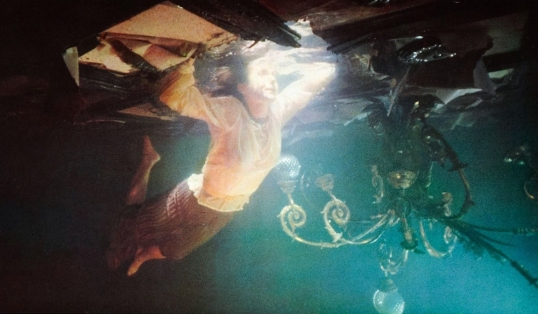
Finally, I have to mention the best and most haunting scene in the film. When Rose searches a cellar for a clue that she believes will lead her to the Mother of Darkness, she discovers a hole that leads to a flooded ballroom. When Rose drops her keys into the hole, she plunges into water and swims through the room. (The first time I saw this scene, I immediately said, “Don’t do that! You’re going to ruin your clothes!”) As Rose discovers, not only keys get lost in that flooded ballroom. There’s a dead body as well, one which floats into the scene from out of nowhere and then seems to be intent on following Rose through the entire room. It’s a sequence that is both beautiful and nightmarish. (It certainly does nothing to help me with my fear of drowning.)
In the end, Inferno is a dream of dark and disturbing things. Does the plot always make sense? Not necessarily. But that plot’s not important. The film’s surreal imagery and atmosphere of doom and paranoia casts a hypnotic spell over the viewer. Inferno is perhaps as close to a filmed nightmare as you’ll ever see.
“She writes poetry.”
“A pastime especially suited for women.”
— Mark and the Nurse (Veronica Lazar) in Inferno
Finally, no review of Inferno would be complete without discussing some of the people who worked behind-the-scenes.
Along with acting in the film, Daria Nicolodi also worked on the script. As is so often the case with Daria and Dario’s collaborations, there are conflicting reports of just how involved Nicolodi was with the final script. Daria has said that she would have demanded co-writing credit, if not for the fact that it had previously been such an ordeal to get credited for Suspiria. Others have claimed that, while Nicolodi offered up some ideas, the final script was almost all Argento’s creation.
(Comparing the films that Argento made with Nicolodi to the ones that he made without her leads me to side with Nicolodi.)
Working on the film as a production assistant was William Lustig, the famed exploitation film producer and director who would later become the CEO of Blue Underground. Reportedly, during filming, Lustig attempted to convince Nicolodi to star in a film that he was going to direct. Nicolodi’s co-star would have been legendary character actor Joe Spinell. Disgusted by the film’s script, Nicolodi refused the role and, as a result, Caroline Munro ended up playing the stalked fashion photographer in Lustig’s controversial Maniac.
Future director Michele Soavi worked on several of Argento’s films. I’ve always been under the impression that Soavi was a production assistant on Inferno but, when I rewatched the film, he wasn’t listed in the credits. Inferno is also not among his credits on the imdb. I guess the idea that one of my favorite Italian horror directors worked on one of my favorite Italian horror films was just wishful thinking on my part.
However, you know who is listed in the credits? Lamberto Bava! Bava, who would later direct the Argento-produced Demons, worked as an assistant director on Inferno. That leads us to perhaps the most famous member of Inferno’s crew…
Mario Bava!
Inferno was the final film for the father of Italian horror. As so often happens, there are conflicting reports of just how involved Bava was with the production. It is know that he worked on the special effects and that he directed some second unit work while Argento was bed ridden with hepatitis. Irene Miracle has said that almost all of her scenes were directed by Mario Bava and that she rarely saw Argento on set.
Mario Bava is often erroneously described as being Dario Argento’s mentor. That’s certainly what I tended to assume until I read Tim Lucas’s All The Colors of the Dark, the definitive biography on Mario Bava. Bava was certainly an influence and it’s certainly true that Argento appears to have had a better relationship with him than he did with Lucio Fulci. But the idea that a lot of Italian horror fans have — that Mario Bava was hanging out around the set of The Bird With The Crystal Plumage and offering Argento fatherly advice — does not appear to be at all true. (It’s a nice image, though.) With all that in mind, it’s still feels somewhat appropriate that Bava’s final work was done on one of the best (if most underappreciated) Italian horror films of all time.
“I do not know what price I shall have to pay for breaking what we alchemists call Silentium, the life experiences of our colleagues should warn us not to upset laymen by imposing our knowledge upon them.”
— The Three Mothers by E. Varelli, as quoted in Dario Argento’s Inferno




 Through the Shattered Lens