For tonight’s excursion into televised horror, we have an episode of Thriller!
This episode is called T and it deals with an artist (Alejandro Rey) who saves a young woman (Ursula Andress) from drowning. It turns out that the local villagers believe that the woman is a witch. The artist has no time for superstition and takes the woman back to his home. She starts as his model and then becomes his lover. She may not be a witch but her mother (Jeanette Nolan) definitely is…
And, of course, this episode is introduced by the one and only Boris Karloff!
This Italian film from 1965 takes place in a future that is a lot like our present. After years of war and senseless violence, the world is finally at “peace.” Wars are avoided by allowing people to take part in the Big Hunt. When you join the Hunt, you’re agreeing to take part in 10 rounds of competition. For five rounds, you’re the hunter. For the other five rounds, you’re the hunted. Survive all 10 rounds and your reward will be money and retirement. So far, only 15 contestants have managed to survive.
If you’re being hunted, you get a letter informing you that you are now being hunted. The only way to win is to kill the person who has been assigned to hunt you. Unfortunately, you’re not told who is hunting you and, if you accidentally kill someone who is not hunting you, you’ll be sent to prison for 30 years. And, of course, the whole time you’re trying to avoid getting killed, others are being hunted around you. World peace means that there are constant gun battles in the streets, all of which are calmly observed by a rather apathetic populace. It’s a violent world but it’s legal violence so it doesn’t really concern anyone beyond the people that are getting killed.
(At one point, an announcement is heard while a hunter guns down his target: “Live dangerously but obey the law…live dangerously but obey the law…”)
Coverage of the Big Hunt is the world’s most popular television show and, as a result, legalized murder has become big business. Companies regularly sponsor hunters and turn their kills into elaborate commercials for their products.
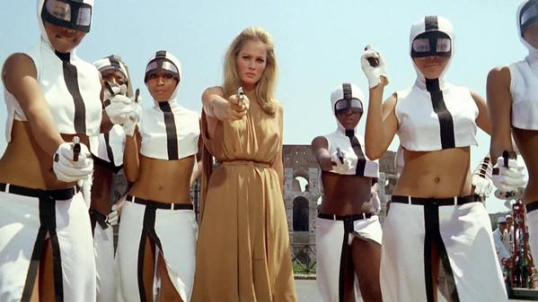
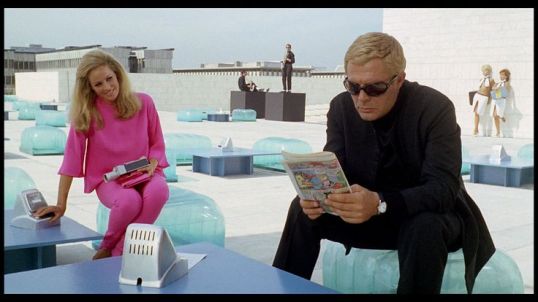
When we first meet Caroline Meredith (Ursula Andress), she is using a literal bullet bra to shoot a man dead. Caroline is sponsored by Ming Tea and, when she is assigned to hunt Marcello Pollitti (Marcello Mastroianni), the company flies her out to Italy. In order to make Marcello’s death as cinematic and commercial as possible, Ming Tea and Caroline decide to lure him to Rome’s Temple of Venus. The Ming Tea dancers are flown in, a choreographer starts working on their routine, and Caroline tracks down Marcello.
Marcello has just found out that he’s being hunted and he’s more than a little depressed. He’s also paranoid and when Caroline first approaches him, Marcello suspects that she’s his hunter and not, as she claims, a journalist. However, because of the legal penalty for killing a non-hunter, Marcello cannot kill Caroline until he’s sure that she wants to kill him. Meanwhile, Caroline cannot kill Marcello until they’re at the Temple of Venus, in front of the cameras and the dancers.
And, of course, there’s also the fact that, as they get to know each other, Caroline and Marcello start to fall in love. When Caroline observes Marcello conducting a bizarre religious ceremony (he’s the head of a cult of sun worshippers), she is so touched that she starts to cry. Or does she? Are her tears just a ploy to keep Marcello from suspecting that she wants to kill him? We’re never quite sure.
If you didn’t already know that The 10th Victim was made in 1965, you would guess it after just a few minutes. This is one of those hyperstylized works of pop art that, for many people, define 60s cinema. How you react to the film will depend on how much tolerance you have for its nonstop style. Speaking as someone who happens to love over-the-top pop art, I enjoyed it but I could imagine other viewers ripping out their hair at the sound of the film’s peppy theme song.
But, if you’re patient, you will eventually discover that, underneath the film’s excesses, it’s actually a rather clever satire of media, politics, culture, religion, and just about everything else that deserves to be satirized. Marcello Mastroianni and Ursula Andress are both a lot of fun and, in the end, the whole thing works as both a surprisingly accurate prophecy of today’s world and as a time capsule of the 1960s.
Plus, I loved the bullet bra. I need to get one of those.
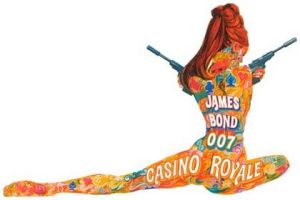
As you probably already know, we here at the Shattered Lens have been counting down the days until the American release of Skyfall by reviewing every single film in the James Bond franchise. Today, we take a look at the first non-EON Bond film, the epic, psychedelic 1967 spoof Casino Royale.
Where to begin?
When Ian Fleming’s first James Bond novel, Casino Royale, was published in 1953, veteran Hollywood producer Charles K. Feldman bought the film rights. However, Feldman didn’t buy the rights to Fleming’s subsequent novels and was forced to sit by and watch as Albert Broccoli and Harry Saltzman had unexpected success with Dr. No and the subsequent EON-produced Bond films. Much as Kevin McClory did with Thunderball, Feldman first attempted to co-produce a serious adaptation of Casino Royale with Broccoli and Saltzman. However, when Feldman, Broccoli, and Saltzman couldn’t come to an agreement on how each side would be compensated in the proposed production deal, Feldman decided to make Casino Royale on his own. He also decided that, instead of trying to compete with EON by making a “straight” James Bond film, his version of Casino Royale would be a satirical extravaganza.
Feldman’s vision of James Bond is apparent from Casino Royale’s opening credits. While the credits are definitely based on the iconic openings of the EON Bond films, they’re also designed to play up the fact that Casino Royale — in the grand tradition of the Hollywood studios at their most excessive — is meant to be a big budget, all-star extravaganza.
Casino Royale actually starts out with a pretty clever premise. It seems that the name “James Bond,” is simply a code name that has been assigned to several British spies over the years. As M (played by John Huston, who also directed the first third of the film), explains it, the name “James Bond” strikes such fear in the hearts of Britain’s enemies that the name must be kept alive.
(Speaking for myself, this is an idea that I kinda wish that the official James Bond series would adopt. If nothing else, it would certainly explain how Pierce Brosnan and Daniel Craig could possibly be the same person.)
The original James Bond (played by David Niven) has long since retired to his stately country estate, where he spends his time playing the piano and complaining about how the agents who have inherited his name are sullying his reputation with excessive womanizing and violence. It turns out the Sir James Bond is a man renowned for his “celibate image.” At the start of the film, Bond is asked to come out of retirement by not only M but the heads of the CIA, KGB, and French secret service as well. SMERSH, an organization of female assassins that’s led by the mysterious Dr. Noah, has been eliminating agents worldwide and only the original (and very chaste) Bond can defeat them. Bond, however, refuses and M responds by ordering a mortar attack on Bond’s estate. The estate is blown up but so is M and Bond soon finds himself returning to London as the new head of MI6.
Interestingly enough, David Niven was one of the actors who was considered for the role of James Bond in Dr. No. Reportedly, Ian Fleming was quite enthusiastic for Niven to take the role but, by the time that Dr. No went into production, Niven was considered to be too old. There’s a nice bit of irony here in seeing David Niven playing a retired James Bond who spends a good deal of the film complaining about the men who have subsequently assumed his name.
Once Niven takes over MI6, he orders that, in order to confuse SMERSH, all British agents (including female agents) will be known as James Bond. The rest of the film is divided into episodes that feature these new James Bonds battling SMERSH and the mysterious Dr. Noah.
Among these agents, there’s the handsome Coop (played by Terrence Cooper) who has been trained to resist all sexual temptations.
There’s Mata Bond (Joanna Pettet), the daughter of Sir James Bond and Mata Hari.
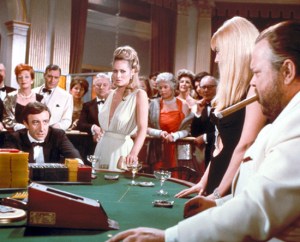
There’s Vesper Lynd (Ursula Andress) who is sent to seduce and recruit the expert gambler Evelyn Tremble (Peter Sellers) so that Tremble can beat SMERSH agent Le Chiffre (Orson Welles) at the Casino Royale.
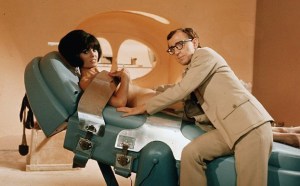
Best of all, there’s Sir James Bond’s nephew, Jimmy Bond. Jimmy Bond is played by Woody Allen and … well, let’s just take a look at Jimmy’s first scene in the film:
Casino Royale had a notoriously troubled production history and most of those troubles seemed to center on Peter Sellers. While the film was designed to be a broad, slapstick comedy, Sellers reportedly insisted on trying to play his role straight and even rewrote his lines to make his scenes more dramatic. Welles eventually grew so disgusted with Sellers that he refused to be in the same room with him. This caused quite a bit of difficulty since Sellers was in almost every scene that featured Welles. Eventually, Sellers walked off the film and the film had to be hastily (and awkwardly) rewritten to account for his sudden absence.
When one watches Casino Royale today, it’s hard to escape the conclusion that Sellers was essentially correct. While most of Casino Royale often feels disjointed and incoherent, the scenes featuring Sellers, Andress, and Welles are some of the strongest in the film. Sellers’ dramatic approach doesn’t negate the film’s comedy. If anything, it makes the comedy even stronger because Sellers actually seems to be invested in the reality his character, regardless of how ludicrous a situation that character may find himself in.
When I watched Casino Royale, I was struck by the stark contrast between the parts of the film that worked and the parts that didn’t. This is a movie that truly swings from one extreme to another. Either the film’s satire is working brilliantly (mostly in the scenes featuring Woody Allen and Peter Sellers) or it’s falling completely flat (like in an extended sequence that features Deborah Kerr as a SMERSH assassin).
I found myself laughing more at the little scenes than the big set pieces. For instance, I loved it when David Niven embraces Miss Moneypenny (Barbara Bouchet) just to be then told that she’s actually the daughter of the original Miss Moneypenny. I don’t know much about the actor Terrence Cooper (though, according to Wikipedia, he was also a contender to take the role of James Bond in the official series) but I enjoyed the brief sequence where Moneypenny “tests” him to see if he can take on the Bond identity. Unfortunately, the film doesn’t really have enough of these small, clever moments.
Ultimately, I found that Casino Royale works best when viewed as a time capsule. Casino Royale was made at a time when the established major Hollywood studios (and veteran producers like Charles K. Feldman) were struggling to remain relevant. Foreign films (including, it must be said, the James Bond films) were challenging the common assumptions of what could and what couldn’t be shown on-screen and the studio system reacted by trying to make films that would appeal to younger audiences while also reassuring older audiences that the movies hadn’t really changed that much. The end result were films like Casino Royale that featured the occasional psychedelic sequence along with cameos from old (and safe) Hollywood stars like George Raft, William Holden, and Charles Boyer. Casino Royale is the type of self-indulgent film that could only have been made in 1967 and, as such, it’s a valuable time capsule for all of us cinematic historians.
I also have to admit that, as excessive as Casino Royale may be, I happen to love excess. Casino Royale might be overlong and occasionally incoherent but the costumes are simply to die for. The film is a visual feast, if nothing else.
Casino Royale was released to scathing reviews and terrible box office but, in the years since, it has become something of a cult favorite. Our own Trash Film Guru has identified Casino Royale as his favorite Bond film. Myself, I found the film to be extremely flawed and yet oddly fascinating to watch. Casino Royale is a total mess and that is both its greatest flaw and greatest strength.
Tomorrow, we’ll return to the official James Bond series by taking a look at You Only Live Twice.
Hi there! As you may already know, in the days leading up to the release of Skyfall, we’re going to be looking at the previous films in the James Bond franchise. Today, we take a quick look at the first of the “official” James Bond films — 1962’s Dr. No.
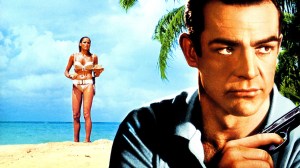
Dr. No is a film of many firsts. It was the first film to be adapted from one of Ian Fleming’s original novels. (Though it was not the first adaptation, that honor going to the 1954 made-for-tv version of Casino Royale). It was, of course, the first Bond film to be produced by the legendary team of Harry Saltzman and Albert Broccoli. It featured the first true Bond girl, with Ursula Andress playing Honey Rider and spending the entire film in an iconic white bikini. Dr. No featured the first appearance of both M and Miss Moneypenny (played, respectively, by Bernard Lee and Lois Maxwell). That iconic theme music made its first appearance in Dr. No as well. However, most importantly, Dr. No featured the first appearance by Sean Connery in the role of James Bond. Even more than Andress’ white bikini, Connery is the reason why Dr. No proved to be the rather unlikely launching pad for one of the most succesful film franchises in cinematic history.
Dr. No, in fact, is a film that contains so many historic firsts that, often, it seems like reviewers tend to neglect the film itself and, instead, chose to concentrate on the film’s legacy. And indeed, 50 years after it was first released, it’s difficult to watch Dr. No without viewing everything about it in relation to what the James Bond franchise would eventually become. Instead of evaluating the film on its own individual merits, the tendency is to watch Dr. No and to spend a lot of time thinking things like: That’s the first time the world ever heard Sean Connery say, “Bond, James Bond.” We tend to forget that, when Connery and director Terrence Young actually made Dr. No, they had no way of knowing that 22 sequels would follow. They didn’t know that they were making film history.
Dr. No begins with a shooting in Jamaica. John Strangeways, the British Intelligence station chief, is ambushed and gunned down by three assassins. Shortly afterward, in a surprisingly brutal scene, his secretary is also assassinated. In response, James Bond is summoned to the offices of MI6. When he receives the summons, Bond is busy gambling and seducing Sylvia Trench (Eunice Grayson). Sylvia, incidentally, was originally meant to be a character who would pop up in all of the subsequent Bond films. Basically, she would have functioned as Bond’s girlfriend, the loyal woman who waited at home while Bond went to exotic countries and slept with every other woman in the world. Perhaps wisely, this idea was abandoned after just two movies but still, Bond’s initial meeting with Sylvia (and the audience) is such an iconic moment that words simply won’t do it justice. Here it is, for your viewing pleasure:
This scene has to rank as one of the best intro scenes in film history. In just a few brief minutes, this scene tells us everything that we need to know about both James Bond and, even more importantly, Sean Connery’s interpretation of the character. In this scene, Connery’s Bond is the epitome of narcissistic charm, giving just a hint of the determined cruelty lurking right underneath the surface. It’s especially interesting to compare Connery’s Bond here to Daniel Craig’s interpretation of the character. Whereas Craig’s Bond often seems to be on the verge of having a nervous breakdown, Connery is established in his first scene as being a cool and calm professional. Craig may be the ideal Bond for our troubled reality but Connery will always be the Bond of our dreams and fantasies.
Bond is sent to Jamaica, where he teams up with CIA agent Felix Leiter (played by Jack Lord). Again, it’s interesting to compare this version of Felix Leiter with Jeffrey Wright’s more-recent interpretation of Felix. Whereas Jack Lord’s Felix Leiter is a cool, calm professional (a bit like an asexual version of Connery’s Bond, to be honest), Jeffrey Wright’s Felix often seems to be mired in self-loathing. Both interpretations are perfectly legitimate (and Felix is usually such a superfluous character that just about any interpretation will do). Instead, they’re interesting largely because of the way that each one of them epitomizes the decade in which each film was made.
With the help of Leiter, Bond quickly figures out that Strangeways’ death is linked to the mysterious, Dr. No (Joseph Wiseman), who has his own private island near Jamaica. The natives claim that a dragon guards the island but Bond, never one to let something like that stop him (especially when it’s always his allies — like the unfortunate Quarrel — who get killed in these films, as opposed to him) sneaks onto the island. It’s here that he first spies Honey Rider (Ursula Andress) walking along the beach. Again, Honey’s introduction is such an iconic scene that, rather than try to describe it, it’s better just to show it:
For all the talk of how the Bond girls were often sexist stereotypes, I would have loved to have been an old school Bond girl. Seriously, they got to be all sexy, they got to make love to James Bond, and occasionally, they got to help save the world. Seriously, what fun!
I’ve spent so much time talking about James Bond and Honey Rider that I haven’t left much room for Dr. No. But that’s okay because, to be honest, Dr. No is not really that interesting of a villain. As opposed to future Bond villains, Dr. No is something of a bland character. Joseph Wiseman plays him with a lot of menace and he has a few over the top moments but it doesn’t matter because there’s really nothing to distinguish Dr. No from any other megalomaniac that’s ever shown up in a low budget spy movie. He’s a perfectly acceptable villain but he’s not an extremely memorable one. (Perhaps if Christopher Lee had accepted the role when it was offered to him, Dr. No would have been a bit more of an effective character.) Rest assured that Dr. No does have an impressive secret headquarters and, that once he does capture Bond and Honey, he takes his time to explain all of his evil plans as opposed to doing something sensible like killing them.
So, how does Dr. No hold up 50 years after first being released?
Surprisingly well.
Despite having a weak villain, Dr. No is still a lot of fun. As opposed to future Bond films, Dr. No was a low-budget affair and, at it’s best, it comes across as an appealing B-movie. Ultimately, the film is best known for introducing audiences to Sean Connery in the role of James Bond and perhaps that is for the best because Connery truly is the best thing in Dr. No. Five decades later, you can still see why the world was so intrigued with both the actor and the character.
Tomorrow, we’ll take a look at one of my personal favorite films of all time — From Russia With Love!
Hi! It’s time for another edition of Lisa Marie’s Favorite Exploitation and Grindhouse Trailers. Today’s theme — well, as explained at the end of this post, I nearly dedicated this post to my menses but then I changed my mind. There really isn’t a theme beyond the fact that these trailers entertained me and hopefully, they’ll entertain you as well. Well, that and the trailers are all about wild sex and wild nature.
I love this trailer! It’s for a film directed by Radley Metzger and personally, I think it’s wonderfully erotic in its old school, sordid way. The use of still frames gives it a real La Jetee feel.
From director Serigo “Not Leone or Corbucci” Martino, this film features Stacy Keach, Ursula Andress, and perhaps the most oddly inappropriate orgy scene in the history of Italian cannibal films. If this film seems to be a lot like Cannibal Ferox, it’s because they both ended up using a lot of the same stock footage.
What are the Lepus you may ask? Well, in case you haven’t heard of this movie or come across it on late night television, I’ll tell you after the trailer.
The Lepus are giant killer bunny rabbits. They hop in slow motion and kill a lot of people. Seriously.
At the same time the southwest was being ravaged by killer bunny rabbits, the real south was being attacked by killer frogs. Mother Earth was on angry bitch in the 70s and to her, I say, “You go, girl!”
Mother Nature was still angry in the ’80s apparently. By this point, I think you start to say, “Someone needs to get off the drama train, girl.”
6) Confessions Of A Summer Camp Counselor (1978)
But why was Mother Nature so ticked off? I think the answer might be found in this trailer. Apparently, in the 70s, there was an actor named Robin Askwith who had the sex appeal of a groundhog. And he apparently starred in a series of British films that all had titles like Confessions of a Window Washer, Confessions of an Altar Boy, and, in the case of this trailer, Confessions of a Summer Camp Counselor. Apparently, Robin played a character named Timothy Lea and he spent these films getting laid. By all accounts, both they and Mr. Askwith were quite popular in Britain which just goes to prove, once again, that the Irish were right. Anyway, I assume that some film producer is currently in pre-production on Confessions of a Registered Sex Offender.
One final note:
Originally, I was going to gross out (and taunt) my male friends by calling this post 6 Trailers For A Bloody Period. And, I’ll warn you right now — I still like that title and if I can find 6 exploitation trailers that center around menstruation, I’m going to resurrect it sometime in the future.
 Through the Shattered Lens