The Films of Dario Argento: Opera


It can be argued that 1987’s Opera is one of Dario Argento’s most personal films.

In the mid-80s, Argento was hired to direct an opera, in this case a production Giuseppe Verdi’s Macbeth.  Argento described the opportunity to direct an opera as being a case of one of his childhood dreams coming true.  Unfortunately, certain people were scandalized with the idea of hiring a director of violent horror films to direct the opera, even though Macbeth is one of the most horrific of Shakespeare’s plays.  I mean, if any story seems to be custom-made for a director who is known for his complex set pieces and his willingness to indulge in graphic imagery, it would seem to be Macbeth.  Despite this, the production was canceled and Argento was left feeling like an outsider in his own industry.

Along with his disappointment over the canceled production of Macbeth, Argento was also suffering on a personal level when he directed Opera because he had just separated from his long time partner and collaborator, Daria Nicolodi.  The two of them had a notoriously volitale relationship, one that led to some of Argento’s best films and reportedly some of his biggest on-set fights.  Despite the fact that they had split up, Argento still wrote a role for her in his latest film.  At first, Nicolodi refused the role but she changed her mind when Argento promised her the most spectacular death scene in the movie.  However, when it came time to shoot the scene, Nicolodi apparently grew paranoid that Argento was planning to kill her for real.  Fortunately, Nicolodi was incorrect about that and Argento was totally correct about her scene being one of the best in the film.
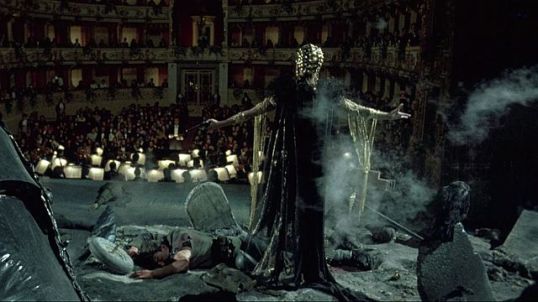
Opera takes place during a production of Macbeth, one that is directed by a controversial horror director named Marco (played by Ian Charleson, the star of the Oscar-winning Chariots of Fire).  When his star is injured in an auto accident, Marco is forced to cast the young understudy, Beth (Cristina Marsillach), as Lady Macbeth.  Despite the doubts of many, Betty gives a strong performance in the role.  She stuns the audience.  Perhaps the power of her performance is due to her own traumatic memories of her mother being murdered by a never captured assailant.

Speaking of murder, people around Betty start dying as well, often while Betty is forced to watch.  The black-gloved killer often come out of nowhere, gags Betty, and ties her to whatever is nearby.  The killer always tapes a row of needles under Betty’s eyes, keeping her from being able to close them or to look away as the killer then proceeds to murder her friends.  The first victim is Betty’s handsome boyfriend, Stefano (William McNamara).  The second murder is a costumer (Barbara Cupisti).  Three of the opera’s ravens are killed, leaving the remaining ravens determined to get revenge.

Betty, it should be noted, refuses to go the police about what she has witnesses because she thinks that the killer is the same person who murdered her mother.  You have to wonder at her logic or the fact that director Marco agrees with her decision.  Personally, if I witnessed a murder as brutal as the murder of Stefano, I would go to the police.  It’s hard to really sympathize with Betty’s decision, as much as the film seems to think that I should.

Opera has a lot of fans and it does feature some of Argento’s strongest visuals.  Towards the end of the film, there’s an extended raven attack in the opera house that is one of Argento’s greatest set pieces.  And, for all of her fears that she was about to be killed for real, Daria Nicolodi’s shocking death scene is Argento at his best.  Both Ian Charleson and Urbano Barberini give excellent performance and, even if the genesis of the film was found in Argento’s anger over his canceled version of Macbeth, there’s a lot of affection to be found in the film’s portrayal of what goes into putting on a massive production.  One gets the feeling that, for once, Argento actually likes the majority of the characters in the film.

That said, I have to admit that there are a few things that I don’t particularly care for in Opera.  If I liked Phenomena more than most viewers, I like Opera a bit less.  After each murder, Argento attacks our ears with heavy metal and I assume the point is to contrast the stateliness of the opera with the chaos of the killer’s actions.  But, while I can respect Argento’s logic (assuming that was his logic), the music itself tends to be repetitive and, after the second time that we hear it, it gets kind of boring.  And Betty is not a particularly sympathetic protagonist, both due to the way she’s written and also Cristina Marsillach’s less than convincing performance in the role.  Reportedly, Argento and Marsillach did not get along during filming and perhaps that explains why her performance never really seems to come alive.  Everyone in the film insists the Betty is a revelation of Lady Macbeth but there’s nothing about Marsillach’s performance that makes us believe that.  It’s hard not to feel that the film would have been improved if Cristina Marsillach and Barbara Cupisti had switched roles.

(Director Michele Soavi, who has a small role in this film, did later cast Cupisti as the lead in his film Stage Fright and watching Cupisti in that film, it’s even easier to imagine her as the lead in Argento’s film.)

The film ends on a strange note, one that seems to serve as a call-back to Phenomena.  What I find interesting is that critics who like the film overall tend to be critical of the ending and the idea of Marsillach talking to a lizard.  Whereas I, someone who does not like the film quite as much as some others, absolutely loves the ending because it’s just so weird and it comes to use from out-of-nowhere.  It’s as if Argento is saying, “You might have kept me from directing an opera but it’s my movie and I’m in control here.”

Opera did well in Italy and the rest of Europe but, as was so often the case, Argento was screwed by his American distributors.  Opera was originally supposed to get an American theatrical release but, when the distributor went bankrupt, the film was only given a video release, with much of the gore edited out to ensure that the film received an R-rating and could be carried by Blockbuster.  (That’s right.  Blockbuster wouldn’t carry anything above an R.  Where’s your God now, video nerds?)  Fortunately, all that was edited out was put back in when Opera was released on DVD in 2002.

The (Reviewed) Films of Dario Argento:

  1. The Bird With The Crystal Plumage
  2. Cat O’Nine Tales
  3. Four Flies on Grey Velvet
  4. Deep Red
  5. Suspiria
  6. Inferno
  7. Tenebrae
  8. Phenomena 

The TSL’s Grindhouse: Gor (dir by Fritz Kiersch)


The 1987 film Gor opens with a nerdy college professor (played by Urbano Barberini, of Demons and Opera fame) giving perhaps the worst lecture in the history of underwhelming lectures.  The professor explains that there is a counter-earth, a place that he claims is known as Gor.  Gor shares the same orbit as Earth but it’s linearly opposed to Earth, which apparently makes it impossible to see.  However, the professor says that his father gave him a ring which can transport the user to Gor.  The only problem is that the professor has not figured out how to use the ring.

The students all look incredibly bored with the lecture and I don’t blame them.  Not only does the professor seem to be rambling but he doesn’t even offer up any visual aides.  He could have at least utilized a powerpoint presentation or something.  Instead, his only teaching aide is a whiteboard on which he’s written “counter-earth.”  I have to wonder what their final exam is going to look like.  “True or false.  Your professor is a freaking loon.”

(I found myself wondering what university would possibly grant tenure to some guy who thinks he owns a magic ring but then I remembered Evergreen College.)

The professor’s name is Tarl Cabot and I think that’s a good deal of his problem right there.  When you give a child a name like Tarl Cabot, you’re pretty much guaranteeing that he’s going to grow up believing that he has a magic ring that’ll transport him to another planet.

Of course, in Tarl’s case, it turns out that the ring does just that.  After his teaching assistant dumps him so that she can go on a date with another professor, Tarl crashes his car and when he wakes up, he finds himself on Gor.  Apparently, the ring only works if you crash your car or something.

As for Gor itself, it turns out to be kind of a dump.  It’s a huge desert.  Seriously, check out this counter-earth:

If Tarl wanted to see a desert, he could have just driven around Southern California and saved himself a lot of trouble.

Yes, there is trouble in Gor.  No sooner has Tarl arrived then he’s being attacked by a bunch of barbarians on horseback.  The barbarians are led by the evil Sarm (played by Oliver Reed).  Much as with the case of Tarl Cabot, I think that once you name a child Sarm, you’ve pretty much guaranteed the way that his life is going to turn out.  Anyway, Tarl somehow survives being attacked by the barbarians.  He even manages to kill Sarm’s son, which leads to Sarm declaring that he wants Tarl dead.

Fortunately, Tarl is eventually rescued by another group of barbarians.  This group is led by Talena (Rebecca Ferratti) and she wants Tarl to help her rescue her father from Sarm’s fortress.  But how can Tarl help when he’s literally useless?  Don’t worry!  The good barbarians are willing to train Tarl.  One montage later, Tarl is now a master swordsman.  Now, all Tarl has to do is dress like a barbarian and then track down a little person who can serve as a guide to Sarm’s fortress!

And what a fortress it is!  Sarm may be evil but he likes to make sure that both his guests and his slaves have a good time.  Sarm welcomes Tarl to the fortress and even tries to recruit him over to his side.  (So apparently, Sarm’s over that whole “you killed my son” thing.)  Sarm understands that the best way to recruit Tarl is with a dance number!  As Sarm laughs lustfully, the slaves put on a show.  It’s somewhat out-of-place but at least it distracts from the rest of the film.

Anyway, there’s a lot of problems with Gor but the main one is that the place itself just doesn’t seem like it’s worth all the trouble.  After spending years trying to figure out how to get to the planet, Tarl arrives and discovers that it’s basically the same desert that was used in almost every post-apocalyptic film made in the 80s and 90s.  (In fact, judging from John Carter, it’s still being used today.)  What I always wonder about this type of movie is 1) why is the other planet always full of humans who speak perfect English and 2) why do all of these planets feature a society that resembles that ancient Roman Empire?  Apparently, swords and arrows are literally universal weapons because they’re used on every planet in the universe.

When I first saw that this film starred Urbano Barberini, I assumed that it was going to turn out to be an Italian production.  (In the late 80s, there were several Italian films that featured barbarians fighting in post-apocalyptic landscapes.)  However, it turns out that Gor was a South African production, co-produced by the legendary Harry Alan Towers and directed by an American named Firtz Kiersch.  (Kiersch also directed the first film version of Children of the Corn.)  That said, the film itself is so ineptly dubbed and the production values are so low-budget that it would still be easy to mistake Gor for a film directed by Bruno Mattei or Claudio Fragasso.

Because he’s so badly dubbed, it’s difficult to really judge Barberini’s performance as Tarl Cabot.  At the very least, he looks good with a sword in his hand and he’s cute — if never quite believable — when he plays Tarl as a neurotic physicist.  However, Barberini can’t really compete with Oliver Reed, who devours every inch of scenery that he can find.  Reed bellows and laughs and appears to be drunk in almost every scene in which he appears but at least he seems to be having a good time.  Reed is also required to wear a silly helmet in most of his scenes and I sincerely hope that he got to take it home with him.

Oliver Reed isn’t the only familiar face to pop up in Gor.  There’s also Jack Palance.  Palance only shows up for about two minutes and he looks rather confused as he discusses his plan to conquer the world.  (Apparently, Palance returned in Gor‘s sequel.)  For two minutes of screen time, Palance managed to score himself third billing in the opening credits of Gor, above even Oliver Reed!  Way to go, Jack!

Anyway, Gor is a pretty stupid movie.  I appreciated the random dance number but otherwise, it’s fairly dull and only occasionally enlivened by Oliver Reed’s refusal to go gently into that dark night.  I’m going to guess that films like this were popular with filmgoers who saw themselves as real-life Tarl Cabots and who spent their spare time thinking, “Nobody will laugh at me once they see me with a sword!”  I caught the film yesterday on Comet TV, which is quickly becoming one of my favorite channels for watching bad movies.


The TSL’s Daily Horror Grindhouse: Demons (dir by Lamberto Bava)


demons

“What the Hell happened to Rosemary?”

— Tony The Pimp (Bobby Rhodes) in Demons (1985)

A lot of what you need to know about Demons, an Italian horror film from 1985, can be summed up by the fact that one of the leading characters is named Tony the Pimp.  Demons is a very self-aware film, one that is not only over-the-top and ludicrous but which is cheerfully aware that it’s over-the-top and ludicrous.  Considering that Demons is an apocalyptic film that ends with nearly the entire cast dead, Demons is a surprisingly good-natured horror film.

The film opens in Berlin.  There’s a mysterious man hanging out at a subway station.  He’s wearing a silver half-mask and, from what we can see of his face, he appears to be heavily scarred.  Interestingly enough, the man is played by Michele Soavi.  (Though Soavi is now best remembered as the director of Dellamorte Dellamore, he was an actor and assistant to Dario Argento when Demons was produced.)  The man doesn’t speak.  Instead, he hands out flyers to random people, inviting them to attend the premiere of a new horror film.

The man obviously does a very good because a truly diverse group of characters show up for the premiere.  There’s a wealthy blind man who comes with his assistant.  (The assistant is played by Dario Argento’s oldest daughter, Fiore.)  There’s an older couple who keep shushing everyone in the audience.  There’s Cheryl (Natasha Hovey), who ends up sitting next to the handsome George (Urbano Barberini, who would later co-star in Dario Argento’s Opera).  And, of course, there’s Tony the Pimp (Bobby Rhoades) who shows up wearing a white suit and with two prostitutes.

The film-within-the-film is a horror film that plays out like an homage to every Italian horror film released in the 1980s.  It deals with four teenagers who stumble across the grave of Nostradamus and end up transforming into blood-thirsty demons.  One of the teenagers is played by Michele Soavi, though it’s never clear whether the teenager and the man in the mask are supposed to be the same person.

As they watch the movie, something strange starts to happen in the audience.  One of the prostitutes scratched her face when she put on a prop mask.  When the same mask appears in the movie, the cut on her face starts to throb.  Soon, she is transformed into a … DEMON!

JUST LIKE IN THE MOVIE!

Needless to say, the arrival of a real-life demon leads to a panic in the theater but guess what?  The doors are locked!  There’s no way out!  When Tony the Pimp breaks into the projection booth, he discovers that there’s no projectionist and the movie cannot be stopped!  On top of that, getting scratched by a demon means that you transform into a demon yourself!

In other words — remember the debate about whether or not horror movies can turn their viewers into murderous monsters?  Well, Demons says that they definitely can…

Demons was directed by Lamberto Bava, son of the famous Mario Bava, and it remains one of the most popular Italian horror films of all time.  With a script that was co-written by Dario Argento (who also produced), Demons is a fun and exciting horror film that cheerfully dares you to take it too seriously.  Watching this energetic film, you can tell that Bava was having a lot of fun with the idea that the world could end as a result of watching just one horror movie.

Demons was a huge box office hit so, naturally, there were hundreds of unofficial sequels.  Though Michele Soavi’s The Church was a Demons film in every way but name, the only official sequel was Demons 2.  We’ll look at that film tomorrow.