Miniseries Review: The Offer (dir by Dexter Fletcher, Adam Arkin, Colin Bucksey, and Gwyneth Horder-Payton)


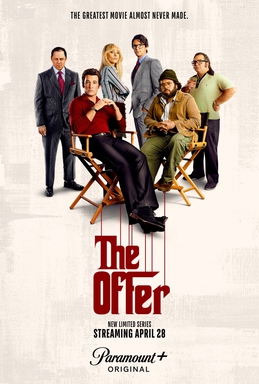
Almost despite myself, I enjoyed The Offer.

That may come as a surprise to some.  The Offer is a 10-hour miniseries about the making of The Godfather and how Hollywood politics aren’t really that much different from Mafia politics.  As anyone who has regularly read this site over the past few years should know, I absolutely love The Godfather.  It’s my favorite movie.  It’s a movie about which I’ve done a lot of personal research.  There’s very little about the making of The Godfather that I don’t know.  If we’re going to be honest, I’m probably a little bit of a snob about it.

So, like many people, I was a bit skeptical when I first heard about The Offer.  It didn’t seem like something that was particularly necessary and it was hard for me to imagine how the miniseries would ever be able to convincingly cast anyone as Marlon Brando or Al Pacino or, for that matter, Francis Ford Coppola.  My skepticism only increased when I learned that the story was going to be told from the perspective of the film’s producer, Al Ruddy.  Everyone agrees that Ruddy was an important part of The Godfather team but he’s never been quite as compelling a figure as the brilliant but often self-destructive Brando or the neurotic but playful Pacino.  When people talk about what makes The Godfather such a brilliant film, they talk about the quotable dialogue.  They talk about the masterful performances.  They talk about Coppola’s skill as a storyteller.  They talk about the way that Gordon Willis lit the scenes so that the characters often seemed to be on the verge of being swallowed by their shadows.  They even talk about how Robert Evans insisted that the film could only be directed by an Italian and how Evans defied Paramount when the studio originally demanded that Coppola cut the film down to two hours.  When Al Ruddy is praised, it’s usually for staying out of the way.

I knew that I would have to watch The Offer eventually but I avoided it while it was actually airing and I made sure not to read anyone else’s opinion to it.  Despite my own obvious biases, I did want to try to maintain as open a mind as I possibly could.  That said, I wasn’t expecting much when I finally watched The Offer this weekend.

But, as I said at the start of this review, I enjoyed it.

Don’t get me wrong.  It’s a bit of a silly show.  If The Offer was a sitcom, it would be called Everybody Loves Ruddy because the main theme of the show seems to be that Al Ruddy (played by a miscast Miles Teller) was literally the most important man in the entire history of Hollywood.  There’s not a problem that Ruddy can’t solve, whether it’s convincing CBS to air a tasteless sitcom called Hogan’s Heroes or convincing Paramount to take a huge risk on a mercurial director named Coppola and an unknown actor named Pacino.  When gangster Joe Colombo (Giovanni Ribisi) tries to interfere with production, Ruddy befriends him and is soon a popular guy with the crew.  When Al Pacino (Anthony Ippolito) signs a contract with MGM, Ruddy puts the pressure on Paramount to find a way to get Pacino out of it.  When Coppola (Dan Fogler) has a fight with Gordon Willis (T.J. Thyne), Ruddy convinces them to make up.  When Robert Evans (Matthew Goode) goes on a coke binge, Ruddy snaps him out of it.  When …. well, you get the idea.  There’s nothing Al Ruddy can’t do!  When Evans mentioned that Henry Kissinger was coming to the Godfather premiere, I half expected Al Ruddy to negotiate a ceasefire in Vietnam.

From the start, The Offer is full of visual cues and dialogue that pay homage to not only The Godfather but the other films of the period.  The first line of the miniseries is Joe Colombo telling someone to, “Leave the cannoli.”  At first, I groaned but, slowly but surely, the show won me over.  By the end of the first episode, it was obvious that The Offer was not necessarily meant to be taken literally.  The Offer doesn’t tell the story of what Hollywood was really like in the late 60s and early 70s.  Instead, it tells the story of how people like me, who were born a few decades too late, imagine it was.  It’s less about the decade itself and more about how that decade continues to fascinate us and spark our imagination.  In our imagination, Robert Evans is snorting coke in his office, Ali MacGraw is lounging by the pool, Frank Sinatra is making angry phone calls to Joe Colombo, Al Pacino is so nervous that he can’t look anyone in the eye, and Marlon Brando is wandering around his mansion in a kimono and talking about how he can’t get anyone to see his latest, politically-charged film.  In our fantasies, it only makes sense that Evans and his assistant Peter Bart (Josh Zuckerman) would spend all of their time dropping titles of well-regarded, still-remembered films because why would anyone fantasize about them discussing a film that was forgotten?  And, of course, no one is going to fantasize about people discussing some actor who was briefly big in 1972 and then spent the rest of their career on television.  Instead, in the fantasy, it’s all about Robert Redford, Jack Nicholson, Liz Taylor, and Marlon Brando.  It also makes sense that only classic 70s music would be heard in the background of every scene because, seriously, who ever fantasizes about a bad song playing at a party?

Once it is accepted that it is all meant to be a fantasy, it becomes much easier to appreciate The Offer for what it is, a gossipy, Hollywood story with a Mafia subplot and an overabundance period detail.  Once the viewer accepts The Offer is a fantasy, the viewer is freed up to appreciate the 70s-chic wardrobe.  Once the viewer gets past the fact that the cast is playing characters based on actual people, it becomes much easier to appreciate the performances of character actors like Colin Hanks (who plays an uptight executive) and Burn Gorman (who plays the notoriously eccentric businessman, Charles Bluhdorn).  Patrick Gallo is slyly funny as Mario Puzo while Dan Fogler does a credible enough job as Coppola, even if he never quite captures Coppola’s larger-than-life persona.  Even Lou Ferrigno gets a nice bit, playing a mob enforcer turned unwilling actor.  At the center of it all is the absolutely brilliant Matthew Goode, giving a charismatic performance as the brilliant but sometimes unstable Robert Evans.

As a history, The Offer won’t win any points for accuracy.  But, as a fantasy, it’s undeniably entertaining.  It’s not so much the story of how The Godfather was made but the story of how we wish it was made.

Miniseries Review: Angelyne (dir by Matt Spicer and Lucy Tcherniak)


Who is the real Angelyne?

That’s question that is at the heart of Peacock’s new miniseries, Angelyne.  The obvious answer is that Angelyne (played, quite well, by Emmy Rossum) is a Los Angeles icon who, in the 80s and 90s, was known for having her image plastered on billboards across the city.  The billboards usually featured a provocative picture of Angelyne, her name, and a phone number that one could call.  Billboards, of course, are used for advertising and Angelyne was advertising herself.  What service did Angelyne provide?  She provided the service of being a celebrity that people might actually run into while walking or driving around the city.  She drove her pink Corvette across Los Angeles, waved at tourists, and sold merchandise to her fans.  She even twice ran for governor.  Before the Kardashians and the explosion of social media, Angelyne was famous for being famous.  And when people asked who Angelyne was before she became Angelyne, she replied that she had always been Angelyne.  Sometimes, she said she was someone who had come to Los Angeles from another state.  Sometimes, she said that she was a literal angel, sent down to spread peace and help people believe in themselves.  Other times, she suggested that she was an extra-terrestrial.  Perhaps her most honest response was that she was whatever the person looking at her wanted to be.  People saw Angelyne and they projected their own feelings onto her.

Filmed in a manner that combines faux documentary footage with flashbacks, each of Angelyne‘s five episodes focuses on someone from Angelyne’s past as they talk about their role in Angelyne’s enigmatic life.  Often times, they seem to be struggling to come to terms with the fact that they’re obsessed with someone about whom they actually know very little.  A smarmy reporter (Alex Karpovsky) and a twerpy filmmaker (Max Allen) both investigate Angelyne’s past and it’s hard not to resent their efforts to bring her down to Earth.  (The reporter, at one point, actually says that Angelyne lost her right to privacy when she ran for governor, as if anyone seriously believed Angelyne was going to be the next governor of California.  Seriously, most viewers will want to smack him.)  Cory Hunt (Philip Ettinger), the lead singer of a band that Angelyne was briefly a member of, tries to take credit for creating her persona but he’s never credible and Angelyne even interupts their flashbacks to say that he’s lying.  Wendy Wallace (played by Molly Ephraim) struggles to come to terms with the fact that her father, Harold (Martin Freeman), not only bankrolled Angelyne’s billboards but also neglected his family to “manage” Angelyne’s career.  Angelyne’s assistant, Rick (Hamish Linklater), devotes his life to supporting and protecting Angelyne but sometimes, even he has to take a break.

All of them get their chance to tell their story and, as played by Rossum, Angelyne gets to tell her story.  Not surprisingly, Angelyne’s story often differs from the stories being told about her.  Frequently, a flashback will come to a halt as soon as Angelyne announces, “That’s not what happened.”  When the twerpy filmmaker claims that he got Angelyne to admit the truth about who she was before she remade herself as Angelyne, Angelyne pops up to tell us that it never happened.  Even after the “truth” of Angelyne’s past has been revealed, Angelyne shows up to assure that the story isn’t true and, if it is true, it’s only halfway true and it’s impossible not to respect Angelyne’s refusal to accept or admit to being anyone other than a Los Angeles icon named Angelyne.  The miniseries suggests that Angelyne is someone who dealt with unimaginable pain and trauma by creating herself as almost a cartoon of what it means to be a celebrity.  The miniseries also suggests that, at the very least, Los Angeles should be thankful that she did.

In many ways, Angelyne feels like a superior companion piece to Hulu’s Pam & Tommy.  Both miniseries are about the curious nature of fame and the America’s bizarre celebrity culture.  The main difference is that while Pam & Tommy was thuddingly literal and featured Seth Rogen wandering around with that stupid mullet, Angelyne is stylish and imaginative and there’s not a mullet in sight.  Whereas Pam & Tommy struggled to justify its existence, Angelyne features a scene where the title character flies a UFO over Los Angeles.  Whereas Pam & Tommy presented Hugh Hefner as being a benevolent father figure, Angelyne features a scene where Angelyne tells off a smug Hefner and informs him that there’s nothing his magazine can do for her that she can’t do for herself.  For that scene alone, Angelyne deserves to be seen.

Lisa Marie’s Week In Television: 5/22/22 — 5/28/22


We’ve been up in Arkansas for most of this week so I haven’t watched much television.  Interestingly enough, I have watched quite a few films and written quite a few reviews.  I guess there’s probably a lesson to be learned there.

I have to be honest.  As much as I want to get caught up on all of the miniseries and shows that I didn’t get a chance to see over the past few months, it’s difficult to get started.  It doesn’t help that even the miniseries that sound interesting are still way too long.  I saw a show that I was interested in watching on Netflix but then I checked and I discovered that it’s 10 episodes long, each episode is over 60 minutes, and the first episode deals with the main character’s grandparents.  It’s hard for me to justify spending 11 to 12 hours on a show that doesn’t even start with the main storyline.  During the pandemic, streaming services could get away with that sort of thing because there were no other options.  Today, there are other options, assuming you don’t live in one of those crazy lockdown states up north.

Anyway, here are a few thoughts on what I did watch this week:

1883 (Paramount Plus)

This western miniseries serves as a prequel to Yellowstone, a very popular show that I have yet to really watch.  Sam Elliott plays Shea Brennan, an aging and suicidal cowboy who helps to lead a group of German settlers across the frontier.  Along for the ride are the Duttons (played by Tim McGraw and Faith Hill) and their teenage daughter, Elsa (Isabel May).  It’s a long journey, full of tragedy and violence.  Many people die, some from gunshot and some just from accidentally run over by a wagon.  Elsa narrates.  Shea finds something to live for.  The Duttons eventually settle in the land that will serve as the setting of Yellowstone.  

Each episode of 1883 was sponsored by a store that sells tractor supplies and that pretty much tells you who the target audience was for the show.  For all the graphic violence, sex, and precision F-bombs, 1883 is a fairly old-fashioned western.  That said, it was all very well-done and well-acted.  Isabel May was the cast standout while Sam Elliott showed that, regardless of how you may feel about his Power of the Dog opinions, he’s still one of the most authentic western actors around.  1883 was long but, even over 10 episodes, there weren’t any slow spots and even potentially distracting cameos from Billy Bob Thornton and Tom Hanks didn’t take away from the show’s narrative momentum.

On a personal note, I liked 1883‘s portrayal of Fort Worth as being the most lawless town in Texas.

Allo Allo (Sunday Night, PBS)

Having stowed away on the airplane that was meant to pick up the British airmen, Edith and Rene found themselves in the UK!  They also discovered that Captain Geering (last seen 3 seasons ago) was now working for the British.  Edith and Rene received medals for Chuchhill and then, to Rene’s consternation, they were promptly sent back to France.  They arrived just in time to keep Momma and LeClerc from performing their new cabaret number.  

By Allo Allo standards, this episode was actually fairly coherent.

American Idol (Monday Night, ABC)

Though I kind of lost interest in this season after Hollywood week, I did tune in to see Noah Thompson win the season on Monday.  To be honest, Noah seems like he’s destined to be one of the forgotten winners of American Idol but I was still happy to see that he beat the annoyingly quirky Leah Marlene and the annoyingly monikered Huntergirl.

Barry (Sunday Night, HBO)

While this week’s episode didn’t feature anything quite as brilliant as last week’s customer service conversation, it was still a very good episode.  Gene’s dinner with Joe Mantegna was cringe comedy at its best.  Meanwhile, Sally’s show was canceled despite its RT score.  At first, I was a bit worried she would take Barry back but fortunately, Barry ruined the moment and she get kicked him out again.

Better Call Saul (Monday Night, AMC)

Poor Howard!  I’ve seen enough of this show and Breaking Bad to know that Howard was probably going to die at some point but I was still upset to see it happen.  Patrick Fabian was terrific in the role.  Hopefully, the Emmy voters will remember Fabian this year.  If nothing else, he’s come a long way since he played Prof. Lasky on Saved By The Bell: The College Years.

Creepshow (Shudder)

On Friday, I watched the third episode of season 3.  A tech billionaire destroyed the wrong painting.  A prisoner took revenge after his pet spider was killed.  It was all enjoyably macabre.  Those killer spiders were especially creepy!  Agck!

Dynasty (Friday Night, The CW)

All the scheming and the plotting and the melodramatic dialogue continued this week.  To be honest, I was a bit out of it on Friday because I had strained my back earlier in the day so I’ll probably have to rewatch Friday’s episode.  I just know I’m going to miss Dynasty when it’s gone.

Survivor (Wednesday Night, CBS)

Maryanne won.  I was happy that Maryanne won.  I know some people are saying that she only won because she was likable but Maryanne did engineer the Omar blindside so I think she earned her right to claim victory.  That said, I am getting a little bit tired of people riding their immunity idols all the way to the end of the game.  The show needs to put a time limit on those idols.  Anyway, I wrote about the finale for the Reality TV Chat Blog!

We Own This City (Monday Night, HBO)

This week’s episode was a bit heavy-handed but that’s what most of us have to come to expect from David Simon’s recent work.  We Own This City works when it’s dealing with the corrupt cops but it comes to a halt whenever the focus shifts to the DOJ investigators.  Treat Williams’s cameo as a reform-minded police academy instructor was embarrassingly over-written and felt out-of-place.  That said, the good still outweighs the bad when it comes to this show.  It may be uneven but, at its best, it’s still a thought-provoking look at the warrior cop mentality and how systemic corruption can destroy a city.

Scenes I Love: Berkman Goes Boom from Barry


Today’s scene that I love is a fairly recent one.  

On Sunday’s episode of HBO’s Barry, hitman-turned-actor Barry Berkman (played by Bill Hader) accepted a contract to blow up a house and the Bolivian gangsters within.  He was given a bomb which had been purchased on the Dark Web and which, unfortunately, had been programmed to continually repeat a phrase in Japanese.  He was also given the Detonator App (developed by KABOOM), which would allow him to remotely detonate the bomb.

The only problem is that the app didn’t seem to be working and as Barry tried to figure out why, some of the gangsters heard the bomb “speaking” underneath the house.  Meanwhile, Fernando — who was not supposed to be in the house when the bomb went off — showed up to talk to his father-in-law.  While Fernando discovered that his own secrets were no longer secret, Barry wondered if he would even be able to get the bomb to go off.

Customer service to the rescue!

As I said, I saw this scene on Sunday and, as Monday comes to a close, I’m still laughing about it.  It almost makes me want to get a job at Kaboom.  This is a wonderfully executed and detailed scene and one of the best that I’ve seen so far this year.

“Alright, sounds like we were successful….”


Miniseries Review: Candy


It’s strange how things work out.

In 1980, something terrible occurred in the town of Wylie, Texas.  Candy Montgomery, who was a Sunday School teacher and who had what seemed like the ideal life, killed Betty Gore.  Betty was reportedly one of Candy’s closest friends but Candy still ended up striking her 41 times with an axe.  After Candy was arrested, she revealed that she had cheated with Betty’s husband.  She also said that she attacked Betty in self-defense.  At her trial, she was ultimately found not guilty.

It was one of those small town scandals that the media tends to love and, 42 years after it all happened, it’s still spoken of down here in Texas.  Every five years or so, there’s a big “where are they now?” article in the Dallas Morning News.  Betty’s widowed husband married a woman that he started dating a few weeks after Betty’s death.  Candy’s lawyer, Don Crowder, tried to launch a political career and, when that failed, got addicted to cocaine and ended up committing suicide.  As for Candy, she divorced the husband who stood with her through the trial and apparently now lives, under a new name, in another town.

Still, despite the case’s continuing notoriety in Texas, I was recently a bit surprised to learn that there was not one but two Candy Montgomery miniseries in development.  HBO has Love and Death, which stars Elizabeth Olsen as Candy.  Love and Death is scheduled to come out later this year and it’ll probably suck because it’s written by David E. Kelley and this is exactly the type of story that’s going to bring out all of his worst instincts.  Meanwhile, Hulu produced Candy, starring Jessica Biel as Candy and Melanie Lynesky as Betty Gore.

Candy aired, over five nights, last week and I have to say that Hulu did a good job of presenting the story.  I’m usually a bit cynical about true crime miniseries (especially ones that are set in small town Texas in the late 70s) but Candy was actually really good.  The first episode featured a somewhat frazzled but always smiling Candy as she tried to balance a day that included swim lessons, bible school, taking the kids to see The Empire Strikes Back, and, of course, killing her best friend.  The final episode featured the courtroom drama, in which the ghost of Betty Gore could only watch as Candy Montgomery made herself the center of the tragedy.  In between, Candy provided a portrait of small-town life, church gossip, a mid-life crisis, and a lot of shag carpeting and wood paneling.  The miniseries balanced melodrama with satire but it also worked as a portrait of a group of people who all realized that their lives hadn’t turned out the way that they wanted them too.  Both Candy and Betty are portrayed as being frustrated and dissatisfied with what the world has to offer them.  The difference is that, while Betty wears her pain for all to see, Candy hides everything behind a quick smile and a superficially friendly manner.  In the end, one gets the feeling that Candy was acquitted because no one wanted to believe that someone who seemed so perfect could do something so horrific.

Candy is also well-served by its cast.  Melanie Lynesky is often heart-breaking as Betty Gore, while also still playing her with just enough anger that Candy’s story of being attacked is not easy to dismiss.  Jessica Biel keeps you guessing as Candy, playing her as someone who you would probably want to be friends with, even though you can’t help but suspect that she would also probably gossip about you behind your back.  Timothy Simons and Pablo Schrieber are well-cast as Candy and Betty’s clueless husbands.  Simons especially deserves some credit for generating sympathy for a character who, as written, could have been portrayed as just being a caricature.  And yes, Justin Timberlake does show up as the deputy who investigated the crime.  While it does feel a bit like stunt casting, Timberlake is convincing once you get used to the 70s porn mustache.

Though it aired without the fanfare that greeted other Hulu miniseries like Dopesick, Pam & Tommy, and The Girl From Plainville, Candy is a compulsively watchable and, at times, even thought-provoking work of true crime.  Without any of the slow spots that marred The Girl From Plainville or Dopesick‘s preachiness, Candy is definitely one that will benefit from being binged.  Check it out the next time you have five hours to kill.


Lisa Marie’s Week In Television: 5/1/22 — 5/7/22


Why didn’t anyone tell me that Ghosts was so good!?  Over the past few days, I’ve been watching it and loving it.

Anyway, here’s some more thoughts on my week in television!

Atlanta (Thursday Night, FX)

During this week’s funny but unsettling episode, Al got stoned in Amsterdam.  It’s possible that he met a mysterious women named Lorraine who warned him about the people around him and who took him to a club where he met Liam Neeson.  It’s also possible that Al hallucinated the whole thing while passed out in a doorway.

Barry (Sunday Night, HBO)

The latest episode of Barry really, really freaked me out.  Basically, Barry found himself with two options.  He could either get Gene a role on a TV show in order to make up for killing Gene’s girlfriend or he could just kill Gene.  Barry was determined to give Gene a second chance and, by extension, himself a second chance.  Barry was trying to do the right thing.  The problem is that Barry is a sociopath who is trying to be the good person that he is incapable of being.

This episode was all about abusive relationships.  Sally is trying to produce her dramedy about her own abusive relationship but she doesn’t seem to understand that her current relationship with Barry is just as abusive as the one she escaped.  (The scene where Barry yelled at her for not casting Gene was legitimately scary.)  Barry is trying to recover from his abusive relationship with Fuches, little realizing that he’s repeating Fuches’s behavior with the way that he’s manipulating Gene.  Is Gene going to end up becoming a hit man by the end of this season?  It could happen.  Meanwhile, the only vaguely healthy relationship on the show, between Noho Hank and Cristobal, came to an end due to them being members of rival criminal gangs.

Bill Hader continues to astound as Barry.  He’s both sincere and terrifying.  Barry truly believes that he’s capable of doing the right thing even though we know he isn’t.  This week’s episode reminded us that Barry can be a scary guy.  When he indicated that he would kill Gene’s grandson if Gene didn’t accept the role that Barry had gotten for him, it was a chilling moment.  I’ll never look at Barry the same way again.

Better Call Saul (Monday Night, AMC)

Rhea Seehorn directed this week’s episode of Better Call Saul, which featured both Jimmy’s continuing efforts to destroy Howard’s career and also his move into his new office.  Meanwhile, Gus and Mike continued to search for evidence of Lalo still being alive.  This was a well-done episode, one that did a good job of showing how Jimmy McGill transformed into the Saul Goodman who would later be hired by Walter White.

The Brady Bunch (Sunday Morning, MeTV)

Oh no!  Marcia lost her diary!  However, this somehow led to her meeting Davy Jones so I guess everything worked out.  This was followed by an episode in which the kids were worried that Mike and Carol were going to sell the house so they pretended to be ghosts.  Then, Carol and Mike had tickets to a show and Alice had a date so Greg and Marcia were left in charge of the house.  Disaster followed.  Then, during Sunday’s fourth episode, Marcia was accused of pulling a prank by her school’s principal.  The principal was played by the distinguished character actor, E.G. Marshall.  One can only guess how Marshall felt about going from Broadway and Oscar-nominated films like 12 Angry Men to appearing on The Brady Bunch.  Actually, he was probably happy for the money.  I hope Marshall was paid well because he definitely classed up the joint.

Full House (Sunday Afternoon, MeTV)

MeTV aired 4 episodes of Full House on Sunday and I’m struggling to remember much about any of them.  In the first episode, Jesse was worried that he wasn’t smart enough for Rebecca and he proved that he wasn’t by acting stupid.  Rebecca, however, forgave him.  Then, Michelle and Kimmy ended up babysitting some bratty kid who got his head stuck in a bannister.  This was followed by an episode in which Danny started dating again and managed to forgive his date for having a messy apartment.  And then, in our final episode, Michelle started preschool and accidentally set the class’s pet bird free.  So, Danny bought a new bird and demanded that everyone be nice to his daughter, despite the fact that she was kind of a self-centered brat.

Ghosts (Thursday Night, CBS)

What a charming show!  For some reason, I was under the impression that Ghosts was just another gimmicky show but I finally sat down and binged the first eleven episodes on Paramount Plus and I discovered that I was totally wrong.  This is really a sweet, witty, intelligent, and well-acted show and one of my favorites of the season.  I loved the episode where Sam went to see her mom.  That made me tear up.  As for my favorite ghost …. Trevor.  Yep, it has to be Trevor.

The Girl From Plainville (Hulu)

This frustratingly uneven miniseries came to a close this week.  The final episode dealt with the day that Conrad committed suicide and also Michelle’s final days before heading to prison.  Considering just how inconsistent this show has been, the finale was actually pretty effective.  The lengthy fantasy sequence, in which Michelle imagined running into Conrad at a bar while home from the college that, in reality, she’ll never get to attend, worked far better than it had any right to.  In the end, this miniseries didn’t have much to tell us about the suicide of Conrad Roy that we didn’t already know but it did work as a showcase for the talents of Elle Fanning and Colton Ryan.

Law & Order (Thursday Night, NBC)

I have to admit that, when this week’s episode of Law & Order started, I rolled my eyes when it appeared that the main villain was going to be a barely disguised version of Elon Musk.  But then it turned out that guy was just a red herring and the accused instead turned out to be a former State Department employee who claimed that he couldn’t control his actions because of Havana Syndrome.  To my great surprise, this turned out to be the the best episode of the season so far, largely because the prosecution finally lost a case and Price was left to wonder if it was largely due to his own self-righteous approach to the law.  Sam Waterston finally got a few good scenes too.  The Law & Order revival has, for the most part, been uneven but I do think that it’s been getting better.

The Love Boat (Sunday Afternoon, MeTV)

A famous actress took a cruise and fell for Captain Stubing.  Unfortunately, not even the promise of being wealthy and secure could convince the captain to give up the sea.

M*A*S*H* (Weekday Evenings, MeTV)

On Sunday, I watched two episodes of this old sitcom.  The first one featured an obnoxious surgeon from Arkansas, who got in trouble for trying to steal Col. Potter’s horse.  The second was a bit more dramatic, as a friend of Hawkeye’s died on the operating table and a teenage Ron Howard appeared as a soldier who lied about his age in order to enlist.  In the past, I’ve found M*A*S*H to be a bit too preachy for my tastes but this was actually a pretty effective and well-acted episode.

Survivor (Wednesday Night, CBS)

I wrote about the latest episode of Survivor here!

We Own The City (Monday Night, HBO)

The second episode of David Simon’s latest miniseries about Baltimore was as compelling and as packed with detail as the first.  While setting in his jail cell, Jon Bernthal’s Wayne Jenkins remembered the process by which he went from being a relatively honest cop to being the poster child for police corruption.  Nicole Steele continued her investigation of Daniel Hersl.  In the role of Hersl, Josh Charles only appeared during the final few minutes of the episode but he still made a huge impression as the epitome of everything that people tend to dislike about the cops.  I look forward to seeing where this series is heading.

TV Review: The Girl From Plainville 1.5 “Mirrorball” (dir by Pippa Bianco)


Well, I tried.

I really did.  Coming off of the high that I got off reviewing each episode of The Dropout, I thought it would be pretty easy to review all 8 episodes of The Girl From Plainville but, having watched the fifth episode last night, I think I’m done.

Don’t get me wrong.  I will continue to watch the series.  (There’s only three weeks left.)  And I’ll certainly include any thoughts that I have about the show in my “Week in Television” post.  But I think I’m done with trying to come up with 500-1000 words to use to review each episode because, quite frankly, there’s just not much to say about The Girl From Plainville.  The story of how Michelle Carter encouraged Conrad Roy to commit suicide is well-known.  The fact that Michelle Carter was put on trial and convicted is also well-known.  This show is trying to build-up suspense about a story that most viewers will already know.

It perhaps wouldn’t matter if The Girl From Plainville had something new or unexpectedly insightful to say about the case.  But the fact of the matter is that Michelle Carter is not that interesting of a human being.  Everything that I’ve read and seen about the case seems to suggest that she really didn’t have much going on inside of her brain.  Because she lacked an actual personality, Michelle learned how to behave and how to interact through social media and television.  Conrad’s death allowed her to live her life as if it was an episode of Glee, or at least that’s what Michelle was hoping.  And now, years after Conrad’s suicide, Michelle is out of prison and being played in a miniseries by Elle Fanning.  It doesn’t seem to be quite fair, does it?

As for last night’s episode, it felt pretty much like a filler episode.  The prosecution team continued to build a case against Michelle while Michelle had to deal with going from briefly being the most popular girl in school to being an absolute pariah.  We also got a few clumsily handled flashbacks to Michelle texting Conrad.  Last weekend, I watched Dopesick, which also aired on Hulu and also used a jumbled timeline.  The timeline in Dopesick did occasionally get confusing but, at the same time, it worked because it took place over several years and the actors could be made to look older or younger, depending on the timeline.  If Michael Keaton had a hint of hair, you know the show was taking place in the 90s.  If he was bald, you know it was 2004.  The Girl From Plainville, on the other hand, is only dealing with a two-year period and, as such, it’s hard to keep track of what’s happening when.  The characters played by Elle Fanning and Chloe Sevigny pretty much look and act the same in 2012 as they do in 2014.  It’s a very clumsily constructed story structure, one that does the miniseries little good.

That said, Elle Fanning continues to give a convincingly unhinged performance as Michelle and Colton Ryan is appropriately vulnerable as Conrad.  (Sorry,  I’m not going to call him Coco.)  I think if the miniseries had done away with all of the flashback nonsense and just told their story in chronological order, Fanning and Ryan’s strong performances would have been better served.  For now, I’m done with doing full reviews of this show but, if next week’s episode is a surprisingly good one, that could change.

TV Review: The Walking Dead 11.15 “Trust” (dir by Lily Manye)


It’s often been said that, in the world of The Walking Dead, you shouldn’t trust anyone.

Of course, that’s not necessarily true.  Indeed, if you don’t trust anyone, you’re actually probably increasing the odds that you’ll end up getting eaten by walkers or killed by Reapers or Whisperers or whoever the main villain of the season happens to be.  You have to be willing to join up with some sort of community and that requires taking a leap of faith and putting your trust in the survival and leadership capabilities of someone who, under normal circumstances, would probably forever be a stranger to you.

That said, the world of The Walking Dead does require a certain amount of weariness.  As the past 11 seasons have shown us, not everyone is worth the trouble.  Some people insist on trying to apply reason to a chaotic world.  Some people simply aren’t strong enough mentally or emotionally to survive the harsh reality of the apocalypse.  Some people are just mean.  And, of course, some people are just too annoying to keep around.  Trust is important but trust also has to be earned.

Last Sunday’s episode of The Walking Dead was all about trust.  In fact, it was so much about trust that it was a little boring.  This was one of those episodes that you could appreciate because it was laying the groundwork for whatever the finale is going to be but, at the same time, you also find yourself wishing that the show would just get on with it.

But, back to the issue of trust:

Hornsy has to decide if he trusted Gabriel and Aaron’s version about what happened at the Apartment Complex.  Hornsby decided that he did not and with good reason because both Gabriel and Aaron were obviously lying.  Aaron can get away with that but Gabriel just broke a Commandment.  As others have pointed out, Gabriel’s not a very good priest.

Maggie had to decide whether or not to trust Daryl when he promised her that the Commonwealth soldiers would only be inside Hillside for a brief moment of time.  She trusted Daryl but, obviously, she still doesn’t trust Hornsby and that’s definitely the right call on her part.  Hornsby is so villainous that you have to admire the show’s restraint in not putting a black hat on his head.

The Hillside residents are trusting Maggie to give them a safe place to live but I couldn’t help but notice that Hillside looks worse and worse every time the show spends any time there.  Would it kill someone to mow the grass and take care of the weeds?  Everything about Hillside just reeks of mosquitos and tetanus shots.

Hornsby had to decide whether or not to trust little Herschel when the kid tried to pretend like his mom hadn’t gone to the Apartment Complex.  Hornsby obviously knew better than to believe a word that kid had to say.

At the Commonwealth, Eugene has decided to trust Max.  Yay! 

Mercer has decided to trust Princess.  Yay!

Mercer has decided that he does not trust Hornsby.  That’s a smart decision but Mercer seriously needs to hurry up and announce whose side he is on.

Finally, the sick of the Commonwealth have decided to trust Ezekiel’s surgical skills.  That seems like something that could go wrong but …. well, we’ll see what happens.

Anyway, with this episode, we finally reached the flashforward from the 9th episode.  We finally learned why the Commonwealth showed up at Hillside and why Daryl was with them.  For all of the speculation, it turns out that Daryl and Maggie are not enemies and, as Daryl showed when Hornsby threatened Herschel, Daryl will probably be on Team Hillside when the inevitable war breaks out.  To be honest, I think we all secretly suspected that was what was going to happen.  Still, it’s hard not to be a little bit disappointed that things worked out so simply and so obviously.  It makes sense, though.  Daryl trusts Maggie.

And, in the end, it’s all about trust.

TV Review: The Dropout 1.8 “Lizzy” (dir by Erica Watson)


(Below, you will find spoilers for the final episode of The Dropout.  I would recommend not reading this post until you’ve watched the episode.)

After all the drama and the deception, The Dropout ended the only way that it could, with Theranos in ruins, Sunny out of Elizabeth’s life, and Elizabeth still unable to comprehend why everyone got upset with her in the first place.  While George Schultz tries to come to terms with his mistakes and Erika Cheung worries about whether or not she’s ruined her future career by coming out as a whistleblower, Elizabeth tries to do damage control by forcing Sunny out of Theranos and then going on television for a cringey interview that pretty much seals her fate.  Both David Boies and Linda Tanner (Michaela Watkins, who became the unexpected heart of this episode) tell Elizabeth that it’s important that she come across as being contrite and sincerely “devastated” by Sunny’s actions.  Elizabeth, however, can’t do it.  As she explains to her mother, Elizabeth has been locking away her emotions for so long that she no longer knows how to express or even feel them.

The end of the episode finds Elizabeth finally pursuing the life that she would have led if she hadn’t dropped out of Stanford, started Theranos, and gotten involved with Sunny.  She’s dating a younger man.  She’s going to Burning Man.  She owns a dog.  She’s ditched the turtleneck.  She’s let her hair down.  She’s speaking in her real voice.  She’s going by “Lizzie.”  She’s reverted back to being the somewhat flakey child of privilege that she was at the start of the miniseries.  Even while Linda Tanner confronts her with the number of lives that she and Theranos destroyed, Elizabeth doesn’t break her stride.  Elizabeth has decided that she’s moved on, even if no one else can.  It’s only when she’s alone that she briefly allow her composure to crack, just long enough to scream into the void.

Of course, the final title card informs us that it doesn’t matter how much Elizabeth wants to be Lizzie, the girl who goes to Burning Man with her boyfriend.  Having been convicted of defrauding her investors, Elizabeth Holmes is currently awaiting her sentencing.  She could end up spending the next twenty years in prison.  And, just as Phyllis Gardner predicted in the previous episode, Elizabeth has made it difficult for other female entrepreneurs to find success in Silicon Valley.

As the episode came to a close, with Elizabeth walking through the now empty offices of Theranos with her dog and an increasingly agitated Linda, I found myself thinking about how those offices progressed through the series.  Theranos went from a shabby office building in the worst part of town to being the epitome of Silicon Valley chic.  In the early episodes, the cluttered Theranos offices and labs were disorganized but there was also a very sincere earnestness to them.  Men like Ian Gibbons actually believed in what they were doing.  By the fourth episode, Theranos transformed into a secretive place that was fueled by paranoia.  With each subsequent episode, the offices became a bit less individualistic and bit more joyless.  In the final episode, the offices were dark and deserted, as empty as Elizabeth and Sunny’s promises.  Looking at those offices, it was hard not to mourn the lost idealism of those early days.  Sunny may have never shared that idealism.  The miniseries suggests that Elizabeth lost her idealism as soon as she finally started to get the positive publicity that she craved.  But the people who were there at the beginning believed in Theranos and its stated mission.  Even Elizabeth’s early investors were taking a chance because they thought she could make the world a better place.  In the end, Elizabeth and Sunny betrayed all of them.  As I said at the start of this review, The Dropout ended the only way that it could, with an empty office, a lot of broken hearts, and Elizabeth Holmes convinced that the world had somehow failed her.  Viewers may never fully understand what was going on in Elizabeth Holmes’s mind but they’ll never forget her or the story of Theranos.

The Dropout was a good miniseries, probably the best that we’ll see this year.  This is a miniseries that better be remembered come Emmy time.  Amanda Seyfried seems to be a lock to at least get a nomination.  Naveen Andrews deserves consideration as well.  The supporting cast provides an embarrassment of riches.  Sam Waterston, Dylan Minnette, Kurtwood Smith, Michaela Watkins, William H. Macy, the great Stephen Fry, Camryn Mi-Young Kim, Kate Burton, Anne Archer, and Laurie Metcalf, all of them are award-worthy.  Give them the Emmy campaign that they deserve, Hulu!

TV Review: The Girl From Plainville 1.4 “Can’t Fight This Feeling Anymore” (dir by Pippa Bianco)


Last week, when the first three episodes of The Girl From Plainville dropped on Hulu, my main concern was that, regardless of how well-acted the show may be or how tragic the true life story might be, there really wasn’t much left to be said about Michelle Carter and Conrad “Coco” Roy.   

Having watch the fourth and latest episode last night, I have to say that I think my concerns were justified.  I mean, don’t get me wrong.  The fourth episode was fairly well-directed.  It was definitely well-acted.  There was a scene where Elle Fanning and Colton Ryan start singing Can’t Stop This Feeling that I’m sure will be a favorite amongst many viewers.  But, in the end, it’s hard to see why eight hours are going to be required to tell this story.  There was really nothing in the fourth episode that couldn’t have been communicated in a two-minute montage.

The fourth episode continued the show’s distracting habit of jumping back and forth in time.  The main problem with this is that, unless Colton Ryan is in the scene, it’s often difficult to keep track of whether we’re seeing the past or the show’s “present.”  There’s not much different between past Michelle and present Michelle.  For that matter, Coco’s parents appear to have been just as miserable in the past as they were in the present.  There was a scene where Coco’s father and his grandfather got into an argument about whether or not they should sell Coco’s truck and it took me a few minutes to understand that the scene was supposed to be taking place in 2014 and not 2012.  To be honest, there’s really no reason for the show’s jumbled timeline, other than the fact that it’s currently what all the Emmy-winning miniseries are doing.  But since we all already know how the story began and how the story is going to end, we don’t really get much out of the show’s mix of flashbacks and flashforwards.

The show seem to be trying to generate some suspense over whether Michelle will actually go on trial over her part in Coco’s death but again, what’s the point?  We all know that she went on trial.  The publicity of the trial is the whole reason why most people are going to be watching this show in the first place.  In fact, all of the legal maneuvering is probably the least interesting part of the story.  So far, both the prosecutor and Michelle’s attorney are coming across as being one-note characters.  That may be a reflection of reality because real-life lawyers are rarely as interesting as their television counterparts but that still doesn’t make for compelling viewing.

What does make for compelling viewing is the show’s suggestion that this was all because of Glee.  Michelle’s obsession with Finn and Rachel, in particular, seems to have been her main motivation for pursuing a relationship with Coco in the first place.  And, of course, Finn died when his actor died so perhaps Coco had to die as well.  (On the bright side, at least Michelle wasn’t obsessed with Puck and Quinn.)  While the rest of the world is trying to understand why Coco killed himself and why Michelle apparently ordered him to get back in the truck, Michelle is imagining herself in an episode of Glee.  As I mentioned earlier, the Can’t Fight This Feeling scene was probably the episode’s highlight, if just because it revealed how fragile Michelle’s concept of reality truly was.

If the fourth episode of The Dropout was where that show justified its existence, the fourth episode of The Girl From Plainville feels like it has more in common with the fourth episode of Pam & Tommy.  The Girl From Plainville works as a showcase for Elle Fanning and, occasionally, Colton Ryan but the show itself still hasn’t quite convinced me that it needs to exist.