Back to School Part II #39: The Glass House (dir by Daniel Sackheim)


the_glass_house_2001_film

Originally, I was planning on using the 2001 thriller The Glass House as one of my guilty pleasure reviews.  Because, seriously, this film truly is one of the guiltiest of all guilty pleasures.  I mean, there’s so much that you can criticize about the movie but it’s so much fun that I always feel rather bad for doing so.  However, after giving it some thought, I decided to use The Glass House as one of my Back to School reviews.  Seeing as how I just totally trashed a Leelee Sobieski film called Here On Earth, it only seems fair to now recommend one of her films.

In The Glass House, Leelee plays Ruby Baker, a 16 year-old whose parents are killed in a car accident.  Though their uncle (Chris Noth) wants to adopt them, the will states that Ruby and her nine year-old brother (Trevor Morgan) will instead be looked after by their parents’ best friends, Erin (Diane Lane) and Terry (Stellan Skarsgard).

Now, here’s the thing.  This is going to blow your mind.  Guess where Erin and Terry live?  They live in a big mansion in Malibu and the entire house is made out of … GLASS!  We have a title, right!?  But wait, there’s more!  Guess what Terry and Erin’s last name is?  That’s right — GLASS!  So, the house is not only literally a glass house but it’s also the Glass house as well!  And beyond that, there’s that old saying that people who live in glass houses shouldn’t throw stones and … well, that really doesn’t apply to this film.

Anyway, I’m making such a big deal about the title because it pretty much tells you everything that you need to know about The Glass House.  There is not a single subtle moment to be found in this entire film. And really, this is not a film that requires or rewards subtlety.  We know that Terry Glass is up to no good from the minute we meet him, largely because he’s played by Stellan Skarsgard and when was the last time Stellan Skarsgard played a trustworthy character?  Skarsgard pretty much gives the same performance here that he’s given in almost every thriller that he’s ever appeared in (including David Fincher’s rehash of The Girl With The Dragon Tattoo — which I’m still ticked off about, by the way) but it works wonderfully because there’s not a hint of pretension to The Glass House.  It just wants to entertain and it does just that.  There’s little that can match the entertainment value of watching Stellan Skarsgard go totally over the top.

Sure, the film has all sorts of flaws.  Ruby’s intelligence changes from scene to scene, depending on what the film’s story needs her to do.  (For that matter, the same thing can be said about every character in the film.)  But the film’s a lot of fun and Leelee Sobieski gives one of the best and most sympathetic performances of her career.  Ruby may be an inconsistent character but she’s so well-played that you like her anyway.  In a film that often threatens to go just a little bit too crazy, Leelee gives a performance of both believable grief and believable inner strength.  She keeps the film grounded just enough that you’ll continue to watch even when the narrative hits a rough patch.  As well, Bruce Dern is hilariously sleazy as a possibly duplicitous attorney.  The only thing more entertaining than watching Stellan Skarsgard go over the top is watching Bruce Dern do the same thing in the same film.

The Glass House is one of those films that seems to show up on cable constantly.  And, 9 times out of 10, I’ll at least watch at least a little bit of it.  It’s just a fun movie.
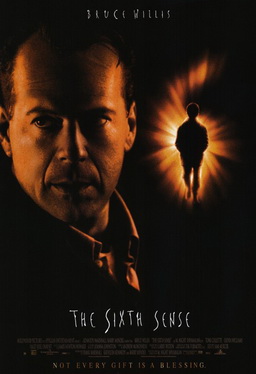
Lisa Reviews on Oscar Nominated Horror Film: The Sixth Sense (dir by M. Night Shyamalan)


The_sixth_sense

Before I talk about the 1999 best picture nominee, The Sixth Sense, I have to ask — is it really necessary to give a spoiler warning?  I mean, everyone knows that this film has a big twist at the end and everyone’s aware of what that twist is, right?  I’m going to assume that’s the case because, quite frankly, it’s kind of pointless to talk about this film without talking about the twist.  I mean, the Sixth Sense has been around for 16 years and it’s still a film that people seem to frequently talk about.  (For instance, “Why aren’t any of M. Night Shyamalan’s other films as good as The Sixth Sense?”)  If you’re over the age of 20, you really have no excuse for not knowing the twist ending of The Sixth Sense.

But, fair is fair — THIS REVIEW CONTAINS SPOILERS!  

Anyway!  The Sixth Sense is the story of a 9 year-old named Cole Sear (Haley Joel Osment).  Cole lives in Philadelphia with his harried but devoted mother, Lynn (Toni Collette).  Cole is a withdrawn child, haunted by the fact that he’s constantly seeing and hearing people that nobody else can hear.  As Cole explains it to his psychologist, Dr. Malcolm Crowe (Bruce Willis), “I see dead people.”

(And you know what?  That line has been quoted and parodied a thousand times since The Sixth Sense was released but that’s because it’s a great movie moment.  Haley Joel Osment was a great child actor and did deserve the Oscar nomination that he received for his performance in this film.)

Malcolm has some issues of his own.  The previous year, one of his former patients (Donnie Wahlberg) broke into his house and shot him, while Malcolm’s terrified wife (Olivia Williams) watched.  Malcolm feels that he was shot because he failed that patient and that he can achieve some sort of redemption by helping Cole.  Of course, as Malcolm devotes more and more time to Cole, he finds it harder and harder to speak to his wife.  In one scene, Malcolm sits down across from her and tells her all about Cole.  She responds by ignoring him and then standing up and walking out of the room.

And when she does that, your natural response is to go, “What a bitch!” and feel sorry for Malcolm.  Except, of course, Cole really does see dead people.  And, as we discover in the film’s twist ending, Malcolm is one of them.  If his wife seemed distant, it was because she didn’t know he was there.  If she seemed emotionally withdrawn, it was because she was deeply mourning him.  Everyone — including Cole — knew that Malcolm was dead.  Everyone but Malcolm.

And you know what?  Film bloggers like me spend a lot of time making snarky comments about M. Night Shyamalan and his twist endings but the ending of The Sixth Sense works beautifully.  It worked when I first saw it and it has worked every time that I’ve seen it since.  Even knowing that Malcolm is dead, it’s still incredibly poignant to watch him realize it.

And that’s why I’d love to have a time machine.  I would love to be able to hop into my time machine and go back to 1999 and see what it was like for the very first audience that watched this film.  How did they react when they discovered — for the very first time — that Bruce Willis was a ghost?  I’d love to find out.

But, even without that time machine, The Sixth Sense holds up surprisingly well.  Haley Joel Osment and Bruce Willis tend to get so much attention for their excellent performances that I’m instead going to praise Toni Collette, who does great work as Cole’s loving but overwhelmed mother.  She didn’t get a great catch phrase nor was she a part of a huge twist but the heart of the film is to be found in her performance.

The Sixth Sense was nominated for best picture of 1999.  It lost to one of the worst films to ever win an Oscar, American Beauty.


Back to School #66: Mean Creek (dir by Jacob Aaron Estes)


mean-creek1

2004’s Mean Creek is one of those films that makes me cry every time.

The story that it tells is, at first glance, a rather simple one.  It’s only as you start to dig beneath the surface that you discover just how complex the film really is.  Sam (Rory Culkin) is being picked on by the school bully, the overweight George (Josh Peck).  When Sam accidentally knocks over George’s video camera while George is filming himself playing basketball, George beats Sam up.

Sam’s older brother Rocky (Trevor Morgan) decided to get revenge and recruits two of his friends to help him out, Clyde (Ryan Kelly) and Marty (Scott Mechlowicz).  Their plan is to invite George to Sam’s birthday party and to take him on a rafting trip.  Eventually, they plan to challenge him to truth or dare, get him to strip naked, and then basically abandon him.

Needless to say, things don’t quite go as planned.

For one thing, it turns out that George is sincerely happy to have been invited to Sam’s party and he even shows up with a gift. George, it turns out, doesn’t consider himself to be a bully.  Instead, he’s just an overweight kid who is insecure about his dyslexia and who doesn’t have any social skills.  Once the boys and Sam’s girlfriend Millie (Carly Schroeder) are floating down the creek, they’re forced to reconsider their plans. Some want to forget about it and let George go.  Some want to still go through with the plan.

And, meanwhile, poor George continues to be his own worst enemy…

Mean Creek is a fascinating film because George is such an unexpectedly complex character.  When we first see him, it’s easy to dismiss him as just your standard middle school bully but, as the film progresses, it becomes apparent that there’s more to George than our first impressions may have suggested.  And yet, every time that we start to feel truly sorry for George, he says the wrong thing or he displays some sort of behavior that reminds us of why he was invited to the birthday party in the first place.  In the end, we’re as conflicted about him as everyone else on the boat.  He’s a bully but he’s not a bad kid.  Can we forgive him for being a bully or does he still need to be taught a lesson?

That’s the question at the heart of Mean Creek and the film’s final answer (or, perhaps I should say, lack of a final answer) makes me cry every time.  I don’t want to spoil the film for those who haven’t seen it (and everyone should see it), so I’m not going to give any more details about the film’s plot.  I’ll just say that Mean Creek is an important film and one that will leave you thinking about what you’ve just seen and how you feel about it.

Mean Creek