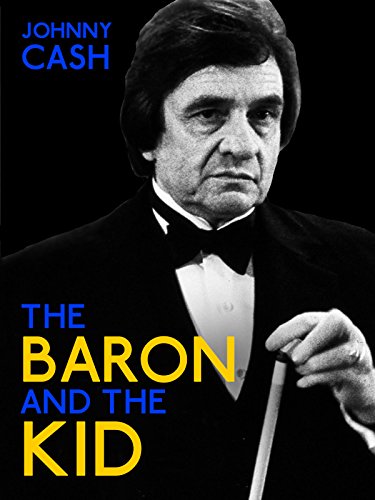
The Baron and the Kid (1984, directed by Gary Nelson)


Ever wonder what The Color of Money would have been like if it starred Johnny Cash and featured less Eric Clapton but more country and western on the soundtrack?  The Baron and the Kid is here to satisfy your curiosity.

Johnny Cash is Will Addington, better known as The Baron.  Back in the day, The Baron was the meanest and the most ruthless pool hustler around.  He’d cheat people out of their money without even giving it a second thought.  He drank.  He doped.  He womanized.  He abused his wife, Dee Dee (June Carter Cash).  After the Baron became the 9-ball world champion, Dee Dee left him and the Baron changed his ways.  Now, years later, he only plays exhibition games for charity and the strongest thing that he drinks is grapefruit juice.

When a young hustler who calls himself the Cajun Kid (Greg Webb) challenges the Baron to a game, the Baron wins easily but he still recognizes that the Kid has a natural talent.  When the Cajun Kid attempts to put up his mother’s wedding ring as stakes for another game, the Baron recognizes the ring as the one that Dee Dee used to wear on her finger.  After talking to Dee Dee, the Baron discovers that the Kid is actually his son.

The Baron takes the Kid under his wing, hoping to train him to become a champion while, at the same time, getting to know his son.  The Kid proves to be a difficult student.  He’s cocky and, like the Baron did in his youth, he has a temper.  He also has a manager, a good-for-nothing con artist named Jack Steamer (Darren McGavin).  Steamer doesn’t want to lose the money that the Kid brings in and he plots to to keep him away from his father.  The Baron, though, is determined to prevent the Kid from making the same mistakes that he made.  However, when the Baron and the Kid both find themselves competing in the same championship, the Baron finds himself being tempted by his old demons.

The Baron and the Kid is okay for a made-for-tv movie.  It’s predictable but Johnny Cash has such a formidable screen presence that it doesn’t matter that he was sometimes a stiff actor.  The Baron’s past of booze and drugs mirrors Cash’s own past and when Cash, as the Baron, talks about how he’s trying to keep the Kid from making the sames mistakes, there’s little doubt that he knows what he’s talking about.  Some of the pool sequences are creatively shot and Richard Roundtree has a great cameo as a cocaine dealer named Frosty.  There’s nothing surprising about The Baron and the Kid but fans of Cash and the game of pool should enjoy it.

Embracing the Melodrama Part II #82: Promised Land (dir by Michael Hoffman)


Promised_land_poster_(1987)When I made out my schedule of reviews for Embracing the Melodrama, I did not realize that I was setting myself up for a mini-marathon of Kiefer Sutherland movies but somehow, that’s exactly what happened!  No sooner had I watched and jotted down my impressions of Bright Lights, Big City and 1969, then I started watching a 1988 film called Promised Land (which should not be confused with the recent Matt Damon/Jon Krasinski fracking film).

And guess who stars in this particular film?

That’s right — Kiefer Sutherland!

Now, if Bright Lights, Big City featured Kiefer as a sociopath and 1969 featured Kiefer as a blonde-haired golden boy, Promised Land features Kiefer as a prototypical outsider.

Promised Land opens at a high school basketball game.  Hancock (Jason Gedrick) is the handsome and popular jock who is a star on the court and who is dating a cheerleader named Mary (Tracy Pollan).  Danny (Kiefer Sutherland) is the nerdy kid who gets good grades and who is nicknamed Senator because he wants to enter politics.  He has an obvious crush on Mary but also appears to have one on Hancock as well.  As Hancock runs up and down the court, nobody cheers louder than Danny.  Meanwhile, Hancock barely knows who Danny is.

Three years later and things have changed.  Hancock, having gone to college on an athletic scholarship just to drop out and return home, is now a vaguely fascistic police officer.  Mary has remained in college.  When she returns home for Christmas break, Hancock tries to rekindle their relationship but Mary has moved on.

Meanwhile, Danny has dropped out of school as well.  After spending a few years drifting around, he meets the lively, vivacious, and totally insane Bev (Meg Ryan).  He and Bev get married in Las Vegas and decide to head back to Danny’s hometown for Christmas…

Drama, violence, and tragedy follow!

But you already guessed that, didn’t you?  That’s one of the problems with Promised Land.  From the minute that Bev says that she wants to meet Danny’s family, you can tell exactly how this story is going to end.  And while a predictable plot can sometimes be redeemed by memorable performances, that’s not the case with Promised Land.  Kiefer Sutherland and Meg Ryan both give good and dangerous performances but Jason Gedrick and Tracy Pollan make for a boring couple.

(Interestingly enough, Tracy Pollan was also in Bright Lights, Big City.)

Promised Land does have some historical significance, in that it was the first film to ever be partially funded by the Sundance Institute.  Robert Redford is listed as an executive producer.  But, historical significance aside, there’s really not much about Promised Land to really recommend going to the effort to try to track it down.  It’s not so much bad as just very forgettable.

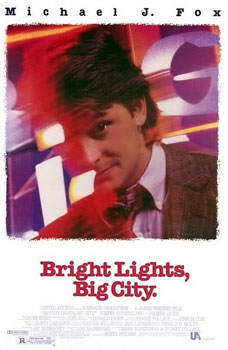
Embracing the Melodrama Part II #80: Bright Lights, Big City (dir by James Bridges)


Bright_Lights_Big_CityThe 1988 film Bright Lights, Big City is one of the many films from the late 80s in which Kiefer Sutherland plays a demonic character.  In this case, his character is so demonic that his name is — seriously, check this shit out — Tad Allagash.  Nobody named Tad Allagash has ever been a good guy!

Tad is the best friend of Jamie Conway (Michael J. Fox), an aspiring writer who has moved to New York City from some middle-America farm state and who now has a job as a fact checker at the New Yorker.  Jamie is still struggling to deal with both the death of his mother (played in flashbacks by Dianne Wiest) and the collapse of his marriage to Amanda (Phoebe Cates).  Tad helps out his depressed little friend by taking him out to the clubs and supplying him with so much cocaine that Jamie literally spends the entire film on the verge of having a geyser of blood shoot out from his powder-coated nostrils.

And the thing is, Tad knows that he’s not a good influence on Jamie’s life but he doesn’t care.  Whenever Jamie starts to get a little bit too wrapped up in his self-pity, Tad is there to make a tasteless joke.  Whenever Jamie tries to argue that he and Amanda aren’t really broken up, Tad is there to remind him that Amanda wants nothing to do with him.  Whenever Jamie starts to think that doing all of this cocaine is potentially ruining his life, Tad is there to cheerfully cut another line.  Tad makes no apologies for being Tad Allagash.  He’s too busy having a good time and it’s obvious that Sutherland’s having an even better time playing Tad.  As a result, Tad Allagash becomes the perfect antihero, the bad guy that you like despite yourself.

Unfortunately, Bright Lights, Big City isn’t about Tad Allagash.  You’re happy whenever Kiefer shows up but he doesn’t show up enough to actually save the film.  No, Bright Lights, Big City is the story of Jamie Conway and that’s why the film is a bit of a pain to sit through.  Despite having a great Irish name, Jamie Conway is one of the whiniest characters that I have ever seen in a film.  From the minute he first appears on screen and starts complaining about the failure of his marriage, you want someone to just tell him to shut up.  When he tells an alcoholic editor (Jason Robards) that his latest short story was autobiographical, you nod and think, “So, that’s why it hasn’t been published.”

Of course, since Jamie is the main character, everyone in the film feels sorry for him but he really is just insufferable.  There’s a lengthy scene where Jamie delivers a drunken monologue to a sympathetic coworker, Megan (played by Swoosie Kurtz).  And while Jamie goes on and on about how he first met Amanda and how their marriage fell apart (and how it was all her fault), poor Megan has to sit there and try to look sympathetic.  Personally, I would have kicked Jamie out of my apartment after the first minute of that whiny diatribe.  Megan has the patience of a saint.

There is some curiosity value to watching Michael J. Fox snort cocaine.  (I wonder if contemporary audiences shouted, “McFly!” as they watched Fox sniffing up the devil’s dandruff.)  But otherwise, Bright Lights, Big City is a relic of 80s cinema that can be safely forgotten.