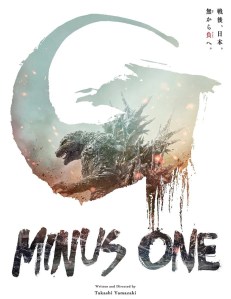
Although I’ve watched a number of Godzilla movies growing up, I’ve only gone to the movies for two. There was Roland Emmerich’s 1998 Godzilla, which was fun for the effects and cringe worthy for the acting. There was also Gareth Edwards 2014 Godzilla, that focused so heavily on the humans, it dodged fighting sequences until the last 30 minutes. Takashi Yamazaki’s Godzilla Minus One is an amazing piece of work that gives the audience a small group of humans to focus on versus a beast that’s a true terror to behold. I laughed, cheered, and gasped at times with this one.
Godzilla Minus One takes place over the course of a few years. When Kamikaze fighter pilot Koiji Shikishima lands on a secret refueling island, the soldiers there discover he’s been trying to dodge his responsibilities. Before anyone can react, however, a large beast arrives, laying waste to the entire base and only leaving Shikishima and head mechanic Tashibana alive.
A year later, Shikishima returns to his home villiage, which is damaged from the war. He happens upon a young woman, Noriko (Minami Hamabe, Shin Kamen Rider) and a little girl named Akiko. He takes them in and gives them shelter, but is haunted by nightmares of the beast. Can Shikishima confront his fears? Can Godzilla be stopped?
The script is one of Godzilla Minus One‘s best strengths. It does borrow from a number of different films, true. There are homages to Jaws, King Kong and even Dunkirk, but at the heart of it all are characters to cheer for (Doc was the stand out for me). Granted, there’s only so many storylines you can come up with when it comes to Kaiju stampeding through a city. Godzilla Minus One keeps things simple enough to make one wonder why their story angle wasn’t tried in any of the recent American adaptations. While I won’t say that American filmmakers don’t know how to handle Godzilla – Godzilla: King of the Monsters was enjoyable as well as Godzilla vs. Kong to a degree – Japan knows how to get the best of their creation, and it shows here.
Working off of a budget of about $15 Million (with some speculation that it’s less than that), Takashi Yamazaki also spearheaded the visual effects, along with Kiyoko Shibuya. The effects are used sparingly, and there are moments where you could think that maybe you’re looking at a guy in a suit. Still, the effects run that line between appearing practical and fully CGI. Some of it gets to be a little wild in the film’s 3rd act, but there’s so much fun involved that you might not notice any inconsistancies with the plot (“He’s just gonna stand there for all this?”, my cousin quipped as I relayed the movie to her scene by scene). From a sound and music standpoint, the film keeps all the classic Godzilla themes you know and love while varying things up a bit. The Godzilla screams are all there, as well. No real surprise there, of course.
Overall, Godzilla Minus One is a fun watch, raising the bar for what Godzilla films could be and puts Takashi Yamazaki’s name on the radar for future projects.
.




 Through the Shattered Lens