Embracing the Melodrama Part III #4: The Grasshopper (dir by Jerry Paris)


“It’s very simple what I want to be: totally happy; totally different; and totally in love.”

— Christine Adams (Jacqueline Bisset) in The Grasshopper (1970)

Seriously, is Christine asking for too much?

Total happiness?  That may sound like a lot but trust me, it can be done.

Totally different?  That’s a little bit more challenging because, to be honest, you’re either different or you’re not.  If you have to make the effort to be different, then you definitely are not.

Totally in love?  Well, it depends on how you define love…

At the start of The Grasshopper, Christine thinks that she’s heading to America to find love.  While an oh-so late 60s/early 70s theme song plays in the background, Christine leaves her small hometown in Canada and she heads down to California.  She’s planning on meeting up with her boyfriend Eddie (Tim O’Kelly) and taking a job as a bank teller.

Of course, it soon turns out that working in a bank isn’t as exciting as Christine originally assumed.  Eddie expects Christine to just be a conventional girlfriend and that’s not what Christine is looking for. As well, it’s possible that Christine may have seen Targets, in which O’Kelly played an all-American boy who picks up a rifle and goes on a killing spree.

And so, Christine abandons Eddie and heads to Las Vegas.  Since this movie was made in 1970 and Uber didn’t exist back then, Christine’s preferred method of traveling is hitchhiking.  This gives her a chance to meet the usual collection of late 60s weirdos who always populate movies like this.  One driver crosses herself when Christine says that she plans to have a baby before getting married.  Another is a hacky Las Vegas comic.

In Vegas, Christine applies for a job as a showgirl.  As she explains to sleazy casino owner Jack Benton (Ed Flanders), she “once did Little Women in school.”

“Did you do it nude?” Jack replies.

Yep, that’s Vegas for you!  It’s the city of Showgirls, Casino, and Saved By The Bell: Wedding in Vegas, after all!

Anyway, thing do get better once Christine meets and falls in love with Tommy Marcott (Jim Brown), a former football player who is now working as a door greeter in Jack’s casino.  Everyone tells Christine not to get involved with Tommy.  One of Jack’s men, a menacing hitman who looks just like Johnny from Night of the Living Death (he even wears glasses), warns Christine to watch herself.

Through a long series of events, Christine ends up on her own again.  The usual collection of 70s events occur: murder, drugs, prostitution, and ultimately a stint as the mistress of a rich man played by Joseph Cotten.  The important thing is that it all eventually leads to Christine and a skywriter getting stoned, stealing a plane, and deciding to write a message in the sky.

That’s when this happens:

Yes, it’s all very 1970!

Anyway, The Grasshopper is one of those films that tries to have it both ways.  Establishment audiences could watch it and think, “Wow, those kids are really messed up.”  Counterculture audiences could watch it and say, “Old people are such hypocrites.”  Oddly enough, The Grasshopper was written by future director Garry Marshall and it’s an incredibly overwrought film.  There’s not a subtle moment to be found in the entire film and the film’s direction is flashy but empty.  However, for those of us who love history, it’s as close to 1970 as we’re going to get without hopping into a time machine.
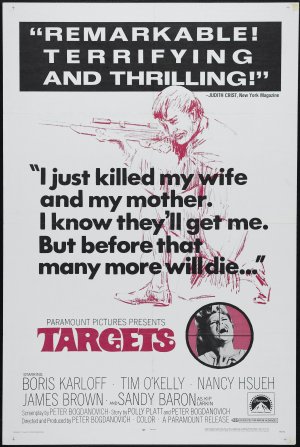
Horror Film Review: Targets (dir by Peter Bogdanovich)


targetsposter

The year was 1968 and legendary producer Roger Corman had aging horror star Boris Karloff under contract.  Karloff still owed Corman two days of work and Corman was never one to let an opportunity pass him by.  Corman approached film critic Peter Bogdanovich and made him an offer.  Corman would finance any film that Bogdanovich wanted to make, on the condition that he stayed under budget, used Boris Karloff, and included some scenes from The Terror.  Bogdanovich agreed and the end result was one of the best films of Karloff’s long career.

Karloff plays Byron Orlok.  Orlok (named, of course, after the vampire in Nosferatu) is a veteran horror star who now finds himself working almost exclusively in B-movies.  When the film starts, he’s just announced his retirement.  Orlok is bitter that Hollywood never fully appreciated his talents but, beyond that, he’s come to believe that horror movies can never hope to compete with the horrors of the real world.  People have become so desensitized to horror that it’s impossible to scare them, he believes.  Orlok plans on making one final promotional appearance at a drive-in that will be showing his final film.  (His final film, of course, is The Terror.)

Meanwhile, there’s a man named Bobby Thompson (Tim O’Kelly) and he’s about to shock the world.  Bobby has just recently returned from Vietnam.  He works as an insurance agent and his cheerfully bland countenance hides the fact that Bobby is going insane.  He is struggling to pay the bills and he resents the fact that his wife is now working and that they have to live with his parents.  His strict and taciturn father continues to criticize him, especially after Bobby points a rifle at him during target practice.  Bobby, incidentally, loves his guns.  After he murders both his wife and his mother, Bobby uses that gun to start shooting at strangers.

Bobby starts his rampage by shooting at cars on the freeway but eventually, he ends up at the drive-in.  While The Terror plays out on the big screen, Bobby shoots at the men, women, and children who have gathered to watch the movie, proving Orlok’s point that cinematic horror cannot hope to match the horror of everyday life…

Even though it was made 48 years ago, Targets is a film that feels extremely relevant today.  As I watched the film, I couldn’t help but think about not only James Holmes’s 2012 rampage in Aurora, Colorado but also the more recent sniper attacks in my hometown of Dallas.  For me, it was interesting to see that apparently this stuff was going on even in 1968.  (We tend to think of mass shooting as being a recent phenomena.)  Targets is an open plea for gun control (which, again, is something that we tend to think of as being a relatively new thing).  I’ll leave the political debate for others to consider and instead just say that Targets is a chilling portrait of both madness and violence.

However, Targets also works brilliantly as a tribute to Boris Karloff.  Though he may have never been as bitter as Orlok, Karloff is basically playing himself in Targets.  He’s portrayed as a cultured and kindly man who just happened to be very good at playing scary characters and Karloff gives perhaps his best performance in the role. Some of the best scenes in Targets are the scenes where Orlok (and, by extension, Karloff) discusses his career with his friend, Sammy Michaels (played by Bogdanovich).  You find yourself really wishing that you could have hung out on the set of Targets just to hear the stories that were told while the cameras weren’t rolling.

(Incidentally, Sammy Michaels was named after famed director Sam Fuller, who helped to write the film’s screenplay and provided a good deal of free advice to Bogdanovich.)

Targets works as both a horror film and a tribute to a great actor.  If for no other reason, watch it for Boris.