4 Shots From 4 Holiday Films: Special Horror Edition


4 Shots From 4 Films is just what it says it is, 4 shots from 4 of our favorite films. As opposed to the reviews and recaps that we usually post, 4 Shots From 4 Films is all about letting the visuals do the talking.

4 Shots From 4 Holiday Films

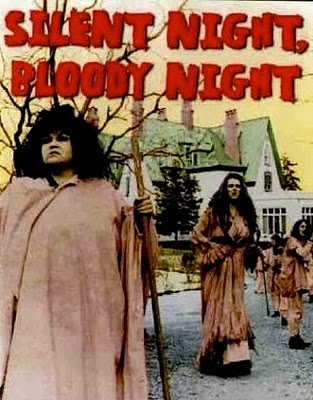
Silent Night, Bloody Night (1972, dir by Theodore Gershuny)

Silent Night, Bloody Night (1972, dir by Theodore Gershuny)

Black Christmas (1974, dir by Bob Clark)

Black Christmas (1974, dir by Bob Clark)

The Silent Partner (1978, dir by Daryl Duke)

The Silent Partner (1978, dir by Daryl Duke)

Christmas Evil (1980, dir by Lewis Jackson)

Christmas Evil (1980, dir by Lewis Jackson)

October Hacks: Silent Night, Bloody Night (dir by Theodore Gershuny)


Filmed in 1972 and subsequently released in 1974, Silent Night Bloody Night is a real treat, an atmospheric thriller that has a wonderfully complicated plot that will keep you guessing.

Silent Night Bloody Night opens with attorney John Carter (Patrick O’Neal) arriving in a small town on Christmas Eve.  He’s traveling with his assistant and mistress, Ingrid (Astrid Heeren).  He’s been hired by Jeff Butler (James Patterson) to oversee the sell of his grandfather’s home.  When Carter arrives, he finds that the town is run by a group of elderly eccentrics, including the mute Charlie Towman (John Carradine).  Charlie communicates by ringing a bell and he’s the editor of the town newspaper.  Carter convinces the town council to buy the Butler mansion.  Then, Carter and Ingrid go to the mansion, make love, and are promptly brutally hacked to death by an unseen assailant with an axe.  It’s a shocking moment because, up until their death scene, Carter and Ingrid seemed to be our main characters.  Much as with Marion Crane’s shower in Psycho, their murder leaves an absence at the heart of the film.

That night, our new hero, Jeff Butler (James Patterson) comes to the isolated town to check on how the sale is going.  He finds the mansion locked up and no one willing to talk about John Carter.  With the help of local girl Diane (Mary Woronov), Jeff investigates his grandfather’s death and discovers that the town is full of secrets and people who are willing to kill to maintain them.  As we discover through some wonderfully dream-like flashbacks, Jeff’s grandfather died nearly 40 years ago when he was set on fire in his own home.  Those aren’t the only flashbacks to the film.  In an extended sepia-toned flashback, we learn about the previous inhabitants of the house.  They are all played by former Warhol superstars, including Candy Darling, Ondine, Tally Brown, Charlotte Fairchild, Lewis Love, Harvey Cohen, George Trakas, Susan Rothenberg, and Jack Smith.  (Mary Woronov was, herself, a former member of Warhol’s entourage.)

Silent Night Bloody Night has a terrible reputation.  Mary Woronov, who was married to director Theodore Gershuny at the time she made the film, later described it as being “lousy.”  Personally, I think the film’s reputation has more to do with all of the grainy, bad copies of the film that have turned up in various Mill Creek box sets over the years than the quality of the film itself.  (Silent Night Bloody Night is in public domain.)  The film itself is atmospheric, memorably bloody, and — for those who have the patience to deal with the occasional slow spot — effectively creepy.  Mary Woronov is a likable lead and the Warhol superstars definitely make an impression.  The film plays out at its own deliberate pace and, at its best, it duplicates the feeling of a particularly macabre holiday dream.

Director Theodore Gershuny uses the low budget to his advantage and the sepia-toned flashbacks are truly disturbing and haunting.  Ultimately, Silent Night Bloody Night feels like a dream itself and the mystery’s solution is less important than the journey taken to reach it.

Horror On The Lens: Silent Night, Bloody Night (dir by Theodore Gershuny)


The 1974 film Silent Night, Bloody Night is an oddity.

On the one hand, it’s pretty much a standard slasher film, complete with a menacing mansion, a horrible secret, a twist ending, and John Carradine playing a mute newspaper editor.

On the other hand, director Ted Gershuny directs like he’s making an underground art film and several of the supporting roles are played by actors who were best known for their association with Andy Warhol.

Personally, I like Silent Night, Bloody Night.  It has a terrible reputation and the film’s star, Mary Woronov, has gone on record calling it a “terrible movie” but I like the surreal touches the Gershuny brought to the material and the sepia-toned flashbacks have a nightmarish intensity to them.  The film makes no logical sense, which actually makes it all the more appealing to me.  As the saying goes, your mileage may vary.

Watch and decide for yourself!

Late Night Retro Television Review: Monsters 2.12 “Museum Hearts”


Welcome to Late Night Retro Television Reviews, a feature where we review some of our favorite and least favorite shows of the past! On Wednesdays, I will be reviewing Monsters, which aired in syndication from 1988 to 1991. The entire series is streaming on YouTube.

Wow, it’s been more than a little while since I last reviewed an episode of Monsters!  Well, it’s time to get back to it!  Like most anthology series, Monsters can be frustratingly uneven but occasionally, the viewer does get lucky with a really good episode.  Take this week, for instance….

Episode 2.12 “Museum Hearts”

(Dir by Theodore Gershuny, originally aired on January 7th, 1990)

Cheryl (Louise Roberts) comes to the natural history museum to see her husband, Danny (Patrick Breen).  Danny, one of the museum’s curators, said he would be working late in the basement but, as Cheryl discovers, Danny is actually in basement cheating on her with Edwina (Sarah Trigger).

However, the three of them have an even bigger problem that Danny’s infidelity.  While they’re busy arguing in the basement, the museum closes and all the doors are locked.  Danny’s suggestion is that they spend the night having a threesome.  Cheryl’s suggestion is that Danny find a way to get them out of the basement.

Attempting to reach a high window, dumbass Danny climbs on top of ancient coffin.  His foot goes through the wood.  Danny not only cuts open his ankle but he also steps on the mummified remains of Cerridwen (Pamela Dean Kelly), a Druid priestess.  His foot goes through her chest, revealing her heart.  Danny decides that it would be a good idea to grab the heart and take it as a souvenir.  Cerridwen, who is not quite dead, is not happy about that idea.

At first, Danny, Cheryl, and Edwina are terrified about the idea of being stuck with a mummy.  But it turns out that Cerridwen hates cheating men like Danny.  Cheryl and Edwina proceed to sacrifice Danny, allowing Cerridwen to revert back to her youthful appearance.  The three women leave the museum together.

So far, Monsters has been a rather uneven series but I really liked this episode.  A lot of that is due to Theodore Gershuny’s direction.  Gershuny also directed one of my favorite grindhouse films, Silent Night Bloody Night.  Just as in that film, Gershuny creates an ominous and dream-like atmosphere that goes a long way towards making up for the fact that episode’s story is rather predictable.  Fortunately, Danny is such a sleaze that it’s impossible not take some joy out of him getting his macabre comeuppance.  I liked the fact that all three of the women worked together rather than allowing Danny to turn them against one another.  Instead of getting mad at Edwina, Cheryl put the blame for Danny’s infidelity right where it belonged, on Danny.

This was a good episode with a good message.  Don’t mess around in the basement of a museum because you never know what you might find down there.  And, for the love of God, don’t step on a mummy’s chest.

Horror On The Lens: Silent Night, Bloody Night (dir by Theodore Gershuny)


The 1974 film Silent Night, Bloody Night is an oddity.

On the one hand, it’s pretty much a standard slasher film, complete with a menacing mansion, a horrible secret, a twist ending, and John Carradine playing a mute newspaper editor.

On the other hand, director Ted Gershuny directs like he’s making an underground art film and several of the supporting roles are played by actors who were best known for their association with Andy Warhol.

Personally, I like Silent Night, Bloody Night.  It has a terrible reputation and the film’s star, Mary Woronov, has gone on record calling it a “terrible movie” but I like the surreal touches the Gershuny brought to the material and the sepia-toned flashbacks have a nightmarish intensity to them.  The film makes no logical sense, which actually makes it all the more appealing to me.  As the saying goes, your mileage may vary.

Watch and decide for yourself!

Late Night Retro Television Reviews: Monsters 1.2 “Holly’s House”


Welcome to Late Night Retro Television Reviews, a feature where we review some of our favorite and least favorite shows of the past!  On Wednesdays, I will be reviewing Monsters, which aired in syndication from 1988 to 1991.  The entire show is streaming on Youtube.

This week, on Monsters, a creepy robot gets a bit too possessive of its operator.  How monstrous is this robot?  Read on and find out!

Episode 1.2 “Holly’s House”

(Dir by Theodore Gershuny, originally aired on October 29th, 1988)

This week’s monster is Holly.

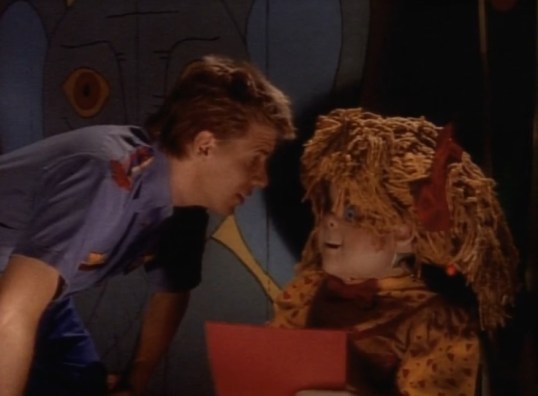
Holly is a robot.  (Sitting inside the Holly costume was actor Michael J. Anderson, who is best known for playing the backwards-talking Man From Another World on Twin Peaks and The Man Who Secretly Controlled Hollywood in Mulholland Drive.)  Holly is the star of an incredibly corny and kind of annoying children’s show called Holly’s House.  Every day, Holly deals with her friends, Early Bird and Mike the Mailman.

Mike the Mailman is actually an actor named Lenny (Perry Lang).  Lenny is the sometime boyfriend of Katherine (Marilyn Jones), the actress who not only provides the voice of Holly but also controls the robots movements during filming.  Katherine has been the star of Holly’s House for four years but she has just discovered that she is pregnant.  Katherine wants to quit the show, marry Lenny, and raise her child.  Holly, however, has other ideas….

This episode was basically a variation on the old idea of the ventriloquist being taken over by their dummy.  Is Holly the one who is being rude to Lenny and deliberately ruining the show or is it Katherine acting through Holly?  And when Holly snaps and starts attacking people, is Holly the one doing it or is it Katherine acting out through Holly?  Unfortunately, regardless of whether Holly is acting on her own or not, Katherine is still the one destined to take the blame for all of her anti-social behavior.

Holly was indeed creepy but this episode was still a bit of a let down.  I think the main problem was that there was no way that Holly’s House would have been a success.  I understand that the show’s portrayal of Holly’s House was probably meant to be a commentary on how vapid most children’s shows were but, even at their most vapid, most children’s shows are still somewhat cute.  Holly’s House only has three cast members — an ugly bird, a creepy robot, and an overly cheerful mailman.  There’s not a kid around that would watch that.  Holly obviously wasn’t happy about Lenny encouraging Katherine to quit the show but seriously, the show was probably on its last legs as it was.

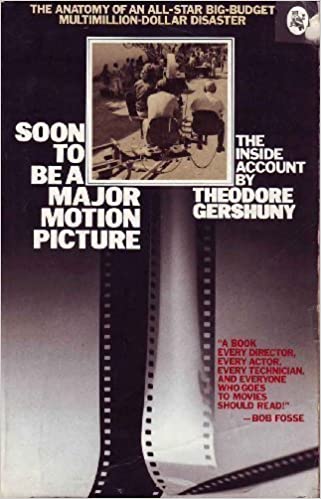
One final note: This episode was directed by Theodore Gershuny, who was the ex-husband of cult film star Mary Woronov and who also directed Silent Night Bloody Night and wrote the excellent book, Soon To Be A Major Motion Picture.  While his direction of this episode didn’t really work for me, I do recommend his Christmas film and the book.

Book Review: Soon To Be A Major Motion Picture by Theodore Gershuny


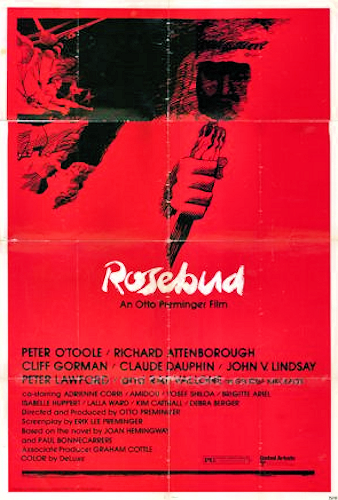
In 1975, United Artists released a political thriller called Rosebud.

Rosebud was based on a best-selling novel.

Rosebud dealt with terrorism, an important topic both in 1975 and today.

Rosebud was directed by Otto Preminger, an acclaimed, award-winning filmmaker who was known for making controversial movies and who had a showman’s flair for publicity.

Rosebud had an international cast of screen veterans and up-and-coming stars.  Peter O’Toole, Richard Attenborough, Cliff Gorman, Peter Lawford, Raf Vallone, Adrienne Corri, Lalla Ward, Claude Dauphin, Isabelle Huppert, and Kim Cattrall all had key roles.  Former New York City Mayor and presidential candidate John V. Lindsay made his acting debut as a U.S. senator.

Rosebud was released with a good deal of publicity.

And, finally, Rosebud is almost totally forgotten today.  Not only did Rosebud receive less-than-stellar reviews, it’s box office failure pretty much spelled the end of Preminger’s directorial career.  (He directed one more film after Rosebud.)  Rosebud sunk into such obscurity that, for years, it wasn’t even available on anything other than VHS tape.  It was finally given a Blu-ray release in 2021 but, unlike some of Preminger’s other films, Rosebud isn’t going to end up getting a Criterion release anytime soon.  (That said, it can currently be streamed for free on a few sites.  So, go watch it after you finish this review.)

Having seen Rosebud, I can tell you that the film wasn’t forgotten because it was a disaster or anything like that.  Instead, Rosebud was forgotten because it was thoroughly mediocre.  There’s nothing particularly terrible about it but there’s nothing particularly good about it.  Instead, it’s a slowly-paced and flatly directed film.  There are a few interesting scenes, the majority of which involve Richard Attenborough’s terrorist.  But otherwise, it’s just a mediocre film from a director who was past his prime.

Interestingly enough, Rosebud’s mediocrity is what makes the 1980 book, Soon To Be A Major Motion Picture, such an interesting read.  While directing Rosebud, Otto Preminger allowed journalist and filmmaker Ted Gershuny to observe every detail of the production.  From Erik Lee Preminger’s attempt to write a workable script to the casting sessions to the film’s eventual release, Gershuny was there.  Soon To Be A Major Motion Picture tells the story of how a group of talented people ended up making a thoroughly forgettable film.  There have been plenty of books written about the production of terrible movies.  There’s been even more books written about the making of classic films.  But Soon To Be A Major Motion Picture is one of the few books to take a serious and detailed look at what it’s like to make a thoroughly mediocre film.  And let’s be honest, most films are mediocre.  Most films are more likely to be Rosebud than they are to be The Godfather, Goodfellas or Battlefield Earth.

The book, not surprisingly revolves around Otto Preminger.  The Preminger described in the book is a complex figure, a proud man and an occasionally sensitive artist who is also frequently a bully.  As the book makes clear, Preminger can be kind but he also came of age at a time when it was common place for directors to yell and be autocratic.  Preminger’s habit of shouting rubs more than a few crew and cast members the wrong way.  When he’s not yelling, Preminger comes across as thoughtful and witty but there’s also an undercurrent of sadness to him as Preminger realizes that the film industry is changing and that he’s getting left behind.  The fact that he directed films like Anatomy of a Murder, Laura, Exodus, and The Cardinal didn’t matter in the new Hollywood.  The same things that had once led to Preminger being branded a rebel and an innovator now led to him being branded as being out-of-touch.  Rosebud was Preminger’s attempt to remain relevant, both artistically and politically.  Unfortunately, the 70s were a brutal decade for the directors who previously defined Hollywood’s Golden Age.  Some, like John Huston, were eventually able to adjust and make a few more good films before their careers were ended by either retirement or death.  Most, however, were like Preminger, too engaged to quit but too old-fashioned to keep up with the younger filmmakers.  Still, even when it becomes obvious that Rosebud is not going to work as a film, Preminger refuses to give up or surrender.  He’s going to make his movie.

Also making a huge impression is Robert Mitchum.  Mitchum was originally cast in the film’s leading role and, having seen Rosebud, it’s easy to understand why Mitchum would seem like the ideal choice to be play Larry Martin, a cynical and hard-boiled journalist and CIA asset.  When Mitchum first appears in the book, he’s a breath of fresh air.  Even on the printed page, it’s easy to see that Mitchum’s no-nonsense style invigorated the disorganized production.  However, Mitchum quickly becomes disillusioned, walks off the film, and is hastily replaced by Peter O’Toole.  Not even Gershuny seems to be sure what specifically caused Mitchum quit the film, though it’s suggested that Mitchum felt that he had been personally slighted by Preminger.  (At one point, Mitchum claims that Preminger accused him of being drunk when he was sober.  At another point, it’s suggested that Mitchum walked because he realized that film wasn’t going to be any good and he felt he was wasting his time.)  O’Toole does his best to take Mitchum’s place, though his poor health proves to be almost as much of a challenge as Mitchum’s bad attitude.

(That said, O’Toole’s apparent frailty disappeared after the production received a bomb threat that is later revealed to have been a hoax.  The book suggests that O’Toole and his entourage tracked down the hoaxer and essentially beat the Hell out of him.)

It’s a highly interesting and well-written book, one that will make you appreciate the effort that goes into making even a forgettable film.  Used paperback copies can ordered off of Amazon for $22.00.  I found my copy at Recycled Books in Denton, Texas and paid $3.00 for it.  Support you local independent book stores, people.

Horror On The Lens: Silent Night, Bloody Night (dir by Theodore Gershuny)


The 1974 film Silent Night, Bloody Night is an oddity.

On the one hand, it’s pretty much a standard slasher film, complete with a menacing mansion, a horrible secret, a twist ending, and John Carradine playing a mute newspaper editor.

On the other hand, director Ted Gershuny directs like he’s making an underground art film and several of the supporting roles are played by actors who were best known for their association with Andy Warhol.

Personally, I like Silent Night, Bloody Night.  It has a terrible reputation and the film’s star, Mary Woronov, has gone on record calling it a “terrible movie” but I like the surreal touches the Gershuny brought to the material and the sepia-toned flashbacks have a nightmarish intensity to them.  The film makes no logical sense, which actually makes it all the more appealing to me.  As the saying goes, your mileage may vary.

Watch and decide for yourself!

4 Shots From 4 Holiday Films: Silent Night Bloody Night, Black Christmas, The Silent Partner, Christmas Evil


4 Shots From 4 Films is just what it says it is, 4 shots from 4 of our favorite films. As opposed to the reviews and recaps that we usually post, 4 Shots From 4 Films is all about letting the visuals do the talking.

4 Shots From 4 Holiday Films

Silent Night, Bloody Night (1972, dir by Theodore Gershuny)

Silent Night, Bloody Night (1972, dir by Theodore Gershuny)

Black Christmas (1974, dir by Bob Clark)

Black Christmas (1974, dir by Bob Clark)

The Silent Partner (1978, dir by Daryl Duke)

The Silent Partner (1978, dir by Daryl Duke)

Christmas Evil (1980, dir by Lewis Jackson)

Christmas Evil (1980, dir by Lewis Jackson)

Shattered Politics #37: Rosebud (dir by Otto Preminger)


Rosebud_-_1975_-_Film_Poster

Before I review the 1975 film Rosebud, allow me to tell you about how I first discovered the existence of this particular film.

The greatest used bookstore in the world is located in Denton, Texas.  It’s called Recycled Books and it is three stories of pure literary goodness!  (Plus, there are apartments on the top floor where I attended some pretty interesting parties but that’s another story….)  When I was attending the University of North Texas, I used to stop by Recycled Books nearly every day.  One day, I happened to be searching the Film and TV section when I came across a beat-up paperback called Soon To Be A Major Motion Picture.

This book, which was written by Theodore Gershuny, told the story of how the previously acclaimed director Otto Preminger attempted to make a film about terrorism.  Starting with the attempts of Preminger’s son, Erik Lee Preminger, to come up with a workable script and then going on to detail how Peter O’Toole came to replace Robert Mitchum as the star of the film and ending with the film’s disastrous release, Soon To Be A Major Motion Picture proved to be a fascinating read.

After finishing the book, I simply had to see Rosebud for myself.  Unfortunately, at that time, Rosebud had not yet been released on Blu-ray or DVD.  So, I actually ended up ordering an old VHS copy of it.  The tape that I got was not in the best condition but it played well enough and I can now say that, unlike the majority of people in the world, I’ve actually seen Rosebud!

Which is not to say that Rosebud is any good.  It’s not the disaster that I had been led to expect.  In fact, it probably would have been more fun if it had been a disaster, as opposed to being just a forgettable film from a director who was probably capable of better.  Preminger started his career in the 30s and was considered, at one point, to be quite innovative.  He directed Laura and Anatomy of a Murder, two great films.  Unfortunately, there’s really nothing innovative about his direction of Rosebud.  In Gershuny’s book, Preminger comes across like an intelligent and thoughtful man who was too set in his ways to realize that what was shocking in 1959 was no longer that big of a deal in 1975.  (And, needless to say, it’s even less of a big deal in 2015.)

As for what Rosebud‘s about, it’s about a man named Sloat (Richard Attenborough), a former journalist who now lives in a cave in Israel and dreams of establishing a worldwide terrorist network.  Under Sloat’s direction, terrorists storm a yacht named the Rosebud and take the girls on board hostage.  The girls are wealthy and privileged.  Their fathers are judges, senators, and businessmen.  CIA agent Larry Martin (Peter O’Toole) is tasked with tracking down and rescuing the girls.  If it sounds like an action film — well, it’s not.  This is not a prequel to Taken.  Instead, it’s a very talky film that has a few isolated good moments and performances but otherwise, is fairly forgettable.

That said, the film does have an interesting cast.  Peter O’Toole seems bored by his role (and who can blame him?) but Attenborough briefly livens things up in the role of Sloat.  As for the girls being held hostage, they’re not given much to do.  One of them is played by a young Isabelle Huppert.  Long before she would play Samantha on Sex and the City, Kim Cattrall plays a hostage here.  The English hostage is played by Lalla Ward, who is now married to Richard Dawkins.

And then there’s the girl’s parents, who are played by an odd assortment of character actors.  Raf Vallone, an Italian, plays a Greek.  (His daughter, meanwhile, is played by the French Isabelle Huppert.)  Peter Lawford, looking somewhat dazed, shows up as Lalla Ward’s father.  (One of the sadder scenes in Gershuny’s book deals with Lawford’s attempts to remember his lines.)  And than, in the role of Cattrall’s father, we have a very distinguished looking man named John Lindsay.

John Lindsay was the former mayor of New York City, a man who ran for President in 1972 and, three years later, attempted to launch a new career as an actor.  Rosebud was his both his first and final film.  (Rumor has it that Martin Scorsese attempted to convince Lindsay to play Senator Palatine in Taxi Driver but Lindsay turned the role down.)  Lindsay is not particularly memorable in Rosebud.  It’s not so much that Lindsay gives a bad performance as much as it’s just the fact that he has a very bland screen presence.  That blandness probably served him well as a politician but, as an actor — well, let’s just say that John Lindsay was apparently no Fred Thompson.

And so that’s Rosebud.  It’s a film that, much like Maidstone, you can only appreciate if you know what went on behind the scenes.  I can’t really recommend Rosebud but, if you ever come across a battered old copy of Soon To Be A Major Motion Picture in a used bookstore, be sure to buy it!

Seriously, you will not be sorry.